

6.4 Metal-Air Battery
165
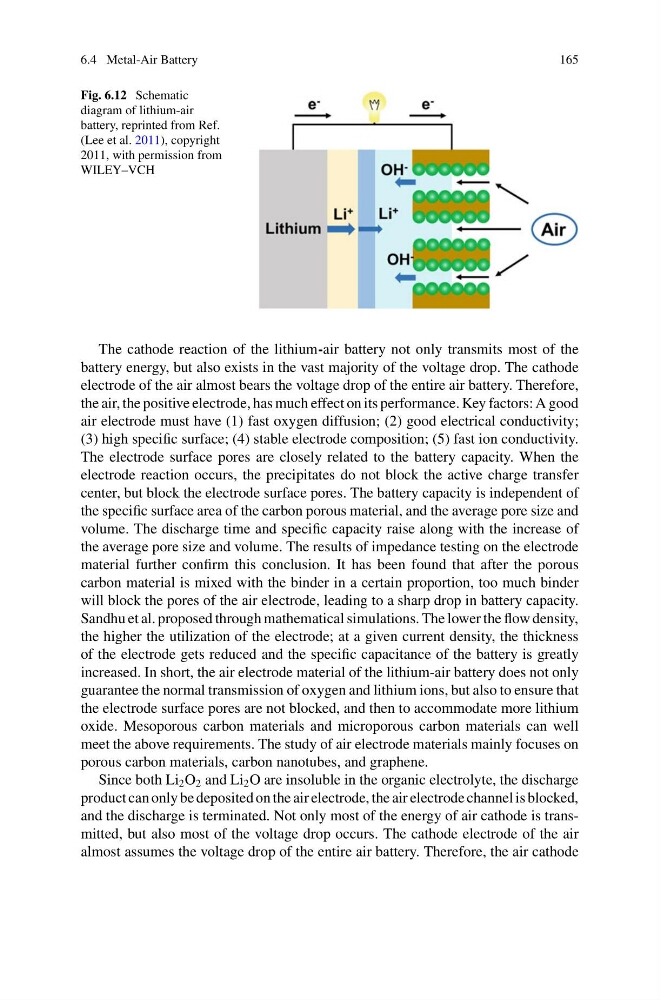
Fig. 6.12 Schematic
diagram of lithium-air
battery, reprinted from Ref.
(Lee et al. 2011), copyright
2011, with permission from
WILEY–VCH
The cathode reaction of the lithium-air battery not only transmits most of the
battery energy, but also exists in the vast majority of the voltage drop. The cathode
electrode of the air almost bears the voltage drop of the entire air battery. Therefore,
the air, the positive electrode, has much effect on its performance. Key factors: A good
air electrode must have (1) fast oxygen diffusion; (2) good electrical conductivity;
(3) high specific surface; (4) stable electrode composition; (5) fast ion conductivity.
The electrode surface pores are closely related to the battery capacity. When the
electrode reaction occurs, the precipitates do not block the active charge transfer
center, but block the electrode surface pores. The battery capacity is independent of
the specific surface area of the carbon porous material, and the average pore size and
volume. The discharge time and specific capacity raise along with the increase of
the average pore size and volume. The results of impedance testing on the electrode
material further confirm this conclusion. It has been found that after the porous
carbon material is mixed with the binder in a certain proportion, too much binder
will block the pores of the air electrode, leading to a sharp drop in battery capacity.
Sandhu et al. proposed through mathematical simulations. The lower the flow density,
the higher the utilization of the electrode; at a given current density, the thickness
of the electrode gets reduced and the specific capacitance of the battery is greatly
increased. In short, the air electrode material of the lithium-air battery does not only
guarantee the normal transmission of oxygen and lithium ions, but also to ensure that
the electrode surface pores are not blocked, and then to accommodate more lithium
oxide. Mesoporous carbon materials and microporous carbon materials can well
meet the above requirements. The study of air electrode materials mainly focuses on
porous carbon materials, carbon nanotubes, and graphene.
Since both Li 2 O 2 and Li 2 O are insoluble in the organic electrolyte, the discharge
product can only be deposited on the air electrode, the air electrode channel is blocked,
and the discharge is terminated. Not only most of the energy of air cathode is transmitted, but also most of the voltage drop occurs. The cathode electrode of the air
almost assumes the voltage drop of the entire air battery. Therefore, the air cathode
165
Fig. 6.12 Schematic
diagram of lithium-air
battery, reprinted from Ref.
(Lee et al. 2011), copyright
2011, with permission from
WILEY–VCH
The cathode reaction of the lithium-air battery not only transmits most of the
battery energy, but also exists in the vast majority of the voltage drop. The cathode
electrode of the air almost bears the voltage drop of the entire air battery. Therefore,
the air, the positive electrode, has much effect on its performance. Key factors: A good
air electrode must have (1) fast oxygen diffusion; (2) good electrical conductivity;
(3) high specific surface; (4) stable electrode composition; (5) fast ion conductivity.
The electrode surface pores are closely related to the battery capacity. When the
electrode reaction occurs, the precipitates do not block the active charge transfer
center, but block the electrode surface pores. The battery capacity is independent of
the specific surface area of the carbon porous material, and the average pore size and
volume. The discharge time and specific capacity raise along with the increase of
the average pore size and volume. The results of impedance testing on the electrode
material further confirm this conclusion. It has been found that after the porous
carbon material is mixed with the binder in a certain proportion, too much binder
will block the pores of the air electrode, leading to a sharp drop in battery capacity.
Sandhu et al. proposed through mathematical simulations. The lower the flow density,
the higher the utilization of the electrode; at a given current density, the thickness
of the electrode gets reduced and the specific capacitance of the battery is greatly
increased. In short, the air electrode material of the lithium-air battery does not only
guarantee the normal transmission of oxygen and lithium ions, but also to ensure that
the electrode surface pores are not blocked, and then to accommodate more lithium
oxide. Mesoporous carbon materials and microporous carbon materials can well
meet the above requirements. The study of air electrode materials mainly focuses on
porous carbon materials, carbon nanotubes, and graphene.
Since both Li 2 O 2 and Li 2 O are insoluble in the organic electrolyte, the discharge
product can only be deposited on the air electrode, the air electrode channel is blocked,
and the discharge is terminated. Not only most of the energy of air cathode is transmitted, but also most of the voltage drop occurs. The cathode electrode of the air
almost assumes the voltage drop of the entire air battery. Therefore, the air cathode