

6.4 Metal-Air Battery
163
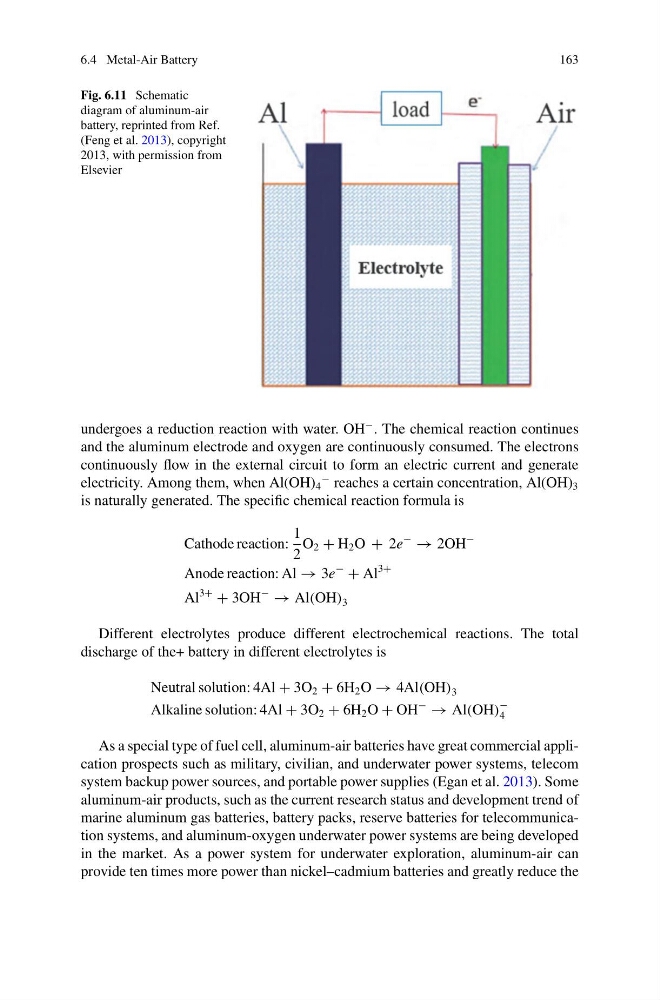
Fig. 6.11 Schematic
diagram of aluminum-air
battery, reprinted from Ref.
(Feng et al. 2013), copyright
2013, with permission from
Elsevier
undergoes a reduction reaction with water. OH
− . The chemical reaction continues
and the aluminum electrode and oxygen are continuously consumed. The electrons
continuously flow in the external circuit to form an electric current and generate
electricity. Among them, when Al(OH) 4
− reaches a certain concentration, Al(OH) 3
is naturally generated. The specific chemical reaction formula is
Cathode reaction:
1
2
O 2 + H 2 O + 2e
−
→ 2OH
−
Anode reaction: Al → 3e
−
+ Al
3+
Al
3+
+ 3OH
−
→ Al(OH) 3
Different electrolytes produce different electrochemical reactions. The total
discharge of the+ battery in different electrolytes is
Neutral solution: 4Al + 3O 2 + 6H 2 O → 4Al(OH) 3
Alkaline solution: 4Al + 3O 2 + 6H 2 O + OH
−
→ Al(OH)
−
4
As a special type of fuel cell, aluminum-air batteries have great commercial application prospects such as military, civilian, and underwater power systems, telecom
system backup power sources, and portable power supplies (Egan et al. 2013). Some
aluminum-air products, such as the current research status and development trend of
marine aluminum gas batteries, battery packs, reserve batteries for telecommunication systems, and aluminum-oxygen underwater power systems are being developed
in the market. As a power system for underwater exploration, aluminum-air can
provide ten times more power than nickel–cadmium batteries and greatly reduce the
163
Fig. 6.11 Schematic
diagram of aluminum-air
battery, reprinted from Ref.
(Feng et al. 2013), copyright
2013, with permission from
Elsevier
undergoes a reduction reaction with water. OH
− . The chemical reaction continues
and the aluminum electrode and oxygen are continuously consumed. The electrons
continuously flow in the external circuit to form an electric current and generate
electricity. Among them, when Al(OH) 4
− reaches a certain concentration, Al(OH) 3
is naturally generated. The specific chemical reaction formula is
Cathode reaction:
1
2
O 2 + H 2 O + 2e
−
→ 2OH
−
Anode reaction: Al → 3e
−
+ Al
3+
Al
3+
+ 3OH
−
→ Al(OH) 3
Different electrolytes produce different electrochemical reactions. The total
discharge of the+ battery in different electrolytes is
Neutral solution: 4Al + 3O 2 + 6H 2 O → 4Al(OH) 3
Alkaline solution: 4Al + 3O 2 + 6H 2 O + OH
−
→ Al(OH)
−
4
As a special type of fuel cell, aluminum-air batteries have great commercial application prospects such as military, civilian, and underwater power systems, telecom
system backup power sources, and portable power supplies (Egan et al. 2013). Some
aluminum-air products, such as the current research status and development trend of
marine aluminum gas batteries, battery packs, reserve batteries for telecommunication systems, and aluminum-oxygen underwater power systems are being developed
in the market. As a power system for underwater exploration, aluminum-air can
provide ten times more power than nickel–cadmium batteries and greatly reduce the