

78
4 International Bioeconomy Governance …
country delegations and in many cases clearly under the leadership of government
officials.
In this context, the most relevant international biofuel governance views have been
those of larger market players: the US, Brazil, and the EU. Meanwhile, UN agencies,
international peasant movements, and most environmental NGOs hold contrasting
views, much less enthusiastic about biofuels when not outright critical. Industry and
scientists, in turn, have not had a consensual stance: oil, automobile, and agricultural
industries have tended to align themselves with the pro-biofuel views of the EU, or
of Brazil and the US, and to support their governments in these agendas (e.g., Jank
2011; Urbanchuk 2013); scientists, however, are more divided and can be found
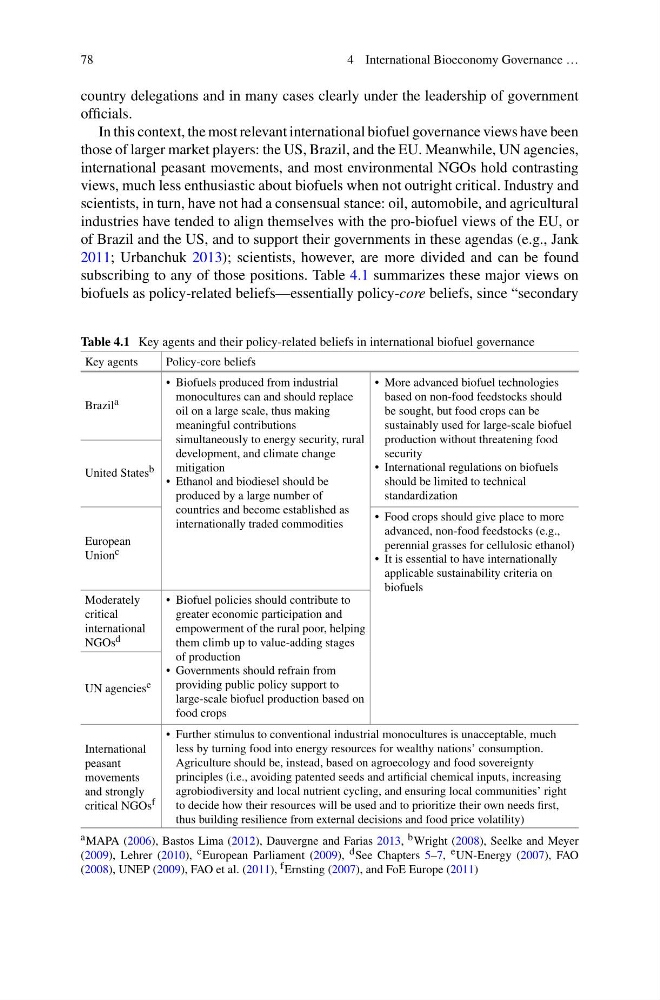
subscribing to any of those positions. Table 4.1 summarizes these major views on
biofuels as policy-related beliefs—essentially policy-core beliefs, since “secondary
Table 4.1 Key agents and their policy-related beliefs in international biofuel governance
Key agents
Policy-core beliefs
Brazil a
• Biofuels produced from industrial
monocultures can and should replace
oil on a large scale, thus making
meaningful contributions
simultaneously to energy security, rural
development, and climate change
mitigation
• Ethanol and biodiesel should be
produced by a large number of
countries and become established as
internationally traded commodities
• More advanced biofuel technologies
based on non-food feedstocks should
be sought, but food crops can be
sustainably used for large-scale biofuel
production without threatening food
security
• International regulations on biofuels
should be limited to technical
standardization
United States b
European
Union c
• Food crops should give place to more
advanced, non-food feedstocks (e.g.,
perennial grasses for cellulosic ethanol)
• It is essential to have internationally
applicable sustainability criteria on
biofuels
Moderately
critical
international
NGOs d
• Biofuel policies should contribute to
greater economic participation and
empowerment of the rural poor, helping
them climb up to value-adding stages
of production
• Governments should refrain from
providing public policy support to
large-scale biofuel production based on
food crops
UN agencies e
International
peasant
movements
and strongly
critical NGOs f
• Further stimulus to conventional industrial monocultures is unacceptable, much
less by turning food into energy resources for wealthy nations’ consumption.
Agriculture should be, instead, based on agroecology and food sovereignty
principles (i.e., avoiding patented seeds and artificial chemical inputs, increasing
agrobiodiversity and local nutrient cycling, and ensuring local communities’ right
to decide how their resources will be used and to prioritize their own needs first,
thus building resilience from external decisions and food price volatility)
a MAPA (2006), Bastos Lima (2012), Dauvergne and Farias 2013, b Wright (2008), Seelke and Meyer
(2009), Lehrer (2010), c European Parliament (2009), d See Chapters 5–7, e UN-Energy (2007), FAO
(2008), UNEP (2009), FAO et al. (2011), f Ernsting (2007), and FoE Europe (2011)
4 International Bioeconomy Governance …
country delegations and in many cases clearly under the leadership of government
officials.
In this context, the most relevant international biofuel governance views have been
those of larger market players: the US, Brazil, and the EU. Meanwhile, UN agencies,
international peasant movements, and most environmental NGOs hold contrasting
views, much less enthusiastic about biofuels when not outright critical. Industry and
scientists, in turn, have not had a consensual stance: oil, automobile, and agricultural
industries have tended to align themselves with the pro-biofuel views of the EU, or
of Brazil and the US, and to support their governments in these agendas (e.g., Jank
2011; Urbanchuk 2013); scientists, however, are more divided and can be found
subscribing to any of those positions. Table 4.1 summarizes these major views on
biofuels as policy-related beliefs—essentially policy-core beliefs, since “secondary
Table 4.1 Key agents and their policy-related beliefs in international biofuel governance
Key agents
Policy-core beliefs
Brazil a
• Biofuels produced from industrial
monocultures can and should replace
oil on a large scale, thus making
meaningful contributions
simultaneously to energy security, rural
development, and climate change
mitigation
• Ethanol and biodiesel should be
produced by a large number of
countries and become established as
internationally traded commodities
• More advanced biofuel technologies
based on non-food feedstocks should
be sought, but food crops can be
sustainably used for large-scale biofuel
production without threatening food
security
• International regulations on biofuels
should be limited to technical
standardization
United States b
European
Union c
• Food crops should give place to more
advanced, non-food feedstocks (e.g.,
perennial grasses for cellulosic ethanol)
• It is essential to have internationally
applicable sustainability criteria on
biofuels
Moderately
critical
international
NGOs d
• Biofuel policies should contribute to
greater economic participation and
empowerment of the rural poor, helping
them climb up to value-adding stages
of production
• Governments should refrain from
providing public policy support to
large-scale biofuel production based on
food crops
UN agencies e
International
peasant
movements
and strongly
critical NGOs f
• Further stimulus to conventional industrial monocultures is unacceptable, much
less by turning food into energy resources for wealthy nations’ consumption.
Agriculture should be, instead, based on agroecology and food sovereignty
principles (i.e., avoiding patented seeds and artificial chemical inputs, increasing
agrobiodiversity and local nutrient cycling, and ensuring local communities’ right
to decide how their resources will be used and to prioritize their own needs first,
thus building resilience from external decisions and food price volatility)
a MAPA (2006), Bastos Lima (2012), Dauvergne and Farias 2013, b Wright (2008), Seelke and Meyer
(2009), Lehrer (2010), c European Parliament (2009), d See Chapters 5–7, e UN-Energy (2007), FAO
(2008), UNEP (2009), FAO et al. (2011), f Ernsting (2007), and FoE Europe (2011)