

2.10.2 Cost Evaluation of Nanomaterials Production
In developing a cost-effective arsenic treatment system, it is required to examine the
production cost of different nanoadsorbents during laboratory-scale studies. Needless to say, the chemical (co-precipitation) approach of synthesis has been reported
to be a common mode of generation of nanoadsorbents at laboratory scale. A new
approach of calculating the cost of produced NPs using chemical method covering
the maximum possible aspects is also suggested by Kumar et al. (2020). This
methodology might help and motivates the future researcher to evalaute the cost
of synthesized NPs and subsequently the estimation of treatment cost of arsenic
contaminated groundwater.
2.10.3 Fabrication of Columns
The adsorption data employing laboratory columns have provided a base for the
application of nanoadsorbents at pilot- and full-scale remediation projects (Su and
Puls 2003; Kundu and Gupta 2005). In most of the studies, the laboratory columns
have been reported to be conventionally designed, which are unambiguously based
on the batch removal experiments (Wang et al. 2009). In the reviewed literature, the
ratio of d column /d particles (d-diameter) has been used for the laboratory scale column
experiments, which depends on the ignorance of wall effect on the mass transfer
(Benenati and Brosilow 1962).
Further, suitable binder is necessary, when the nanoadsorbents have to be used as
packing materials because the loss of particles might occur under the non-uniformity
of flow (Sharma et al. 2010). At the pilot scale in the household treatment units of
arsenic, the nanoadsorbents have been allowed to mix with easily available porous
materials like soil particles. However, the pursuance of an absolute methodology for
the development of laboratory columns is a need among the research community for
the better comparability and interpretation of arsenic removal data at a common
platform. Therefore, for designing of laboratory columns, the factors which need to
be considered are height of reactive zone and column with constant porosity and
their correlation with the required mass of adsorbents, as established by Noubactep
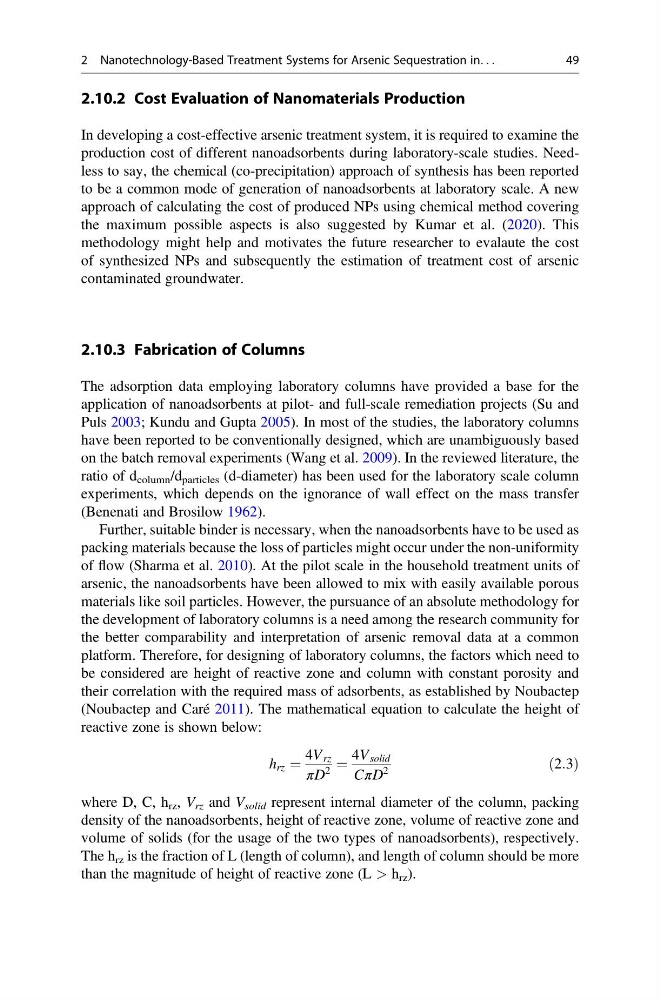
(Noubactep and Caré 2011). The mathematical equation to calculate the height of
reactive zone is shown below:
h rz ¼
4V rz
πD
2
¼
4V solid
CπD
2
ð2:3Þ
where D, C, h rz , V rz and V solid represent internal diameter of the column, packing
density of the nanoadsorbents, height of reactive zone, volume of reactive zone and
volume of solids (for the usage of the two types of nanoadsorbents), respectively.
The h rz is the fraction of L (length of column), and length of column should be more
than the magnitude of height of reactive zone (L > h rz ).
2 Nanotechnology-Based Treatment Systems for Arsenic Sequestration in. . .
49
In developing a cost-effective arsenic treatment system, it is required to examine the
production cost of different nanoadsorbents during laboratory-scale studies. Needless to say, the chemical (co-precipitation) approach of synthesis has been reported
to be a common mode of generation of nanoadsorbents at laboratory scale. A new
approach of calculating the cost of produced NPs using chemical method covering
the maximum possible aspects is also suggested by Kumar et al. (2020). This
methodology might help and motivates the future researcher to evalaute the cost
of synthesized NPs and subsequently the estimation of treatment cost of arsenic
contaminated groundwater.
2.10.3 Fabrication of Columns
The adsorption data employing laboratory columns have provided a base for the
application of nanoadsorbents at pilot- and full-scale remediation projects (Su and
Puls 2003; Kundu and Gupta 2005). In most of the studies, the laboratory columns
have been reported to be conventionally designed, which are unambiguously based
on the batch removal experiments (Wang et al. 2009). In the reviewed literature, the
ratio of d column /d particles (d-diameter) has been used for the laboratory scale column
experiments, which depends on the ignorance of wall effect on the mass transfer
(Benenati and Brosilow 1962).
Further, suitable binder is necessary, when the nanoadsorbents have to be used as
packing materials because the loss of particles might occur under the non-uniformity
of flow (Sharma et al. 2010). At the pilot scale in the household treatment units of
arsenic, the nanoadsorbents have been allowed to mix with easily available porous
materials like soil particles. However, the pursuance of an absolute methodology for
the development of laboratory columns is a need among the research community for
the better comparability and interpretation of arsenic removal data at a common
platform. Therefore, for designing of laboratory columns, the factors which need to
be considered are height of reactive zone and column with constant porosity and
their correlation with the required mass of adsorbents, as established by Noubactep
(Noubactep and Caré 2011). The mathematical equation to calculate the height of
reactive zone is shown below:
h rz ¼
4V rz
πD
2
¼
4V solid
CπD
2
ð2:3Þ
where D, C, h rz , V rz and V solid represent internal diameter of the column, packing
density of the nanoadsorbents, height of reactive zone, volume of reactive zone and
volume of solids (for the usage of the two types of nanoadsorbents), respectively.
The h rz is the fraction of L (length of column), and length of column should be more
than the magnitude of height of reactive zone (L > h rz ).
2 Nanotechnology-Based Treatment Systems for Arsenic Sequestration in. . .
49