

2.9.2.2 In Situ Chemical Treatment
Generally, it involves the direct injection of oxidants to the subsurface such as
KMnO 4 or oxygen, which promotes the oxidation of As
III to As
V and then the
co-precipitation of As
V from iron oxides. In this process, the chemical oxidant is
injected in an aquifer upstream of the contaminated site, and a closed loop can be
generated by pumping of water in the downstream site to utilize it for reinjection.
The reaction between injected chemical and the contaminant inhibits the mobilization of arsenic in aquifer systems. The most efficient chemicals injected into aquifer
are hydrogen peroxide and ferric chloride (Alp et al. 2016). Both of these chemicals
have to be injected sequentially because the oxidation by hydrogen peroxide is a
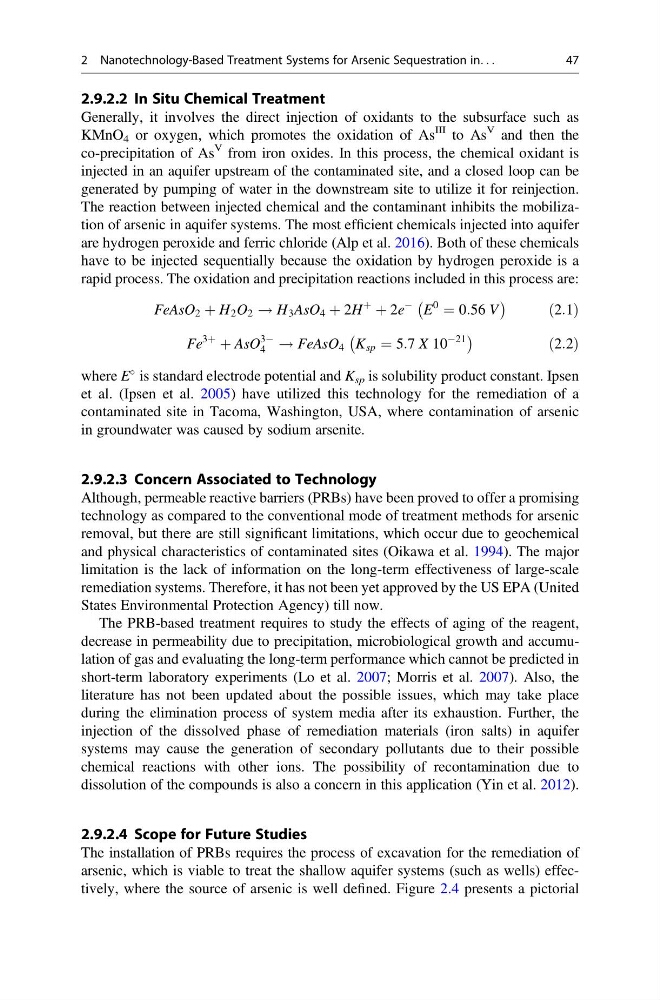
rapid process. The oxidation and precipitation reactions included in this process are:
FeAsO 2 þ H 2 O 2 ! H 3 AsO 4 þ 2H
þ
þ 2e
À E
0
¼ 0:56 V
À
Á
ð2:1Þ
Fe
3þ
þ AsO
3À
4 ! FeAsO 4 K sp ¼ 5:7 X 10
À21
À
Á
ð2:2Þ
where E
is standard electrode potential and K sp is solubility product constant. Ipsen
et al. (Ipsen et al. 2005) have utilized this technology for the remediation of a
contaminated site in Tacoma, Washington, USA, where contamination of arsenic
in groundwater was caused by sodium arsenite.
2.9.2.3 Concern Associated to Technology
Although, permeable reactive barriers (PRBs) have been proved to offer a promising
technology as compared to the conventional mode of treatment methods for arsenic
removal, but there are still significant limitations, which occur due to geochemical
and physical characteristics of contaminated sites (Oikawa et al. 1994). The major
limitation is the lack of information on the long-term effectiveness of large-scale
remediation systems. Therefore, it has not been yet approved by the US EPA (United
States Environmental Protection Agency) till now.
The PRB-based treatment requires to study the effects of aging of the reagent,
decrease in permeability due to precipitation, microbiological growth and accumulation of gas and evaluating the long-term performance which cannot be predicted in
short-term laboratory experiments (Lo et al. 2007; Morris et al. 2007). Also, the
literature has not been updated about the possible issues, which may take place
during the elimination process of system media after its exhaustion. Further, the
injection of the dissolved phase of remediation materials (iron salts) in aquifer
systems may cause the generation of secondary pollutants due to their possible
chemical reactions with other ions. The possibility of recontamination due to
dissolution of the compounds is also a concern in this application (Yin et al. 2012).
2.9.2.4 Scope for Future Studies
The installation of PRBs requires the process of excavation for the remediation of
arsenic, which is viable to treat the shallow aquifer systems (such as wells) effectively, where the source of arsenic is well defined. Figure 2.4 presents a pictorial
2 Nanotechnology-Based Treatment Systems for Arsenic Sequestration in. . .
47
Generally, it involves the direct injection of oxidants to the subsurface such as
KMnO 4 or oxygen, which promotes the oxidation of As
III to As
V and then the
co-precipitation of As
V from iron oxides. In this process, the chemical oxidant is
injected in an aquifer upstream of the contaminated site, and a closed loop can be
generated by pumping of water in the downstream site to utilize it for reinjection.
The reaction between injected chemical and the contaminant inhibits the mobilization of arsenic in aquifer systems. The most efficient chemicals injected into aquifer
are hydrogen peroxide and ferric chloride (Alp et al. 2016). Both of these chemicals
have to be injected sequentially because the oxidation by hydrogen peroxide is a
rapid process. The oxidation and precipitation reactions included in this process are:
FeAsO 2 þ H 2 O 2 ! H 3 AsO 4 þ 2H
þ
þ 2e
À E
0
¼ 0:56 V
À
Á
ð2:1Þ
Fe
3þ
þ AsO
3À
4 ! FeAsO 4 K sp ¼ 5:7 X 10
À21
À
Á
ð2:2Þ
where E
is standard electrode potential and K sp is solubility product constant. Ipsen
et al. (Ipsen et al. 2005) have utilized this technology for the remediation of a
contaminated site in Tacoma, Washington, USA, where contamination of arsenic
in groundwater was caused by sodium arsenite.
2.9.2.3 Concern Associated to Technology
Although, permeable reactive barriers (PRBs) have been proved to offer a promising
technology as compared to the conventional mode of treatment methods for arsenic
removal, but there are still significant limitations, which occur due to geochemical
and physical characteristics of contaminated sites (Oikawa et al. 1994). The major
limitation is the lack of information on the long-term effectiveness of large-scale
remediation systems. Therefore, it has not been yet approved by the US EPA (United
States Environmental Protection Agency) till now.
The PRB-based treatment requires to study the effects of aging of the reagent,
decrease in permeability due to precipitation, microbiological growth and accumulation of gas and evaluating the long-term performance which cannot be predicted in
short-term laboratory experiments (Lo et al. 2007; Morris et al. 2007). Also, the
literature has not been updated about the possible issues, which may take place
during the elimination process of system media after its exhaustion. Further, the
injection of the dissolved phase of remediation materials (iron salts) in aquifer
systems may cause the generation of secondary pollutants due to their possible
chemical reactions with other ions. The possibility of recontamination due to
dissolution of the compounds is also a concern in this application (Yin et al. 2012).
2.9.2.4 Scope for Future Studies
The installation of PRBs requires the process of excavation for the remediation of
arsenic, which is viable to treat the shallow aquifer systems (such as wells) effectively, where the source of arsenic is well defined. Figure 2.4 presents a pictorial
2 Nanotechnology-Based Treatment Systems for Arsenic Sequestration in. . .
47