

2.9.1 Technology Advantages
Subsurface remediation of contaminant of organic volatile pollutants has been
considered an environmental-friendly approach in terms of its attenuation and
release to the atmosphere (Azubuike et al. 2016; Limmer and Burken 2016).
Similarly, the treatment of arsenic-contaminated groundwater in subterranean environment (below surface) is a logical choice in respect to reduce the chance of its
mobilization in living environment. In situ treatment has been considered more
environmental friendly, cost-effective and reliable as compared to ex situ mode of
treatment (Spira et al. 2006). Developing a better understanding about in situ
remediation methods and further improvement appears to be more rational and
relevant choice now rather than to improve the already developed conventional
techniques. Some recent methods explored for the removal of arsenic in subsurface
environment are discussed further.
2.9.2 Methods of Treatment
2.9.2.1 Permeable Reactive Barriers (PRBs)
In the early 1990s, permeable reactive barriers (PRBs) made use of zero-valent iron,
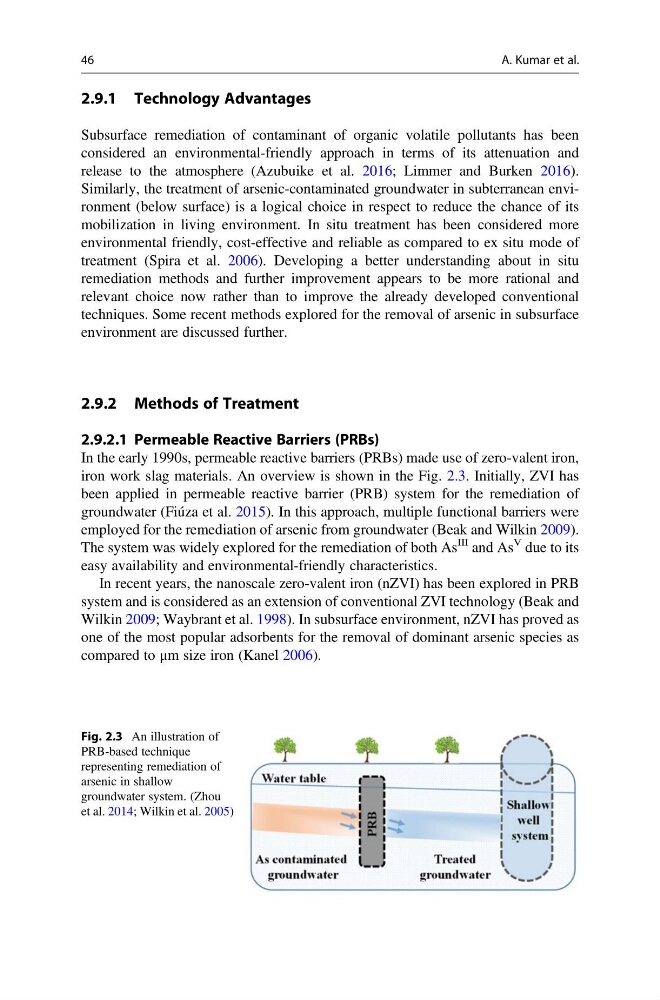
iron work slag materials. An overview is shown in the Fig. 2.3. Initially, ZVI has
been applied in permeable reactive barrier (PRB) system for the remediation of
groundwater (Fiúza et al. 2015). In this approach, multiple functional barriers were
employed for the remediation of arsenic from groundwater (Beak and Wilkin 2009).
The system was widely explored for the remediation of both As
III and As
V due to its
easy availability and environmental-friendly characteristics.
In recent years, the nanoscale zero-valent iron (nZVI) has been explored in PRB
system and is considered as an extension of conventional ZVI technology (Beak and
Wilkin 2009; Waybrant et al. 1998). In subsurface environment, nZVI has proved as
one of the most popular adsorbents for the removal of dominant arsenic species as
compared to μm size iron (Kanel 2006).
Fig. 2.3 An illustration of
PRB-based technique
representing remediation of
arsenic in shallow
groundwater system. (Zhou
et al. 2014; Wilkin et al. 2005)
46
A. Kumar et al.
Subsurface remediation of contaminant of organic volatile pollutants has been
considered an environmental-friendly approach in terms of its attenuation and
release to the atmosphere (Azubuike et al. 2016; Limmer and Burken 2016).
Similarly, the treatment of arsenic-contaminated groundwater in subterranean environment (below surface) is a logical choice in respect to reduce the chance of its
mobilization in living environment. In situ treatment has been considered more
environmental friendly, cost-effective and reliable as compared to ex situ mode of
treatment (Spira et al. 2006). Developing a better understanding about in situ
remediation methods and further improvement appears to be more rational and
relevant choice now rather than to improve the already developed conventional
techniques. Some recent methods explored for the removal of arsenic in subsurface
environment are discussed further.
2.9.2 Methods of Treatment
2.9.2.1 Permeable Reactive Barriers (PRBs)
In the early 1990s, permeable reactive barriers (PRBs) made use of zero-valent iron,
iron work slag materials. An overview is shown in the Fig. 2.3. Initially, ZVI has
been applied in permeable reactive barrier (PRB) system for the remediation of
groundwater (Fiúza et al. 2015). In this approach, multiple functional barriers were
employed for the remediation of arsenic from groundwater (Beak and Wilkin 2009).
The system was widely explored for the remediation of both As
III and As
V due to its
easy availability and environmental-friendly characteristics.
In recent years, the nanoscale zero-valent iron (nZVI) has been explored in PRB
system and is considered as an extension of conventional ZVI technology (Beak and
Wilkin 2009; Waybrant et al. 1998). In subsurface environment, nZVI has proved as
one of the most popular adsorbents for the removal of dominant arsenic species as
compared to μm size iron (Kanel 2006).
Fig. 2.3 An illustration of
PRB-based technique
representing remediation of
arsenic in shallow
groundwater system. (Zhou
et al. 2014; Wilkin et al. 2005)
46
A. Kumar et al.