

14.3.1 Incineration
Incineration is a thermal waste reduction method that involves combustion process
and one of the major anthropogenic sources for the emission dioxins and furans.
However, incineration of contaminated wastes in rotary kilns is usual practice in
many industrialized countries, as they are best suited to accept solid, pasty or liquid
waste. Municipal waste incineration, hazardous waste incineration, medical waste
incineration, light-fraction shredder waste incineration, waste wood and waste
biomass incineration and sewage sludge incineration are the important waste incineration categories in a nation. The major incineration categories that emit dioxins
and furans are municipal waste incineration, hazardous waste incineration and
medical waste incineration, while the rest are least studied. Medical waste
incinerators in China reported emitting 1.18 kg I-TEQ of PCDDs/PCDFs in the
year 2004 (11.5% total PCDD/PCDF emission). In order to minimize the emission of
PCDDs/PCDFs from medical waste incinerators, an advanced gas cleaning and
stable combustion system should be enforced (Li et al. 2010). Municipal solid
waste incinerators contribute to the emission of dioxins, furans and derivatives of
dioxins through stack flue gases and ashes (Wang et al. 2010). Therefore, appropriate control strategies should be installed to regulate the emission of dioxins and
furans.
In India, municipal waste incineration is absent and around 94% of the municipal
solid waste simply dumped, while the rest is either composted (4%) or recycled
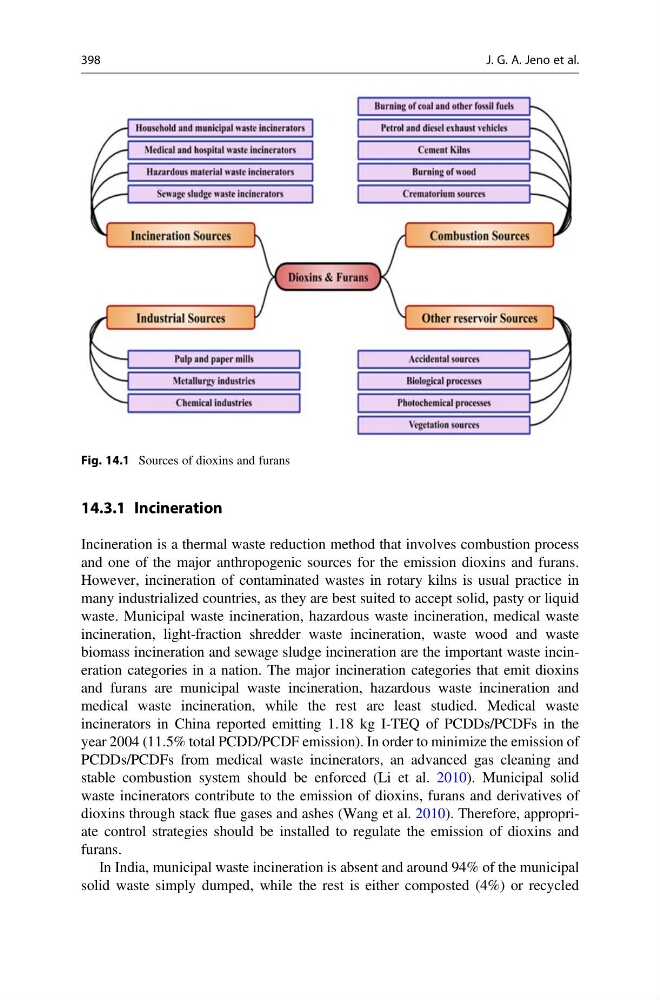
Fig. 14.1 Sources of dioxins and furans
398
J. G. A. Jeno et al.
Incineration is a thermal waste reduction method that involves combustion process
and one of the major anthropogenic sources for the emission dioxins and furans.
However, incineration of contaminated wastes in rotary kilns is usual practice in
many industrialized countries, as they are best suited to accept solid, pasty or liquid
waste. Municipal waste incineration, hazardous waste incineration, medical waste
incineration, light-fraction shredder waste incineration, waste wood and waste
biomass incineration and sewage sludge incineration are the important waste incineration categories in a nation. The major incineration categories that emit dioxins
and furans are municipal waste incineration, hazardous waste incineration and
medical waste incineration, while the rest are least studied. Medical waste
incinerators in China reported emitting 1.18 kg I-TEQ of PCDDs/PCDFs in the
year 2004 (11.5% total PCDD/PCDF emission). In order to minimize the emission of
PCDDs/PCDFs from medical waste incinerators, an advanced gas cleaning and
stable combustion system should be enforced (Li et al. 2010). Municipal solid
waste incinerators contribute to the emission of dioxins, furans and derivatives of
dioxins through stack flue gases and ashes (Wang et al. 2010). Therefore, appropriate control strategies should be installed to regulate the emission of dioxins and
furans.
In India, municipal waste incineration is absent and around 94% of the municipal
solid waste simply dumped, while the rest is either composted (4%) or recycled
Fig. 14.1 Sources of dioxins and furans
398
J. G. A. Jeno et al.