

This chapter encompassed the current status of dioxin/furan accumulation and its
biological implication in the ecosystem. In addition, detailed information on the
sources and exposure risk of dioxins/furans are explained. This chapter also
discusses the presence of dioxins and furans in the global environment and related
regulatory measures. A detailed compilation of bioaccumulation and
biomagnification of dioxins/furans in the food chain and its adverse side effects in
human is also elaborated. For brevity, PCDDs/PCDFs are termed as dioxins/furans
unless specified in the chapter.
14.2 Nature of Dioxins and Furans
Dioxins/furans are volatile to an extent, slightly soluble in water and readily soluble
in lipids. Their lipid solubility aids directly to cross the cell membranes and
accumulates in the fat tissues of several organisms. These compounds have high
toxic properties causing severe abnormalities, developmental problems and interference with regulatory hormonal functions. These are non-polar, poorly water-soluble,
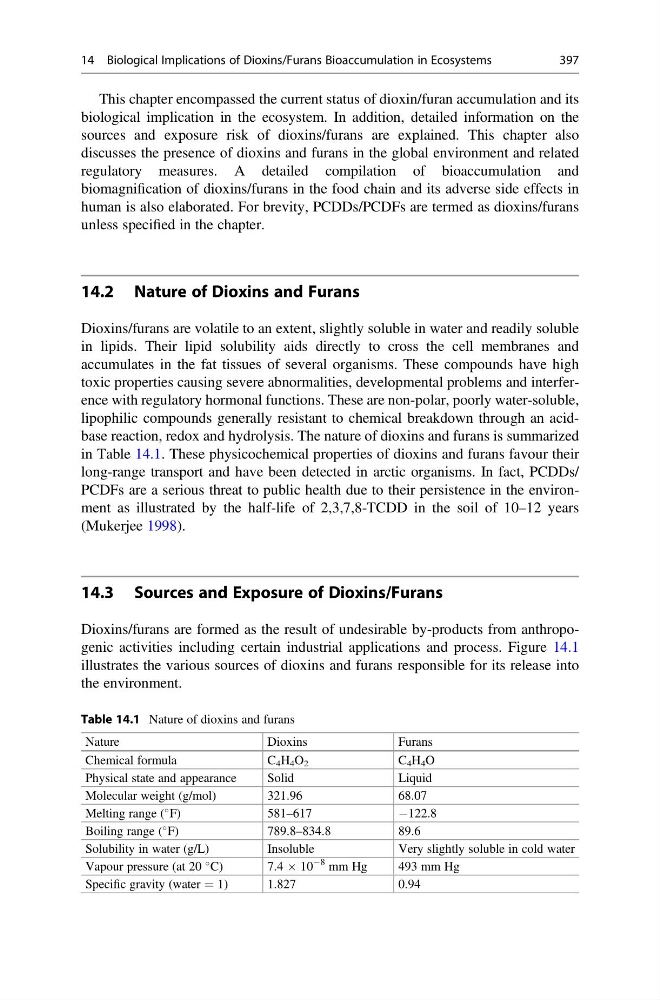
lipophilic compounds generally resistant to chemical breakdown through an acidbase reaction, redox and hydrolysis. The nature of dioxins and furans is summarized
in Table 14.1. These physicochemical properties of dioxins and furans favour their
long-range transport and have been detected in arctic organisms. In fact, PCDDs/
PCDFs are a serious threat to public health due to their persistence in the environment as illustrated by the half-life of 2,3,7,8-TCDD in the soil of 10–12 years
(Mukerjee 1998).
14.3 Sources and Exposure of Dioxins/Furans
Dioxins/furans are formed as the result of undesirable by-products from anthropogenic activities including certain industrial applications and process. Figure 14.1
illustrates the various sources of dioxins and furans responsible for its release into
the environment.
Table 14.1 Nature of dioxins and furans
Nature
Dioxins
Furans
Chemical formula
C 4 H 4 O 2
C 4 H 4 O
Physical state and appearance
Solid
Liquid
Molecular weight (g/mol)
321.96
68.07
Melting range (
F)
581–617
À122.8
Boiling range (
F)
789.8–834.8
89.6
Solubility in water (g/L)
Insoluble
Very slightly soluble in cold water
Vapour pressure (at 20
C)
7.4 Â 10
À8 mm Hg
493 mm Hg
Specific gravity (water ¼ 1)
1.827
0.94
14 Biological Implications of Dioxins/Furans Bioaccumulation in Ecosystems
397
biological implication in the ecosystem. In addition, detailed information on the
sources and exposure risk of dioxins/furans are explained. This chapter also
discusses the presence of dioxins and furans in the global environment and related
regulatory measures. A detailed compilation of bioaccumulation and
biomagnification of dioxins/furans in the food chain and its adverse side effects in
human is also elaborated. For brevity, PCDDs/PCDFs are termed as dioxins/furans
unless specified in the chapter.
14.2 Nature of Dioxins and Furans
Dioxins/furans are volatile to an extent, slightly soluble in water and readily soluble
in lipids. Their lipid solubility aids directly to cross the cell membranes and
accumulates in the fat tissues of several organisms. These compounds have high
toxic properties causing severe abnormalities, developmental problems and interference with regulatory hormonal functions. These are non-polar, poorly water-soluble,
lipophilic compounds generally resistant to chemical breakdown through an acidbase reaction, redox and hydrolysis. The nature of dioxins and furans is summarized
in Table 14.1. These physicochemical properties of dioxins and furans favour their
long-range transport and have been detected in arctic organisms. In fact, PCDDs/
PCDFs are a serious threat to public health due to their persistence in the environment as illustrated by the half-life of 2,3,7,8-TCDD in the soil of 10–12 years
(Mukerjee 1998).
14.3 Sources and Exposure of Dioxins/Furans
Dioxins/furans are formed as the result of undesirable by-products from anthropogenic activities including certain industrial applications and process. Figure 14.1
illustrates the various sources of dioxins and furans responsible for its release into
the environment.
Table 14.1 Nature of dioxins and furans
Nature
Dioxins
Furans
Chemical formula
C 4 H 4 O 2
C 4 H 4 O
Physical state and appearance
Solid
Liquid
Molecular weight (g/mol)
321.96
68.07
Melting range (
F)
581–617
À122.8
Boiling range (
F)
789.8–834.8
89.6
Solubility in water (g/L)
Insoluble
Very slightly soluble in cold water
Vapour pressure (at 20
C)
7.4 Â 10
À8 mm Hg
493 mm Hg
Specific gravity (water ¼ 1)
1.827
0.94
14 Biological Implications of Dioxins/Furans Bioaccumulation in Ecosystems
397