

Based on to their metallic resistance, the removal of Cr(VI), Cd(II), Pb(II) and Zn
(II) has been studied in cultures of D. alaskensis strain 6SR. Such studies showed a
removal rate of 78.3% for 18 mg/L Cr(VI), and for 150 mg/L Cd(II), Pb(II) and Zn
(II), removal rates were greater than 98%. The main mechanism of removal is the
precipitation of the corresponding metallic sulfides, followed by adsorption of these
by the produced EPS and a slight metal accumulation at the level of the periplasmic
space, as shown in the image obtained by transmission electron microscopy (Avilés
Trejo and Salazar López 2014; López-Pérez et al. 2013b, 2015; Peña-Caballero
2016). The removal mechanisms for zinc, lead and cadmium is related to the
production of H 2 S, generated from the anaerobic respiration of the bacterium,
which reacts with zinc, lead and cadmium, forming the respective metallic sulfide,
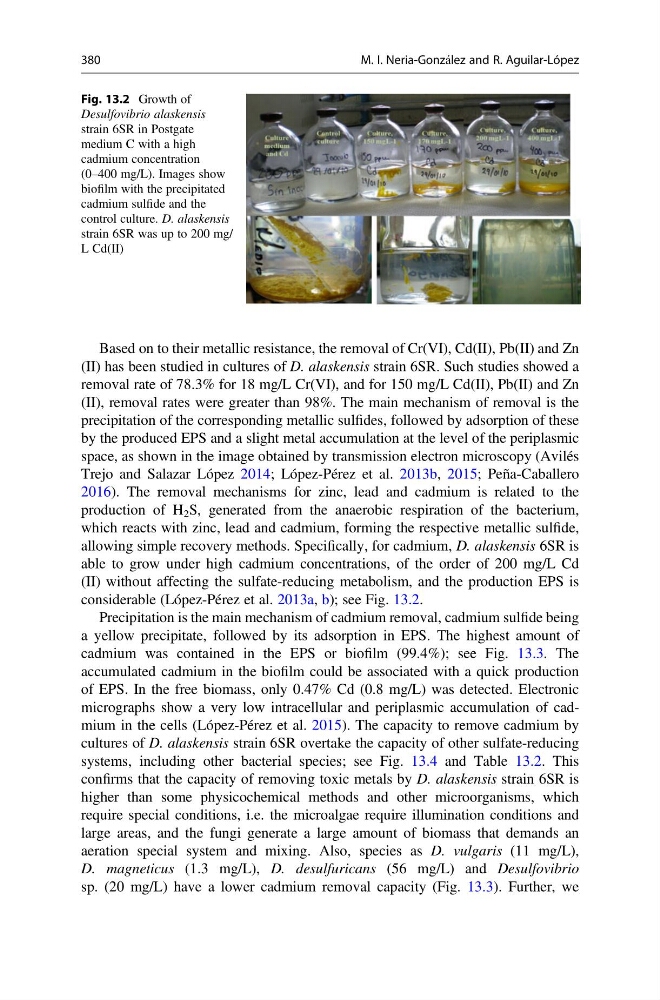
allowing simple recovery methods. Specifically, for cadmium, D. alaskensis 6SR is
able to grow under high cadmium concentrations, of the order of 200 mg/L Cd
(II) without affecting the sulfate-reducing metabolism, and the production EPS is
considerable (López-Pérez et al. 2013a, b); see Fig. 13.2.
Precipitation is the main mechanism of cadmium removal, cadmium sulfide being
a yellow precipitate, followed by its adsorption in EPS. The highest amount of
cadmium was contained in the EPS or biofilm (99.4%); see Fig. 13.3. The
accumulated cadmium in the biofilm could be associated with a quick production
of EPS. In the free biomass, only 0.47% Cd (0.8 mg/L) was detected. Electronic
micrographs show a very low intracellular and periplasmic accumulation of cadmium in the cells (López-Pérez et al. 2015). The capacity to remove cadmium by
cultures of D. alaskensis strain 6SR overtake the capacity of other sulfate-reducing
systems, including other bacterial species; see Fig. 13.4 and Table 13.2. This
confirms that the capacity of removing toxic metals by D. alaskensis strain 6SR is
higher than some physicochemical methods and other microorganisms, which
require special conditions, i.e. the microalgae require illumination conditions and
large areas, and the fungi generate a large amount of biomass that demands an
aeration special system and mixing. Also, species as D. vulgaris (11 mg/L),
D. magneticus (1.3 mg/L), D. desulfuricans (56 mg/L) and Desulfovibrio
sp. (20 mg/L) have a lower cadmium removal capacity (Fig. 13.3). Further, we
Fig. 13.2 Growth of
Desulfovibrio alaskensis
strain 6SR in Postgate
medium C with a high
cadmium concentration
(0–400 mg/L). Images show
biofilm with the precipitated
cadmium sulfide and the
control culture. D. alaskensis
strain 6SR was up to 200 mg/
L Cd(II)
380
M. I. Neria-González and R. Aguilar-López
(II) has been studied in cultures of D. alaskensis strain 6SR. Such studies showed a
removal rate of 78.3% for 18 mg/L Cr(VI), and for 150 mg/L Cd(II), Pb(II) and Zn
(II), removal rates were greater than 98%. The main mechanism of removal is the
precipitation of the corresponding metallic sulfides, followed by adsorption of these
by the produced EPS and a slight metal accumulation at the level of the periplasmic
space, as shown in the image obtained by transmission electron microscopy (Avilés
Trejo and Salazar López 2014; López-Pérez et al. 2013b, 2015; Peña-Caballero
2016). The removal mechanisms for zinc, lead and cadmium is related to the
production of H 2 S, generated from the anaerobic respiration of the bacterium,
which reacts with zinc, lead and cadmium, forming the respective metallic sulfide,
allowing simple recovery methods. Specifically, for cadmium, D. alaskensis 6SR is
able to grow under high cadmium concentrations, of the order of 200 mg/L Cd
(II) without affecting the sulfate-reducing metabolism, and the production EPS is
considerable (López-Pérez et al. 2013a, b); see Fig. 13.2.
Precipitation is the main mechanism of cadmium removal, cadmium sulfide being
a yellow precipitate, followed by its adsorption in EPS. The highest amount of
cadmium was contained in the EPS or biofilm (99.4%); see Fig. 13.3. The
accumulated cadmium in the biofilm could be associated with a quick production
of EPS. In the free biomass, only 0.47% Cd (0.8 mg/L) was detected. Electronic
micrographs show a very low intracellular and periplasmic accumulation of cadmium in the cells (López-Pérez et al. 2015). The capacity to remove cadmium by
cultures of D. alaskensis strain 6SR overtake the capacity of other sulfate-reducing
systems, including other bacterial species; see Fig. 13.4 and Table 13.2. This
confirms that the capacity of removing toxic metals by D. alaskensis strain 6SR is
higher than some physicochemical methods and other microorganisms, which
require special conditions, i.e. the microalgae require illumination conditions and
large areas, and the fungi generate a large amount of biomass that demands an
aeration special system and mixing. Also, species as D. vulgaris (11 mg/L),
D. magneticus (1.3 mg/L), D. desulfuricans (56 mg/L) and Desulfovibrio
sp. (20 mg/L) have a lower cadmium removal capacity (Fig. 13.3). Further, we
Fig. 13.2 Growth of
Desulfovibrio alaskensis
strain 6SR in Postgate
medium C with a high
cadmium concentration
(0–400 mg/L). Images show
biofilm with the precipitated
cadmium sulfide and the
control culture. D. alaskensis
strain 6SR was up to 200 mg/
L Cd(II)
380
M. I. Neria-González and R. Aguilar-López