

think that the anaerobic of culture and handling conditions of SRB could be a
disadvantage in the removal metals but it is quite the opposite. Bacterial growth
under anaerobic conditions produces less biomass, and its simple removal metal
mechanism allows easy recovery of the metallic sulfide, and some of them have an
added value in the manufacture of solar cells (López-Pérez et al. 2015; RangelChávez et al. 2015).
In the case of hexavalent chromium, D. alaskensis strain 6SR is able to grow up to
a concentration of 18 mg/L Cr(VI); see Figs. 13.5 and 13.6. However, some species
as D. vulgaris Hildenborough have the capacity to reduce Cr(VI) to Cr(III) by the
action of dehydrogenase and the cytochrome c 3 , but cells are unable to use Cr
(VI) like a terminal electron acceptor linked to growth (Klonowska et al. 2008;
Franco et al. 2018). This has been demonstrated using a fresh culture medium with
sulfate and chromium, which was inoculated with cells harvested in the exponential
phase and washed. The results indicated that chromium decoupled lactate consumption from sulfate reduction, while chromium reduction is carried out. This explains
that electron flow from cytochrome c 3 is a non-specific process that can be diverted
from sulfate by other redox partners including Cr(VI). Then, the reduction of
chromium in culture for the batch of D. alaskensis strain 6SR was studied under
the same methodology and conditions followed by Klonowska et al. (2008). The
results revealed that the reduction of Cr(VI) is due to the production of H 2 S, since the
sulfate-reducing process was not inhibited by chromium hexavalent, such as
demonstrated to D. vulgaris Hildenborough; see Fig. 13.7 (Avilés-Trejo and
Salazar-López 2014; Peña-Caballero et al. 2016). Therefore, Desulfovibrio
alaskensis strain 6SR is not able to reduce Cr(VI) via enzymatic reduction.
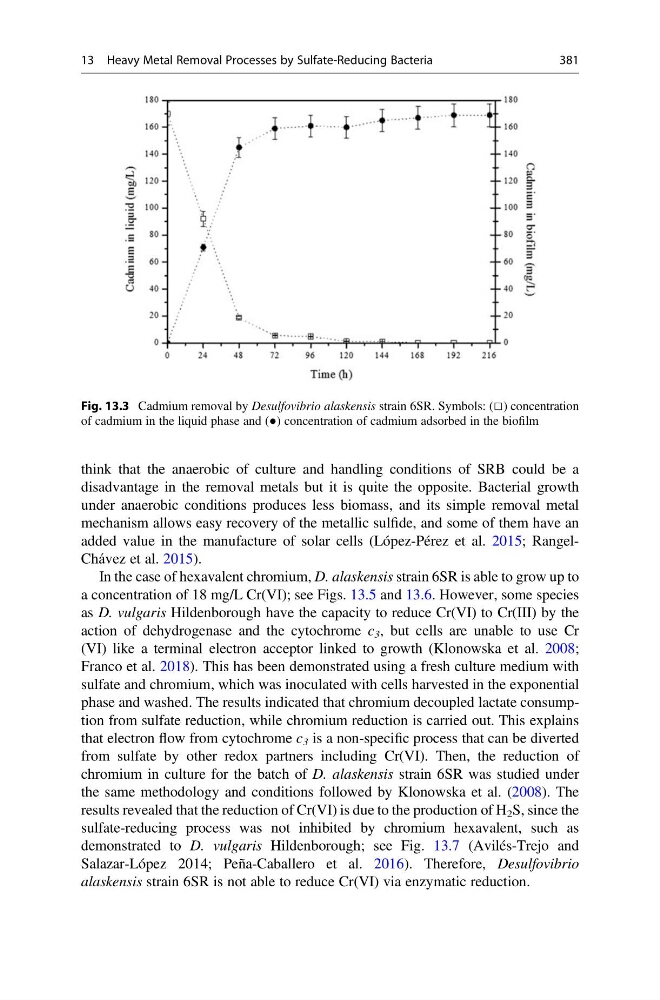
Fig. 13.3 Cadmium removal by Desulfovibrio alaskensis strain 6SR. Symbols: (□) concentration
of cadmium in the liquid phase and (●) concentration of cadmium adsorbed in the biofilm
13 Heavy Metal Removal Processes by Sulfate-Reducing Bacteria
381
disadvantage in the removal metals but it is quite the opposite. Bacterial growth
under anaerobic conditions produces less biomass, and its simple removal metal
mechanism allows easy recovery of the metallic sulfide, and some of them have an
added value in the manufacture of solar cells (López-Pérez et al. 2015; RangelChávez et al. 2015).
In the case of hexavalent chromium, D. alaskensis strain 6SR is able to grow up to
a concentration of 18 mg/L Cr(VI); see Figs. 13.5 and 13.6. However, some species
as D. vulgaris Hildenborough have the capacity to reduce Cr(VI) to Cr(III) by the
action of dehydrogenase and the cytochrome c 3 , but cells are unable to use Cr
(VI) like a terminal electron acceptor linked to growth (Klonowska et al. 2008;
Franco et al. 2018). This has been demonstrated using a fresh culture medium with
sulfate and chromium, which was inoculated with cells harvested in the exponential
phase and washed. The results indicated that chromium decoupled lactate consumption from sulfate reduction, while chromium reduction is carried out. This explains
that electron flow from cytochrome c 3 is a non-specific process that can be diverted
from sulfate by other redox partners including Cr(VI). Then, the reduction of
chromium in culture for the batch of D. alaskensis strain 6SR was studied under
the same methodology and conditions followed by Klonowska et al. (2008). The
results revealed that the reduction of Cr(VI) is due to the production of H 2 S, since the
sulfate-reducing process was not inhibited by chromium hexavalent, such as
demonstrated to D. vulgaris Hildenborough; see Fig. 13.7 (Avilés-Trejo and
Salazar-López 2014; Peña-Caballero et al. 2016). Therefore, Desulfovibrio
alaskensis strain 6SR is not able to reduce Cr(VI) via enzymatic reduction.
Fig. 13.3 Cadmium removal by Desulfovibrio alaskensis strain 6SR. Symbols: (□) concentration
of cadmium in the liquid phase and (●) concentration of cadmium adsorbed in the biofilm
13 Heavy Metal Removal Processes by Sulfate-Reducing Bacteria
381