

bacterium (Feio et al. 2004). Otherwise, the 6SR strain was isolated from a biofilm
formed within an oil pipeline from the southeast of Mexico; the phylogenetic
characterization showed strong homology with D. alaskensis (Neria-González
et al. 2006). Subsequent researches indicate that D. alaskensis is an SRB frequently
found in biofilms developed in the oil pipelines, and these are associated to metallic
biocorrosion of pipelines of the oil industry (Hernández-Gayoso et al. 2004; NeriaGonzález et al. 2006).
Desulfovibrio alaskensis strain 6SR grows in Postgate medium C with a concentration of 3.0% NaCl, pH 7 at 45
C. The growth of the bacterium and the generation
of -SH favour the production of EPS. In a natural environment, the EPS induces the
development of biofilms that allows microorganisms to survive under stress
conditions; also, it offers protection to environmental changes and toxic substances.
But, this situation is not very different in pure cultures because when hydrogen
sulfide accumulates, the EPS is produced as a protection mechanism of the toxicity
of hydrogen sulfide, since despite the sulfate-reducing nature of D. alaskensis strain
6SR, its growth is inhibited by the accumulation of this (Barton 1995; NeriaGonzález et al. 2011). On the other hand, the EPS have an important role in the
adsorption of heavy metals for their chelating properties, an important factor in the
removal of metals in solution. The production of EPS by D. alaskensis strain 6SR
under optimal growth conditions in Postgate medium C is estimated in 780 mg/L,
highest compared with the ones in cultures of Desulfovibrio H0407 (239 mg/L) and
Desulfovibrio LM1 (169 mg/L), obtaining a yield of 6.14 mg EPS/mg cellular
protein (Neria-González et al. 2011).
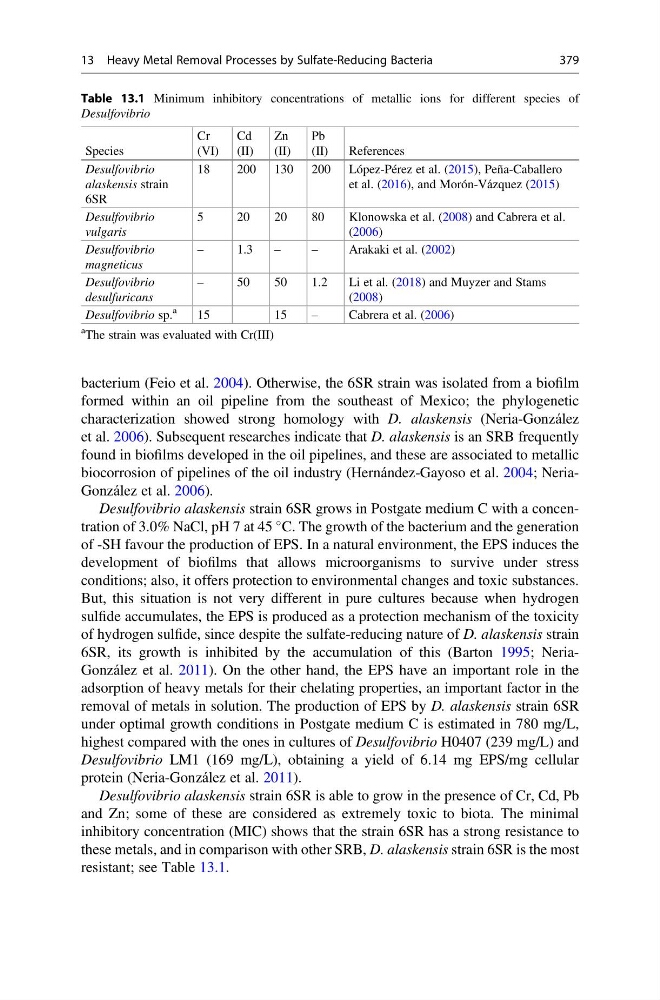
Desulfovibrio alaskensis strain 6SR is able to grow in the presence of Cr, Cd, Pb
and Zn; some of these are considered as extremely toxic to biota. The minimal
inhibitory concentration (MIC) shows that the strain 6SR has a strong resistance to
these metals, and in comparison with other SRB, D. alaskensis strain 6SR is the most
resistant; see Table 13.1.
Table 13.1 Minimum inhibitory concentrations of metallic ions for different species of
Desulfovibrio
Species
Cr
(VI)
Cd
(II)
Zn
(II)
Pb
(II)
References
Desulfovibrio
alaskensis strain
6SR
18
200 130 200 López-Pérez et al. (2015), Peña-Caballero
et al. (2016), and Morón-Vázquez (2015)
Desulfovibrio
vulgaris
5
20
20
80
Klonowska et al. (2008) and Cabrera et al.
(2006)
Desulfovibrio
magneticus
–
1.3
–
–
Arakaki et al. (2002)
Desulfovibrio
desulfuricans
–
50
50
1.2
Li et al. (2018) and Muyzer and Stams
(2008)
Desulfovibrio sp.
a
15
15
–
Cabrera et al. (2006)
a The strain was evaluated with Cr(III)
13 Heavy Metal Removal Processes by Sulfate-Reducing Bacteria
379
formed within an oil pipeline from the southeast of Mexico; the phylogenetic
characterization showed strong homology with D. alaskensis (Neria-González
et al. 2006). Subsequent researches indicate that D. alaskensis is an SRB frequently
found in biofilms developed in the oil pipelines, and these are associated to metallic
biocorrosion of pipelines of the oil industry (Hernández-Gayoso et al. 2004; NeriaGonzález et al. 2006).
Desulfovibrio alaskensis strain 6SR grows in Postgate medium C with a concentration of 3.0% NaCl, pH 7 at 45
C. The growth of the bacterium and the generation
of -SH favour the production of EPS. In a natural environment, the EPS induces the
development of biofilms that allows microorganisms to survive under stress
conditions; also, it offers protection to environmental changes and toxic substances.
But, this situation is not very different in pure cultures because when hydrogen
sulfide accumulates, the EPS is produced as a protection mechanism of the toxicity
of hydrogen sulfide, since despite the sulfate-reducing nature of D. alaskensis strain
6SR, its growth is inhibited by the accumulation of this (Barton 1995; NeriaGonzález et al. 2011). On the other hand, the EPS have an important role in the
adsorption of heavy metals for their chelating properties, an important factor in the
removal of metals in solution. The production of EPS by D. alaskensis strain 6SR
under optimal growth conditions in Postgate medium C is estimated in 780 mg/L,
highest compared with the ones in cultures of Desulfovibrio H0407 (239 mg/L) and
Desulfovibrio LM1 (169 mg/L), obtaining a yield of 6.14 mg EPS/mg cellular
protein (Neria-González et al. 2011).
Desulfovibrio alaskensis strain 6SR is able to grow in the presence of Cr, Cd, Pb
and Zn; some of these are considered as extremely toxic to biota. The minimal
inhibitory concentration (MIC) shows that the strain 6SR has a strong resistance to
these metals, and in comparison with other SRB, D. alaskensis strain 6SR is the most
resistant; see Table 13.1.
Table 13.1 Minimum inhibitory concentrations of metallic ions for different species of
Desulfovibrio
Species
Cr
(VI)
Cd
(II)
Zn
(II)
Pb
(II)
References
Desulfovibrio
alaskensis strain
6SR
18
200 130 200 López-Pérez et al. (2015), Peña-Caballero
et al. (2016), and Morón-Vázquez (2015)
Desulfovibrio
vulgaris
5
20
20
80
Klonowska et al. (2008) and Cabrera et al.
(2006)
Desulfovibrio
magneticus
–
1.3
–
–
Arakaki et al. (2002)
Desulfovibrio
desulfuricans
–
50
50
1.2
Li et al. (2018) and Muyzer and Stams
(2008)
Desulfovibrio sp.
a
15
15
–
Cabrera et al. (2006)
a The strain was evaluated with Cr(III)
13 Heavy Metal Removal Processes by Sulfate-Reducing Bacteria
379