

11.4 Dovetailing of Unit Operations for Sustainable Technique
The emerging trend to treat effluent from industrial sectors and maintain the ecological balance in the water bodies as a mandate from different officials has led to
process dovetailing. The dovetailing involves the correct sequencing of various unit
operations to get the resultant outcome with recyclable quality for daily reuse or
re-entering in water bodies (Bijan and Mohseni 2005). The general theme practised
traditionally is alone natural-based operations such as HSFCW, UASB and TF
which depends on the bed formation or wet land generation with plantation
(Champagne et al. 2017). The single-unit operation cannot serve the objective of
removal of antibiotics, colours, dyes, drug traces, toxic protein and peptides, fats and
carbohydrates (Høibye et al. 2008). The dovetailing strategies by combining with
correct sequence such as ALRs-AC, AC-TF, FBRs-AC, TF-MB-AC, FBRs-ALRs
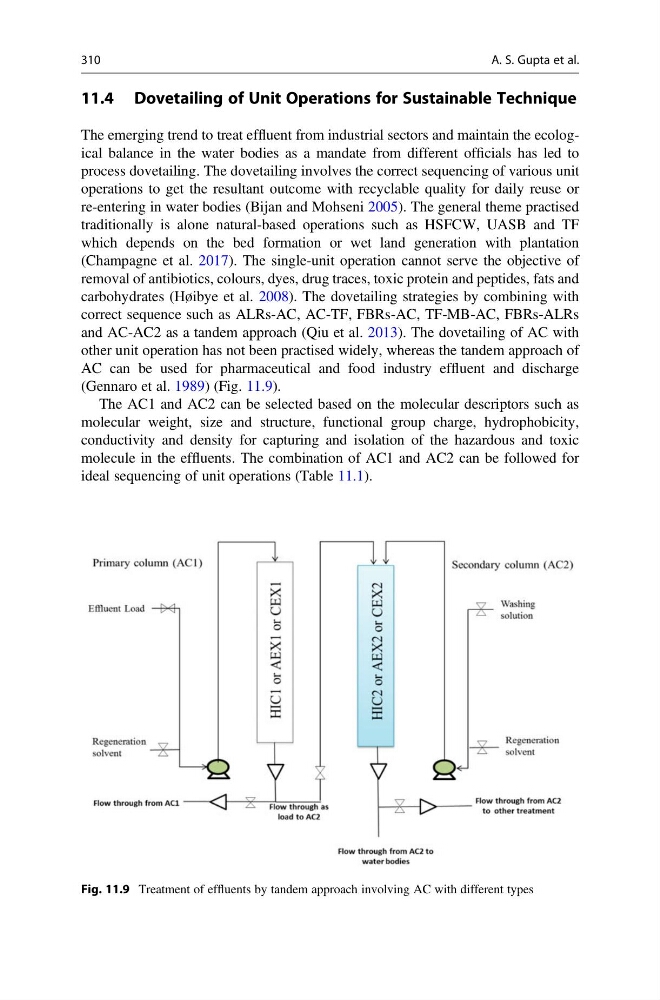
and AC-AC2 as a tandem approach (Qiu et al. 2013). The dovetailing of AC with
other unit operation has not been practised widely, whereas the tandem approach of
AC can be used for pharmaceutical and food industry effluent and discharge
(Gennaro et al. 1989) (Fig. 11.9).
The AC1 and AC2 can be selected based on the molecular descriptors such as
molecular weight, size and structure, functional group charge, hydrophobicity,
conductivity and density for capturing and isolation of the hazardous and toxic
molecule in the effluents. The combination of AC1 and AC2 can be followed for
ideal sequencing of unit operations (Table 11.1).
Fig. 11.9 Treatment of effluents by tandem approach involving AC with different types
310
A. S. Gupta et al.
The emerging trend to treat effluent from industrial sectors and maintain the ecological balance in the water bodies as a mandate from different officials has led to
process dovetailing. The dovetailing involves the correct sequencing of various unit
operations to get the resultant outcome with recyclable quality for daily reuse or
re-entering in water bodies (Bijan and Mohseni 2005). The general theme practised
traditionally is alone natural-based operations such as HSFCW, UASB and TF
which depends on the bed formation or wet land generation with plantation
(Champagne et al. 2017). The single-unit operation cannot serve the objective of
removal of antibiotics, colours, dyes, drug traces, toxic protein and peptides, fats and
carbohydrates (Høibye et al. 2008). The dovetailing strategies by combining with
correct sequence such as ALRs-AC, AC-TF, FBRs-AC, TF-MB-AC, FBRs-ALRs
and AC-AC2 as a tandem approach (Qiu et al. 2013). The dovetailing of AC with
other unit operation has not been practised widely, whereas the tandem approach of
AC can be used for pharmaceutical and food industry effluent and discharge
(Gennaro et al. 1989) (Fig. 11.9).
The AC1 and AC2 can be selected based on the molecular descriptors such as
molecular weight, size and structure, functional group charge, hydrophobicity,
conductivity and density for capturing and isolation of the hazardous and toxic
molecule in the effluents. The combination of AC1 and AC2 can be followed for
ideal sequencing of unit operations (Table 11.1).
Fig. 11.9 Treatment of effluents by tandem approach involving AC with different types
310
A. S. Gupta et al.