

Linearized form of Freundlich isotherm : log Q ¼ log Kf þ 1=n log C ð11:6Þ
The plot of logQ vs logC provides the straight-line equation to estimate K f and n
which are Freundlich constant indicating the adsorption capacity and adsorption
intensity, respectively:
Langmuir isotherm : Q ¼
Qmax Kl C
1 þ Kl C
ð11:7Þ
Linearized form of Langmuir isotherm :
1
Q
¼
Kl
Qmax C
þ
1
Qmax
ð11:8Þ
The plot of 1/Q vs 1/C will give a straight-line equation, where Q is the quantity of
solute adsorbed per unit of adsorbent, C is the concentration of protein in solution,
Qmax is the maximum quantity adsorbed at high C and K l is the dissociation
constant which is a measure of strength of binding of solute to adsorbent.
In thermodynamic system for industrial effluent, treatment selection of stationaryphase and effluent-phase environment is critical for process engineering and design.
The particle size of the adsorbents also has major consideration as a critical parameter for column designing for such high-throughput system for treatment of industrial
effluent. It is technically wise to choose particle size with larger particle size so as to
reduce the pressure drop across the operating column at process scale-up from bench
level to process scale. The binding capacity is the important factor for selection of
adsorbent in any mode of AC process. It is always a target to achieve optimum
loading (g of molecule/g of adsorbent) and also to enhance loading on the column by
increasing the aspect ratio (D/h) (Rathore and Velayudhan 2002).
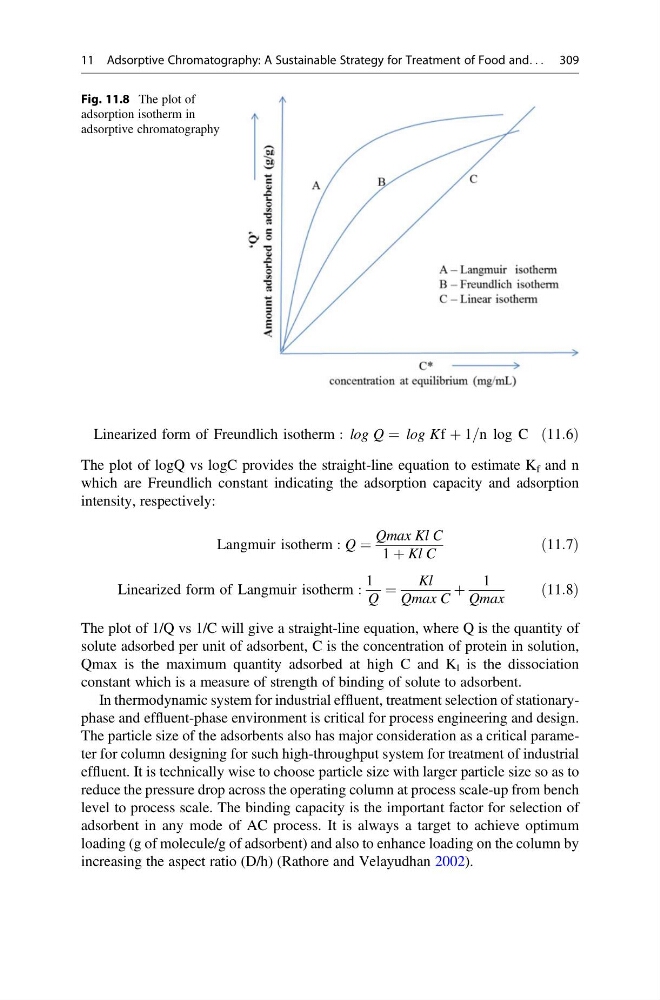
Fig. 11.8 The plot of
adsorption isotherm in
adsorptive chromatography
11 Adsorptive Chromatography: A Sustainable Strategy for Treatment of Food and. . . 309
The plot of logQ vs logC provides the straight-line equation to estimate K f and n
which are Freundlich constant indicating the adsorption capacity and adsorption
intensity, respectively:
Langmuir isotherm : Q ¼
Qmax Kl C
1 þ Kl C
ð11:7Þ
Linearized form of Langmuir isotherm :
1
Q
¼
Kl
Qmax C
þ
1
Qmax
ð11:8Þ
The plot of 1/Q vs 1/C will give a straight-line equation, where Q is the quantity of
solute adsorbed per unit of adsorbent, C is the concentration of protein in solution,
Qmax is the maximum quantity adsorbed at high C and K l is the dissociation
constant which is a measure of strength of binding of solute to adsorbent.
In thermodynamic system for industrial effluent, treatment selection of stationaryphase and effluent-phase environment is critical for process engineering and design.
The particle size of the adsorbents also has major consideration as a critical parameter for column designing for such high-throughput system for treatment of industrial
effluent. It is technically wise to choose particle size with larger particle size so as to
reduce the pressure drop across the operating column at process scale-up from bench
level to process scale. The binding capacity is the important factor for selection of
adsorbent in any mode of AC process. It is always a target to achieve optimum
loading (g of molecule/g of adsorbent) and also to enhance loading on the column by
increasing the aspect ratio (D/h) (Rathore and Velayudhan 2002).
Fig. 11.8 The plot of
adsorption isotherm in
adsorptive chromatography
11 Adsorptive Chromatography: A Sustainable Strategy for Treatment of Food and. . . 309