

11.5 Conclusions and Future Prospects
The conventional methods of effluent management and treatment such as UASB, TF
and HSFCW are predominantly dependent on wetland generation and require
substantial time lapse and high cost for their construction. Thus, long-term maintenance of such methods is a challenge for sustainability. The adsorption phenomenon
in chromatography as strategic approach can be used as an agile and simple and
technically feasible method for effluent treatment. The mechanism of AC provides
high throughput and sustainability. The model of construction for AC process can be
moulded into any stream and outlet with accurate engineering design. The aspect of
adsorbent regeneration in AC for higher number of cycle makes it highly economical
compared to other techniques. The wide application of AC for specific removal of
toxic molecules such as antibiotics, colour and dyes, proteins, peptides, sugar and
organic acids from effluent has resulted into a better technique compared to ALRs,
PBRs and BCRs. The mass transfer coefficient (kLa) in AC can be easily predicted
and understood by isotherm data which provide the engineers an accurate vision for
design and process development at various scale.
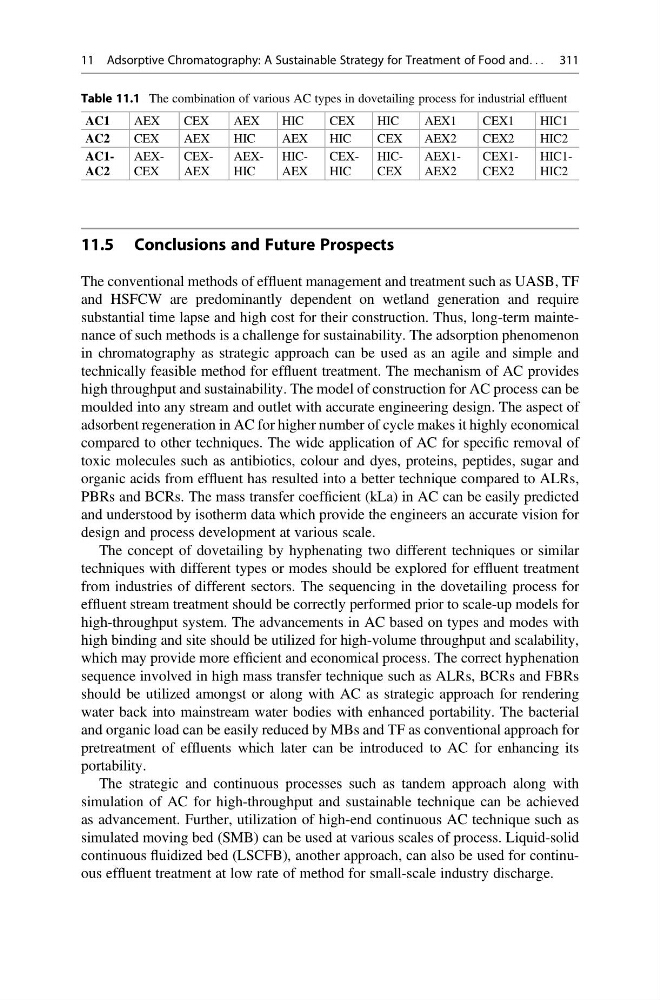
The concept of dovetailing by hyphenating two different techniques or similar
techniques with different types or modes should be explored for effluent treatment
from industries of different sectors. The sequencing in the dovetailing process for
effluent stream treatment should be correctly performed prior to scale-up models for
high-throughput system. The advancements in AC based on types and modes with
high binding and site should be utilized for high-volume throughput and scalability,
which may provide more efficient and economical process. The correct hyphenation
sequence involved in high mass transfer technique such as ALRs, BCRs and FBRs
should be utilized amongst or along with AC as strategic approach for rendering
water back into mainstream water bodies with enhanced portability. The bacterial
and organic load can be easily reduced by MBs and TF as conventional approach for
pretreatment of effluents which later can be introduced to AC for enhancing its
portability.
The strategic and continuous processes such as tandem approach along with
simulation of AC for high-throughput and sustainable technique can be achieved
as advancement. Further, utilization of high-end continuous AC technique such as
simulated moving bed (SMB) can be used at various scales of process. Liquid-solid
continuous fluidized bed (LSCFB), another approach, can also be used for continuous effluent treatment at low rate of method for small-scale industry discharge.
Table 11.1 The combination of various AC types in dovetailing process for industrial effluent
AC1
AEX
CEX
AEX
HIC
CEX
HIC
AEX1
CEX1
HIC1
AC2
CEX
AEX
HIC
AEX
HIC
CEX
AEX2
CEX2
HIC2
AC1AC2
AEXCEX
CEXAEX
AEXHIC
HICAEX
CEXHIC
HICCEX
AEX1AEX2
CEX1CEX2
HIC1HIC2
11 Adsorptive Chromatography: A Sustainable Strategy for Treatment of Food and. . . 311
The conventional methods of effluent management and treatment such as UASB, TF
and HSFCW are predominantly dependent on wetland generation and require
substantial time lapse and high cost for their construction. Thus, long-term maintenance of such methods is a challenge for sustainability. The adsorption phenomenon
in chromatography as strategic approach can be used as an agile and simple and
technically feasible method for effluent treatment. The mechanism of AC provides
high throughput and sustainability. The model of construction for AC process can be
moulded into any stream and outlet with accurate engineering design. The aspect of
adsorbent regeneration in AC for higher number of cycle makes it highly economical
compared to other techniques. The wide application of AC for specific removal of
toxic molecules such as antibiotics, colour and dyes, proteins, peptides, sugar and
organic acids from effluent has resulted into a better technique compared to ALRs,
PBRs and BCRs. The mass transfer coefficient (kLa) in AC can be easily predicted
and understood by isotherm data which provide the engineers an accurate vision for
design and process development at various scale.
The concept of dovetailing by hyphenating two different techniques or similar
techniques with different types or modes should be explored for effluent treatment
from industries of different sectors. The sequencing in the dovetailing process for
effluent stream treatment should be correctly performed prior to scale-up models for
high-throughput system. The advancements in AC based on types and modes with
high binding and site should be utilized for high-volume throughput and scalability,
which may provide more efficient and economical process. The correct hyphenation
sequence involved in high mass transfer technique such as ALRs, BCRs and FBRs
should be utilized amongst or along with AC as strategic approach for rendering
water back into mainstream water bodies with enhanced portability. The bacterial
and organic load can be easily reduced by MBs and TF as conventional approach for
pretreatment of effluents which later can be introduced to AC for enhancing its
portability.
The strategic and continuous processes such as tandem approach along with
simulation of AC for high-throughput and sustainable technique can be achieved
as advancement. Further, utilization of high-end continuous AC technique such as
simulated moving bed (SMB) can be used at various scales of process. Liquid-solid
continuous fluidized bed (LSCFB), another approach, can also be used for continuous effluent treatment at low rate of method for small-scale industry discharge.
Table 11.1 The combination of various AC types in dovetailing process for industrial effluent
AC1
AEX
CEX
AEX
HIC
CEX
HIC
AEX1
CEX1
HIC1
AC2
CEX
AEX
HIC
AEX
HIC
CEX
AEX2
CEX2
HIC2
AC1AC2
AEXCEX
CEXAEX
AEXHIC
HICAEX
CEXHIC
HICCEX
AEX1AEX2
CEX1CEX2
HIC1HIC2
11 Adsorptive Chromatography: A Sustainable Strategy for Treatment of Food and. . . 311