

specifically bound to the adsorbent, and then, the treated water as effluent is
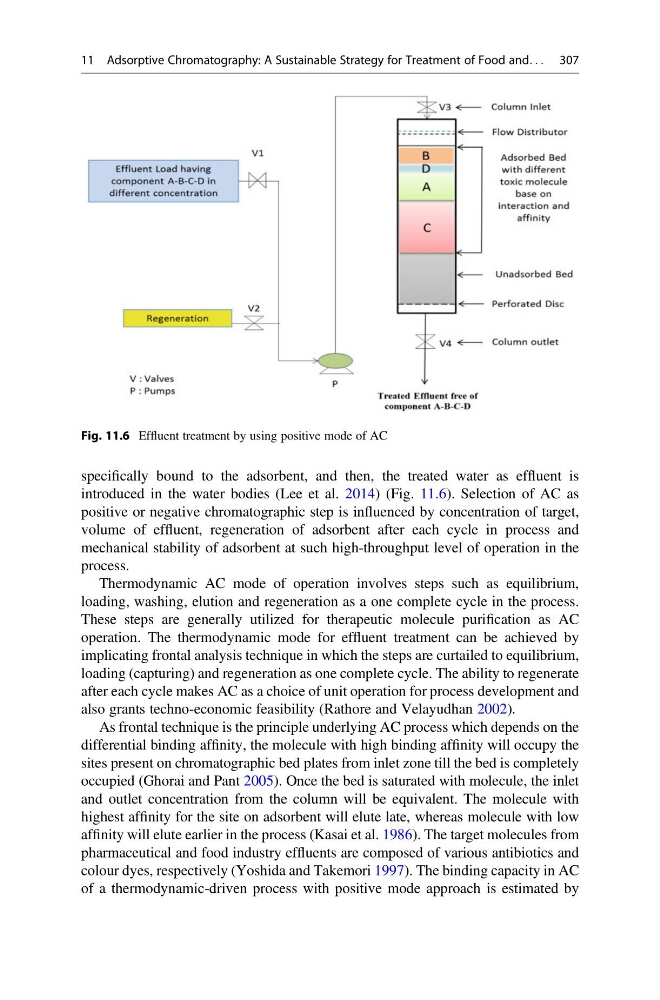
introduced in the water bodies (Lee et al. 2014) (Fig. 11.6). Selection of AC as
positive or negative chromatographic step is influenced by concentration of target,
volume of effluent, regeneration of adsorbent after each cycle in process and
mechanical stability of adsorbent at such high-throughput level of operation in the
process.
Thermodynamic AC mode of operation involves steps such as equilibrium,
loading, washing, elution and regeneration as a one complete cycle in the process.
These steps are generally utilized for therapeutic molecule purification as AC
operation. The thermodynamic mode for effluent treatment can be achieved by
implicating frontal analysis technique in which the steps are curtailed to equilibrium,
loading (capturing) and regeneration as one complete cycle. The ability to regenerate
after each cycle makes AC as a choice of unit operation for process development and
also grants techno-economic feasibility (Rathore and Velayudhan 2002).
As frontal technique is the principle underlying AC process which depends on the
differential binding affinity, the molecule with high binding affinity will occupy the
sites present on chromatographic bed plates from inlet zone till the bed is completely
occupied (Ghorai and Pant 2005). Once the bed is saturated with molecule, the inlet
and outlet concentration from the column will be equivalent. The molecule with
highest affinity for the site on adsorbent will elute late, whereas molecule with low
affinity will elute earlier in the process (Kasai et al. 1986). The target molecules from
pharmaceutical and food industry effluents are composed of various antibiotics and
colour dyes, respectively (Yoshida and Takemori 1997). The binding capacity in AC
of a thermodynamic-driven process with positive mode approach is estimated by
Fig. 11.6 Effluent treatment by using positive mode of AC
11 Adsorptive Chromatography: A Sustainable Strategy for Treatment of Food and. . . 307
introduced in the water bodies (Lee et al. 2014) (Fig. 11.6). Selection of AC as
positive or negative chromatographic step is influenced by concentration of target,
volume of effluent, regeneration of adsorbent after each cycle in process and
mechanical stability of adsorbent at such high-throughput level of operation in the
process.
Thermodynamic AC mode of operation involves steps such as equilibrium,
loading, washing, elution and regeneration as a one complete cycle in the process.
These steps are generally utilized for therapeutic molecule purification as AC
operation. The thermodynamic mode for effluent treatment can be achieved by
implicating frontal analysis technique in which the steps are curtailed to equilibrium,
loading (capturing) and regeneration as one complete cycle. The ability to regenerate
after each cycle makes AC as a choice of unit operation for process development and
also grants techno-economic feasibility (Rathore and Velayudhan 2002).
As frontal technique is the principle underlying AC process which depends on the
differential binding affinity, the molecule with high binding affinity will occupy the
sites present on chromatographic bed plates from inlet zone till the bed is completely
occupied (Ghorai and Pant 2005). Once the bed is saturated with molecule, the inlet
and outlet concentration from the column will be equivalent. The molecule with
highest affinity for the site on adsorbent will elute late, whereas molecule with low
affinity will elute earlier in the process (Kasai et al. 1986). The target molecules from
pharmaceutical and food industry effluents are composed of various antibiotics and
colour dyes, respectively (Yoshida and Takemori 1997). The binding capacity in AC
of a thermodynamic-driven process with positive mode approach is estimated by
Fig. 11.6 Effluent treatment by using positive mode of AC
11 Adsorptive Chromatography: A Sustainable Strategy for Treatment of Food and. . . 307