

11.3 Modes of Adsorptive Chromatography for Treatment
of Effluents and Discharge
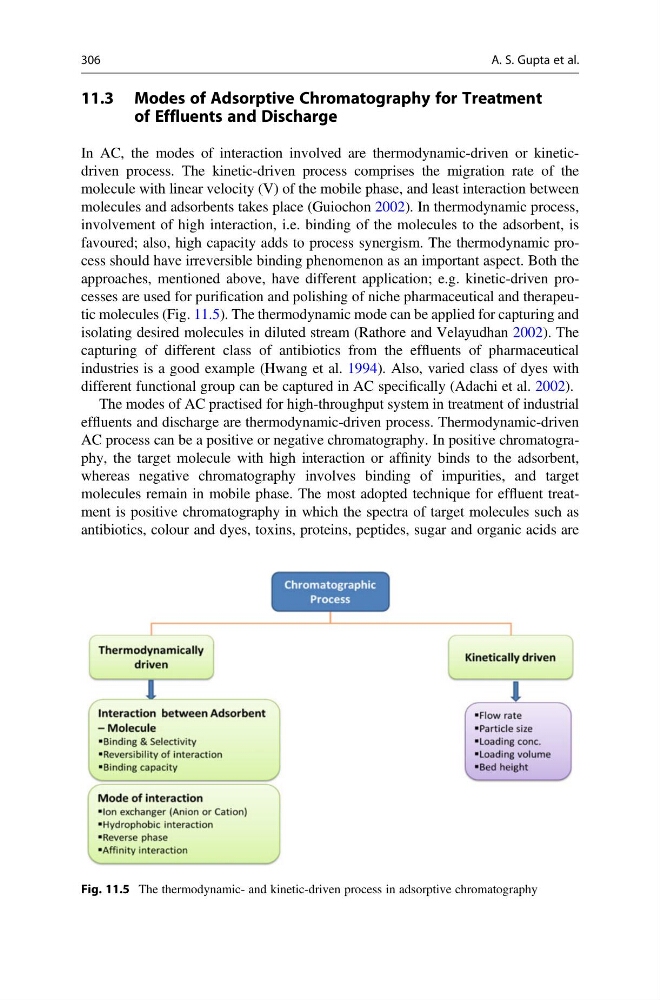
In AC, the modes of interaction involved are thermodynamic-driven or kineticdriven process. The kinetic-driven process comprises the migration rate of the
molecule with linear velocity (V) of the mobile phase, and least interaction between
molecules and adsorbents takes place (Guiochon 2002). In thermodynamic process,
involvement of high interaction, i.e. binding of the molecules to the adsorbent, is
favoured; also, high capacity adds to process synergism. The thermodynamic process should have irreversible binding phenomenon as an important aspect. Both the
approaches, mentioned above, have different application; e.g. kinetic-driven processes are used for purification and polishing of niche pharmaceutical and therapeutic molecules (Fig. 11.5). The thermodynamic mode can be applied for capturing and
isolating desired molecules in diluted stream (Rathore and Velayudhan 2002). The
capturing of different class of antibiotics from the effluents of pharmaceutical
industries is a good example (Hwang et al. 1994). Also, varied class of dyes with
different functional group can be captured in AC specifically (Adachi et al. 2002).
The modes of AC practised for high-throughput system in treatment of industrial
effluents and discharge are thermodynamic-driven process. Thermodynamic-driven
AC process can be a positive or negative chromatography. In positive chromatography, the target molecule with high interaction or affinity binds to the adsorbent,
whereas negative chromatography involves binding of impurities, and target
molecules remain in mobile phase. The most adopted technique for effluent treatment is positive chromatography in which the spectra of target molecules such as
antibiotics, colour and dyes, toxins, proteins, peptides, sugar and organic acids are
Fig. 11.5 The thermodynamic- and kinetic-driven process in adsorptive chromatography
306
A. S. Gupta et al.
of Effluents and Discharge
In AC, the modes of interaction involved are thermodynamic-driven or kineticdriven process. The kinetic-driven process comprises the migration rate of the
molecule with linear velocity (V) of the mobile phase, and least interaction between
molecules and adsorbents takes place (Guiochon 2002). In thermodynamic process,
involvement of high interaction, i.e. binding of the molecules to the adsorbent, is
favoured; also, high capacity adds to process synergism. The thermodynamic process should have irreversible binding phenomenon as an important aspect. Both the
approaches, mentioned above, have different application; e.g. kinetic-driven processes are used for purification and polishing of niche pharmaceutical and therapeutic molecules (Fig. 11.5). The thermodynamic mode can be applied for capturing and
isolating desired molecules in diluted stream (Rathore and Velayudhan 2002). The
capturing of different class of antibiotics from the effluents of pharmaceutical
industries is a good example (Hwang et al. 1994). Also, varied class of dyes with
different functional group can be captured in AC specifically (Adachi et al. 2002).
The modes of AC practised for high-throughput system in treatment of industrial
effluents and discharge are thermodynamic-driven process. Thermodynamic-driven
AC process can be a positive or negative chromatography. In positive chromatography, the target molecule with high interaction or affinity binds to the adsorbent,
whereas negative chromatography involves binding of impurities, and target
molecules remain in mobile phase. The most adopted technique for effluent treatment is positive chromatography in which the spectra of target molecules such as
antibiotics, colour and dyes, toxins, proteins, peptides, sugar and organic acids are
Fig. 11.5 The thermodynamic- and kinetic-driven process in adsorptive chromatography
306
A. S. Gupta et al.