

mass transfer coefficient, g is the gravitational acceleration and lastly ρ p is the
density of the particle (Charpentier 1981; Warren et al. 1976).
The Sherwood number represents the ratio of overall as well as diffusive mass
transfer rates through a boundary layer, and it contains the mass transfer coefficient.
The Schmidt number, which is made up of physical properties of the system, depicts
the ratio of momentum diffusivity and mass diffusivity. Sc is a constant value for
Newtonian fluids at a constant temperature, pressure and composition. The Grashof
number, which is important when the particles are neutrally buoyant, presents the
ratio of gravitational forces to viscous forces. The form of the correlation that is used
to evaluate Sh and thus k s is based on the flow conditions, the configuration of the
mass transfer system and several other factors. As per the above correlations, k s in a
packed bed is based on the liquid velocity around the particles (Warren et al. 1976).
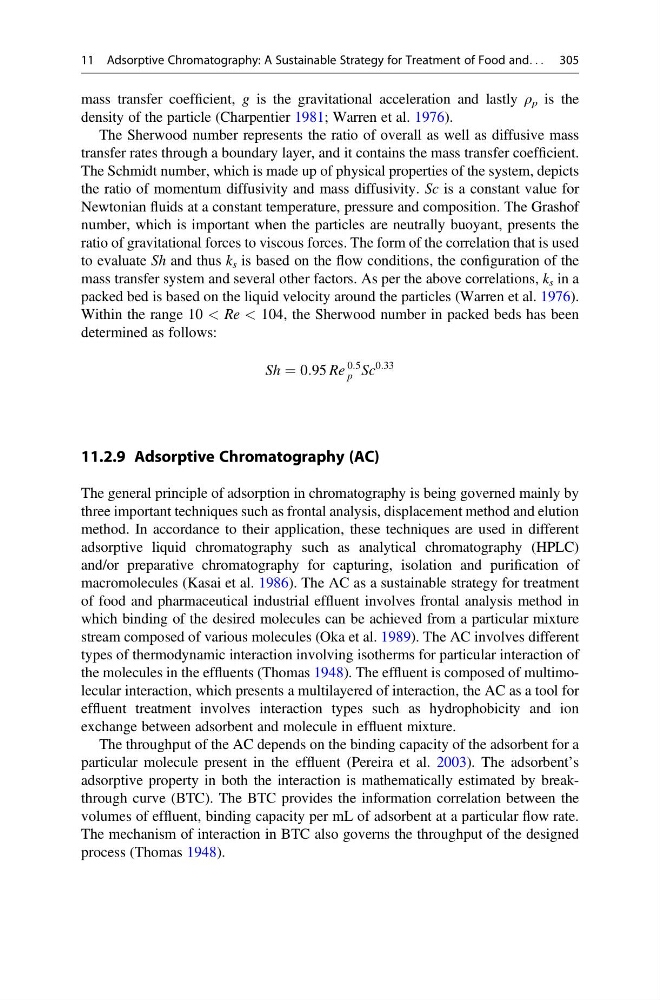
Within the range 10 < Re < 104, the Sherwood number in packed beds has been
determined as follows:
Sh ¼ 0:95 Re
0:5
p Sc
0:33
11.2.9 Adsorptive Chromatography (AC)
The general principle of adsorption in chromatography is being governed mainly by
three important techniques such as frontal analysis, displacement method and elution
method. In accordance to their application, these techniques are used in different
adsorptive liquid chromatography such as analytical chromatography (HPLC)
and/or preparative chromatography for capturing, isolation and purification of
macromolecules (Kasai et al. 1986). The AC as a sustainable strategy for treatment
of food and pharmaceutical industrial effluent involves frontal analysis method in
which binding of the desired molecules can be achieved from a particular mixture
stream composed of various molecules (Oka et al. 1989). The AC involves different
types of thermodynamic interaction involving isotherms for particular interaction of
the molecules in the effluents (Thomas 1948). The effluent is composed of multimolecular interaction, which presents a multilayered of interaction, the AC as a tool for
effluent treatment involves interaction types such as hydrophobicity and ion
exchange between adsorbent and molecule in effluent mixture.
The throughput of the AC depends on the binding capacity of the adsorbent for a
particular molecule present in the effluent (Pereira et al. 2003). The adsorbent’s
adsorptive property in both the interaction is mathematically estimated by breakthrough curve (BTC). The BTC provides the information correlation between the
volumes of effluent, binding capacity per mL of adsorbent at a particular flow rate.
The mechanism of interaction in BTC also governs the throughput of the designed
process (Thomas 1948).
11 Adsorptive Chromatography: A Sustainable Strategy for Treatment of Food and. . . 305
density of the particle (Charpentier 1981; Warren et al. 1976).
The Sherwood number represents the ratio of overall as well as diffusive mass
transfer rates through a boundary layer, and it contains the mass transfer coefficient.
The Schmidt number, which is made up of physical properties of the system, depicts
the ratio of momentum diffusivity and mass diffusivity. Sc is a constant value for
Newtonian fluids at a constant temperature, pressure and composition. The Grashof
number, which is important when the particles are neutrally buoyant, presents the
ratio of gravitational forces to viscous forces. The form of the correlation that is used
to evaluate Sh and thus k s is based on the flow conditions, the configuration of the
mass transfer system and several other factors. As per the above correlations, k s in a
packed bed is based on the liquid velocity around the particles (Warren et al. 1976).
Within the range 10 < Re < 104, the Sherwood number in packed beds has been
determined as follows:
Sh ¼ 0:95 Re
0:5
p Sc
0:33
11.2.9 Adsorptive Chromatography (AC)
The general principle of adsorption in chromatography is being governed mainly by
three important techniques such as frontal analysis, displacement method and elution
method. In accordance to their application, these techniques are used in different
adsorptive liquid chromatography such as analytical chromatography (HPLC)
and/or preparative chromatography for capturing, isolation and purification of
macromolecules (Kasai et al. 1986). The AC as a sustainable strategy for treatment
of food and pharmaceutical industrial effluent involves frontal analysis method in
which binding of the desired molecules can be achieved from a particular mixture
stream composed of various molecules (Oka et al. 1989). The AC involves different
types of thermodynamic interaction involving isotherms for particular interaction of
the molecules in the effluents (Thomas 1948). The effluent is composed of multimolecular interaction, which presents a multilayered of interaction, the AC as a tool for
effluent treatment involves interaction types such as hydrophobicity and ion
exchange between adsorbent and molecule in effluent mixture.
The throughput of the AC depends on the binding capacity of the adsorbent for a
particular molecule present in the effluent (Pereira et al. 2003). The adsorbent’s
adsorptive property in both the interaction is mathematically estimated by breakthrough curve (BTC). The BTC provides the information correlation between the
volumes of effluent, binding capacity per mL of adsorbent at a particular flow rate.
The mechanism of interaction in BTC also governs the throughput of the designed
process (Thomas 1948).
11 Adsorptive Chromatography: A Sustainable Strategy for Treatment of Food and. . . 305