

sand filtration, but unfortunately, these steps can’t filter these MP fiber particles
completely.
Global cooperation is desired to manage and clean synthetic fabric wastes from
the ocean and to remove the primary source of marine microplastic pollution. Recent
investigations offer reason for future hope to assess whether microbial involvement
in microfabric biodegradation has begun to spread in the environment. Strategies
should be developed for enhanced and effective bioremediation of synthetic MFs by
application of microorganisms in natural environment.
9.6
Conclusion
The occurrence of these MF particles in all the spheres of earth is not easy to control,
and the cross infectivity has already affected all the habitats. Methods providing a
minimum infectivity are dangerous for a suitable assessment of their quantity in the
environment. As these tiny fragments after their release into various water sources
interact with planktons and sediments, both suspension and deposit feeders may
accidentally consume these tiny particles. Research on microplastic and microfibers,
specifically, is still in its infancy stage as there are many more unanswered problems.
Solution to these questions is a prerequisite to extend a brighter depiction of their
effect on the oceanic biota and developing an innovative technology.
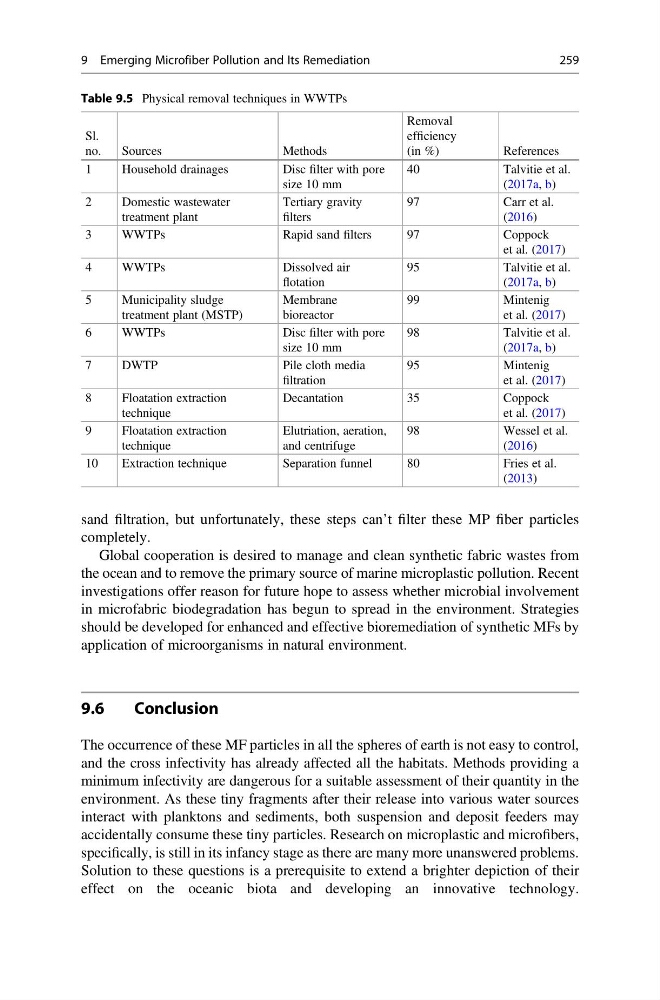
Table 9.5 Physical removal techniques in WWTPs
Sl.
no.
Sources
Methods
Removal
efficiency
(in %)
References
1
Household drainages
Disc filter with pore
size 10 mm
40
Talvitie et al.
(2017a, b)
2
Domestic wastewater
treatment plant
Tertiary gravity
filters
97
Carr et al.
(2016)
3
WWTPs
Rapid sand filters
97
Coppock
et al. (2017)
4
WWTPs
Dissolved air
flotation
95
Talvitie et al.
(2017a, b)
5
Municipality sludge
treatment plant (MSTP)
Membrane
bioreactor
99
Mintenig
et al. (2017)
6
WWTPs
Disc filter with pore
size 10 mm
98
Talvitie et al.
(2017a, b)
7
DWTP
Pile cloth media
filtration
95
Mintenig
et al. (2017)
8
Floatation extraction
technique
Decantation
35
Coppock
et al. (2017)
9
Floatation extraction
technique
Elutriation, aeration,
and centrifuge
98
Wessel et al.
(2016)
10
Extraction technique
Separation funnel
80
Fries et al.
(2013)
9 Emerging Microfiber Pollution and Its Remediation
259
completely.
Global cooperation is desired to manage and clean synthetic fabric wastes from
the ocean and to remove the primary source of marine microplastic pollution. Recent
investigations offer reason for future hope to assess whether microbial involvement
in microfabric biodegradation has begun to spread in the environment. Strategies
should be developed for enhanced and effective bioremediation of synthetic MFs by
application of microorganisms in natural environment.
9.6
Conclusion
The occurrence of these MF particles in all the spheres of earth is not easy to control,
and the cross infectivity has already affected all the habitats. Methods providing a
minimum infectivity are dangerous for a suitable assessment of their quantity in the
environment. As these tiny fragments after their release into various water sources
interact with planktons and sediments, both suspension and deposit feeders may
accidentally consume these tiny particles. Research on microplastic and microfibers,
specifically, is still in its infancy stage as there are many more unanswered problems.
Solution to these questions is a prerequisite to extend a brighter depiction of their
effect on the oceanic biota and developing an innovative technology.
Table 9.5 Physical removal techniques in WWTPs
Sl.
no.
Sources
Methods
Removal
efficiency
(in %)
References
1
Household drainages
Disc filter with pore
size 10 mm
40
Talvitie et al.
(2017a, b)
2
Domestic wastewater
treatment plant
Tertiary gravity
filters
97
Carr et al.
(2016)
3
WWTPs
Rapid sand filters
97
Coppock
et al. (2017)
4
WWTPs
Dissolved air
flotation
95
Talvitie et al.
(2017a, b)
5
Municipality sludge
treatment plant (MSTP)
Membrane
bioreactor
99
Mintenig
et al. (2017)
6
WWTPs
Disc filter with pore
size 10 mm
98
Talvitie et al.
(2017a, b)
7
DWTP
Pile cloth media
filtration
95
Mintenig
et al. (2017)
8
Floatation extraction
technique
Decantation
35
Coppock
et al. (2017)
9
Floatation extraction
technique
Elutriation, aeration,
and centrifuge
98
Wessel et al.
(2016)
10
Extraction technique
Separation funnel
80
Fries et al.
(2013)
9 Emerging Microfiber Pollution and Its Remediation
259