

Woodall et al. 2015). Aquatic contamination due to SMFs and other man-made
sources is a serious topic of concern, and important management equipment for the
abolition of these impurities are of enormous significance (Das and Mishra 2008,
2010; Ghosh et al. 2016; Das et al. 2014). Prohibition of these particles from entering
into freshwater streams by means of present methodology is exclusively high costs
and operating expenditure. Membrane bioreactor, cross-flow filtration, density separation, and centrifugation are the developed methods that can exterminate these
pollutants, but these methods consume a high level of energy. These tiny particles
from large amount of samples can also be confiscated, but these methods cannot be
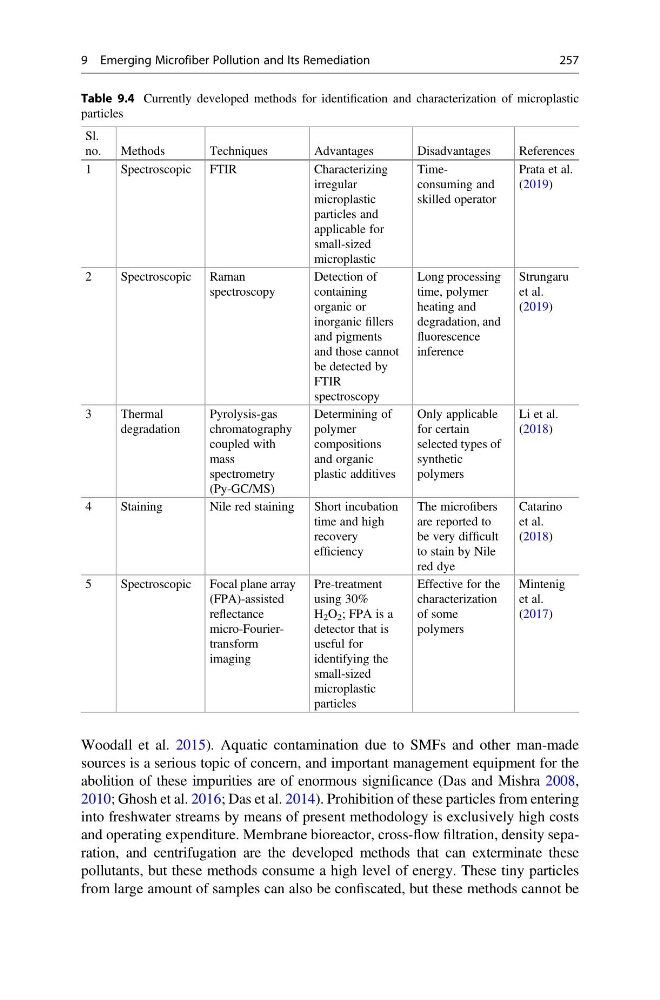
Table 9.4 Currently developed methods for identification and characterization of microplastic
particles
Sl.
no.
Methods
Techniques
Advantages
Disadvantages
References
1
Spectroscopic FTIR
Characterizing
irregular
microplastic
particles and
applicable for
small-sized
microplastic
Timeconsuming and
skilled operator
Prata et al.
(2019)
2
Spectroscopic Raman
spectroscopy
Detection of
containing
organic or
inorganic fillers
and pigments
and those cannot
be detected by
FTIR
spectroscopy
Long processing
time, polymer
heating and
degradation, and
fluorescence
inference
Strungaru
et al.
(2019)
3
Thermal
degradation
Pyrolysis-gas
chromatography
coupled with
mass
spectrometry
(Py-GC/MS)
Determining of
polymer
compositions
and organic
plastic additives
Only applicable
for certain
selected types of
synthetic
polymers
Li et al.
(2018)
4
Staining
Nile red staining
Short incubation
time and high
recovery
efficiency
The microfibers
are reported to
be very difficult
to stain by Nile
red dye
Catarino
et al.
(2018)
5
Spectroscopic Focal plane array
(FPA)-assisted
reflectance
micro-Fouriertransform
imaging
Pre-treatment
using 30%
H 2 O 2 ; FPA is a
detector that is
useful for
identifying the
small-sized
microplastic
particles
Effective for the
characterization
of some
polymers
Mintenig
et al.
(2017)
9 Emerging Microfiber Pollution and Its Remediation
257
sources is a serious topic of concern, and important management equipment for the
abolition of these impurities are of enormous significance (Das and Mishra 2008,
2010; Ghosh et al. 2016; Das et al. 2014). Prohibition of these particles from entering
into freshwater streams by means of present methodology is exclusively high costs
and operating expenditure. Membrane bioreactor, cross-flow filtration, density separation, and centrifugation are the developed methods that can exterminate these
pollutants, but these methods consume a high level of energy. These tiny particles
from large amount of samples can also be confiscated, but these methods cannot be
Table 9.4 Currently developed methods for identification and characterization of microplastic
particles
Sl.
no.
Methods
Techniques
Advantages
Disadvantages
References
1
Spectroscopic FTIR
Characterizing
irregular
microplastic
particles and
applicable for
small-sized
microplastic
Timeconsuming and
skilled operator
Prata et al.
(2019)
2
Spectroscopic Raman
spectroscopy
Detection of
containing
organic or
inorganic fillers
and pigments
and those cannot
be detected by
FTIR
spectroscopy
Long processing
time, polymer
heating and
degradation, and
fluorescence
inference
Strungaru
et al.
(2019)
3
Thermal
degradation
Pyrolysis-gas
chromatography
coupled with
mass
spectrometry
(Py-GC/MS)
Determining of
polymer
compositions
and organic
plastic additives
Only applicable
for certain
selected types of
synthetic
polymers
Li et al.
(2018)
4
Staining
Nile red staining
Short incubation
time and high
recovery
efficiency
The microfibers
are reported to
be very difficult
to stain by Nile
red dye
Catarino
et al.
(2018)
5
Spectroscopic Focal plane array
(FPA)-assisted
reflectance
micro-Fouriertransform
imaging
Pre-treatment
using 30%
H 2 O 2 ; FPA is a
detector that is
useful for
identifying the
small-sized
microplastic
particles
Effective for the
characterization
of some
polymers
Mintenig
et al.
(2017)
9 Emerging Microfiber Pollution and Its Remediation
257