

combined with ascorbic acid (Hou et al. 2016), and discoloration of effluents by
removing dyes (Nidheesh et al. 2013).
8.6.4.2 UV-Based AOPs
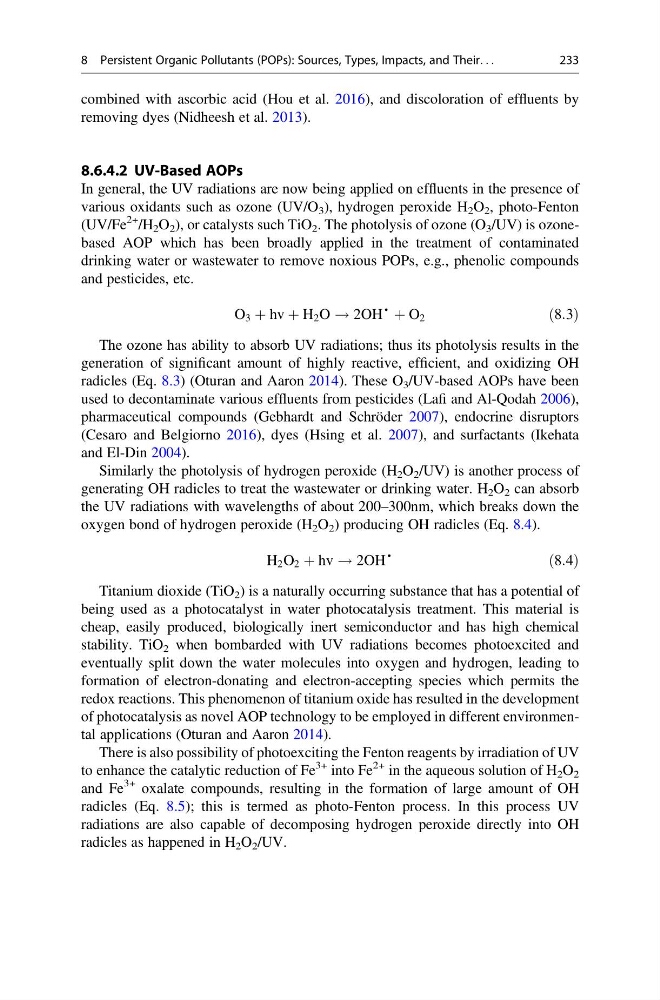
In general, the UV radiations are now being applied on effluents in the presence of
various oxidants such as ozone (UV/O 3 ), hydrogen peroxide H 2 O 2 , photo-Fenton
(UV/Fe
2+ /H 2 O 2 ), or catalysts such TiO 2 . The photolysis of ozone (O 3 /UV) is ozonebased AOP which has been broadly applied in the treatment of contaminated
drinking water or wastewater to remove noxious POPs, e.g., phenolic compounds
and pesticides, etc.
O 3 þ hv þ H 2 O ! 2OH
•
þ O 2
ð8:3Þ
The ozone has ability to absorb UV radiations; thus its photolysis results in the
generation of significant amount of highly reactive, efficient, and oxidizing OH
radicles (Eq. 8.3) (Oturan and Aaron 2014). These O 3 /UV-based AOPs have been
used to decontaminate various effluents from pesticides (Lafi and Al-Qodah 2006),
pharmaceutical compounds (Gebhardt and Schröder 2007), endocrine disruptors
(Cesaro and Belgiorno 2016), dyes (Hsing et al. 2007), and surfactants (Ikehata
and El-Din 2004).
Similarly the photolysis of hydrogen peroxide (H 2 O 2 /UV) is another process of
generating OH radicles to treat the wastewater or drinking water. H 2 O 2 can absorb
the UV radiations with wavelengths of about 200–300nm, which breaks down the
oxygen bond of hydrogen peroxide (H 2 O 2 ) producing OH radicles (Eq. 8.4).
H 2 O 2 þ hv ! 2OH
•
ð8:4Þ
Titanium dioxide (TiO 2 ) is a naturally occurring substance that has a potential of
being used as a photocatalyst in water photocatalysis treatment. This material is
cheap, easily produced, biologically inert semiconductor and has high chemical
stability. TiO 2 when bombarded with UV radiations becomes photoexcited and
eventually split down the water molecules into oxygen and hydrogen, leading to
formation of electron-donating and electron-accepting species which permits the
redox reactions. This phenomenon of titanium oxide has resulted in the development
of photocatalysis as novel AOP technology to be employed in different environmental applications (Oturan and Aaron 2014).
There is also possibility of photoexciting the Fenton reagents by irradiation of UV
to enhance the catalytic reduction of Fe
3+ into Fe
2+ in the aqueous solution of H 2 O 2
and Fe
3+ oxalate compounds, resulting in the formation of large amount of OH
radicles (Eq. 8.5); this is termed as photo-Fenton process. In this process UV
radiations are also capable of decomposing hydrogen peroxide directly into OH
radicles as happened in H 2 O 2 /UV.
8 Persistent Organic Pollutants (POPs): Sources, Types, Impacts, and Their. . .
233
removing dyes (Nidheesh et al. 2013).
8.6.4.2 UV-Based AOPs
In general, the UV radiations are now being applied on effluents in the presence of
various oxidants such as ozone (UV/O 3 ), hydrogen peroxide H 2 O 2 , photo-Fenton
(UV/Fe
2+ /H 2 O 2 ), or catalysts such TiO 2 . The photolysis of ozone (O 3 /UV) is ozonebased AOP which has been broadly applied in the treatment of contaminated
drinking water or wastewater to remove noxious POPs, e.g., phenolic compounds
and pesticides, etc.
O 3 þ hv þ H 2 O ! 2OH
•
þ O 2
ð8:3Þ
The ozone has ability to absorb UV radiations; thus its photolysis results in the
generation of significant amount of highly reactive, efficient, and oxidizing OH
radicles (Eq. 8.3) (Oturan and Aaron 2014). These O 3 /UV-based AOPs have been
used to decontaminate various effluents from pesticides (Lafi and Al-Qodah 2006),
pharmaceutical compounds (Gebhardt and Schröder 2007), endocrine disruptors
(Cesaro and Belgiorno 2016), dyes (Hsing et al. 2007), and surfactants (Ikehata
and El-Din 2004).
Similarly the photolysis of hydrogen peroxide (H 2 O 2 /UV) is another process of
generating OH radicles to treat the wastewater or drinking water. H 2 O 2 can absorb
the UV radiations with wavelengths of about 200–300nm, which breaks down the
oxygen bond of hydrogen peroxide (H 2 O 2 ) producing OH radicles (Eq. 8.4).
H 2 O 2 þ hv ! 2OH
•
ð8:4Þ
Titanium dioxide (TiO 2 ) is a naturally occurring substance that has a potential of
being used as a photocatalyst in water photocatalysis treatment. This material is
cheap, easily produced, biologically inert semiconductor and has high chemical
stability. TiO 2 when bombarded with UV radiations becomes photoexcited and
eventually split down the water molecules into oxygen and hydrogen, leading to
formation of electron-donating and electron-accepting species which permits the
redox reactions. This phenomenon of titanium oxide has resulted in the development
of photocatalysis as novel AOP technology to be employed in different environmental applications (Oturan and Aaron 2014).
There is also possibility of photoexciting the Fenton reagents by irradiation of UV
to enhance the catalytic reduction of Fe
3+ into Fe
2+ in the aqueous solution of H 2 O 2
and Fe
3+ oxalate compounds, resulting in the formation of large amount of OH
radicles (Eq. 8.5); this is termed as photo-Fenton process. In this process UV
radiations are also capable of decomposing hydrogen peroxide directly into OH
radicles as happened in H 2 O 2 /UV.
8 Persistent Organic Pollutants (POPs): Sources, Types, Impacts, and Their. . .
233