

Fe
2þ
þ H 2 O 2 þ UV ! OH
•
þ OH
À
þ Fe
3þ
ð8:5Þ
These photo-Fenton AOPs have been applied for degradation of various
pesticides (organochlorine, phenylurea, and organophosphorous) as well as pharmaceutical compounds such as diclofenac (Ribeiro et al. 2015). This combined process
is found to be more efficient in terms of generating OH radicles, thus increasing the
degradation of organic materials in the effluents in comparison of using only
photolysis or Fenton process (Valcárcel et al. 2012). In addition, the decrease in
the requirements of catalysts can compensate the overall cost of UV installation and
reduce the sludge volume making this process more effective treatment method
(Umar et al. 2010).
8.6.4.3 Sonochemical AOPs
The sonochemical AOPs are another emerging types of advanced treatment process
use of ultrasounds for the degradation of organic pollutants. In these processes
reactive oxidizing species (ROS) can be produced either directly through physical
procedure or indirectly through a chemical mechanism. In physical mechanism the
oxidizing radicles are generated as a result of direct sonolysis or sonication of water
molecules (Eq. 8.6).
2H 2 O þ US ! 2OH
•
þ 2H
ð8:6Þ
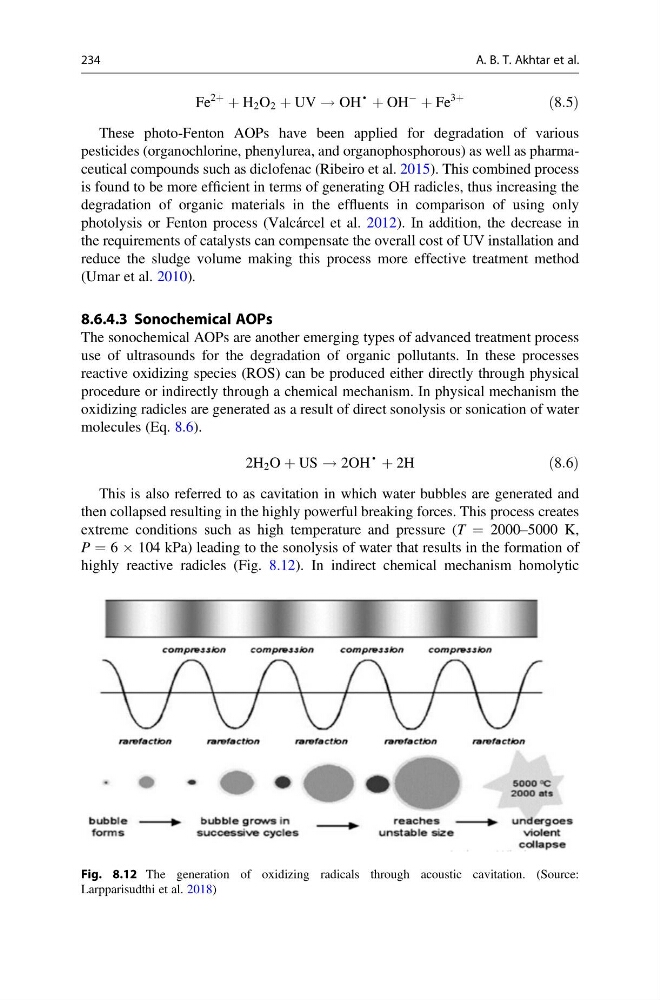
This is also referred to as cavitation in which water bubbles are generated and
then collapsed resulting in the highly powerful breaking forces. This process creates
extreme conditions such as high temperature and pressure (T ¼ 2000–5000 K,
P ¼ 6 Â 104 kPa) leading to the sonolysis of water that results in the formation of
highly reactive radicles (Fig. 8.12). In indirect chemical mechanism homolytic
Fig. 8.12 The generation of oxidizing radicals through acoustic cavitation. (Source:
Larpparisudthi et al. 2018)
234
A. B. T. Akhtar et al.
2þ
þ H 2 O 2 þ UV ! OH
•
þ OH
À
þ Fe
3þ
ð8:5Þ
These photo-Fenton AOPs have been applied for degradation of various
pesticides (organochlorine, phenylurea, and organophosphorous) as well as pharmaceutical compounds such as diclofenac (Ribeiro et al. 2015). This combined process
is found to be more efficient in terms of generating OH radicles, thus increasing the
degradation of organic materials in the effluents in comparison of using only
photolysis or Fenton process (Valcárcel et al. 2012). In addition, the decrease in
the requirements of catalysts can compensate the overall cost of UV installation and
reduce the sludge volume making this process more effective treatment method
(Umar et al. 2010).
8.6.4.3 Sonochemical AOPs
The sonochemical AOPs are another emerging types of advanced treatment process
use of ultrasounds for the degradation of organic pollutants. In these processes
reactive oxidizing species (ROS) can be produced either directly through physical
procedure or indirectly through a chemical mechanism. In physical mechanism the
oxidizing radicles are generated as a result of direct sonolysis or sonication of water
molecules (Eq. 8.6).
2H 2 O þ US ! 2OH
•
þ 2H
ð8:6Þ
This is also referred to as cavitation in which water bubbles are generated and
then collapsed resulting in the highly powerful breaking forces. This process creates
extreme conditions such as high temperature and pressure (T ¼ 2000–5000 K,
P ¼ 6 Â 104 kPa) leading to the sonolysis of water that results in the formation of
highly reactive radicles (Fig. 8.12). In indirect chemical mechanism homolytic
Fig. 8.12 The generation of oxidizing radicals through acoustic cavitation. (Source:
Larpparisudthi et al. 2018)
234
A. B. T. Akhtar et al.