

processes. These advantages make AOPs better in comparison of other competing
treatment methods such as membrane technology or chlorination of organic
materials which result in the generation of secondary waste or organochlorinated
compounds in effluents (Pablos et al. 2013; Deng and Zhao 2015). Some of the
important AOPs categorized on the basis of methodology used for the production of
oxidizing agents such as O
•
,
•
OH, and
•
HO 2 are briefly discussed here.
8.6.4.1 Chemical-Based AOPs
Ozone is considered as the most strong oxidizing agent (Oxidation potential ¼ 2.07 V)
and it reacts with the dissociated or ionized organics. Ozone generates the OH
radicles in the effluents under certain circumstances, which then effectively degrade
the organic compounds in the effluents by readily reacting with them (Gottschalk
et al. 2009). Ozonation can be applied single or in combination with other methods
such as peroxonation O 3 /H 2 O 2 . In peroxonation the ozone gas is coupled with H 2 O 2
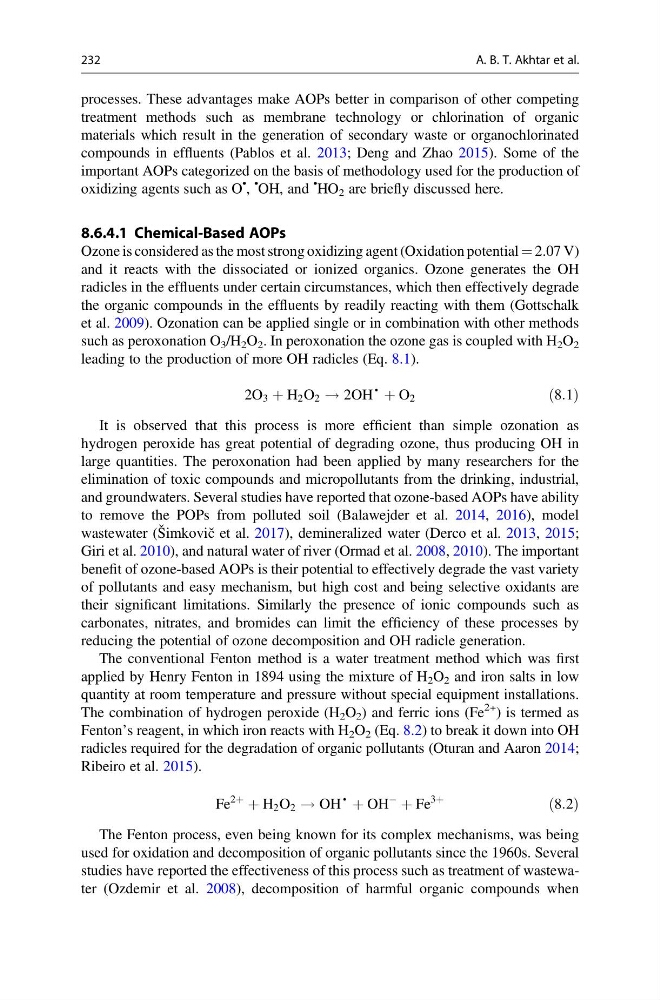
leading to the production of more OH radicles (Eq. 8.1).
2O 3 þ H 2 O 2 ! 2OH
•
þ O 2
ð8:1Þ
It is observed that this process is more efficient than simple ozonation as
hydrogen peroxide has great potential of degrading ozone, thus producing OH in
large quantities. The peroxonation had been applied by many researchers for the
elimination of toxic compounds and micropollutants from the drinking, industrial,
and groundwaters. Several studies have reported that ozone-based AOPs have ability
to remove the POPs from polluted soil (Balawejder et al. 2014, 2016), model
wastewater (Šimkovič et al. 2017), demineralized water (Derco et al. 2013, 2015;
Giri et al. 2010), and natural water of river (Ormad et al. 2008, 2010). The important
benefit of ozone-based AOPs is their potential to effectively degrade the vast variety
of pollutants and easy mechanism, but high cost and being selective oxidants are
their significant limitations. Similarly the presence of ionic compounds such as
carbonates, nitrates, and bromides can limit the efficiency of these processes by
reducing the potential of ozone decomposition and OH radicle generation.
The conventional Fenton method is a water treatment method which was first
applied by Henry Fenton in 1894 using the mixture of H 2 O 2 and iron salts in low
quantity at room temperature and pressure without special equipment installations.
The combination of hydrogen peroxide (H 2 O 2 ) and ferric ions (Fe
2+ ) is termed as
Fenton’s reagent, in which iron reacts with H 2 O 2 (Eq. 8.2) to break it down into OH
radicles required for the degradation of organic pollutants (Oturan and Aaron 2014;
Ribeiro et al. 2015).
Fe
2þ
þ H 2 O 2 ! OH
•
þ OH
À
þ Fe
3þ
ð8:2Þ
The Fenton process, even being known for its complex mechanisms, was being
used for oxidation and decomposition of organic pollutants since the 1960s. Several
studies have reported the effectiveness of this process such as treatment of wastewater (Ozdemir et al. 2008), decomposition of harmful organic compounds when
232
A. B. T. Akhtar et al.
treatment methods such as membrane technology or chlorination of organic
materials which result in the generation of secondary waste or organochlorinated
compounds in effluents (Pablos et al. 2013; Deng and Zhao 2015). Some of the
important AOPs categorized on the basis of methodology used for the production of
oxidizing agents such as O
•
,
•
OH, and
•
HO 2 are briefly discussed here.
8.6.4.1 Chemical-Based AOPs
Ozone is considered as the most strong oxidizing agent (Oxidation potential ¼ 2.07 V)
and it reacts with the dissociated or ionized organics. Ozone generates the OH
radicles in the effluents under certain circumstances, which then effectively degrade
the organic compounds in the effluents by readily reacting with them (Gottschalk
et al. 2009). Ozonation can be applied single or in combination with other methods
such as peroxonation O 3 /H 2 O 2 . In peroxonation the ozone gas is coupled with H 2 O 2
leading to the production of more OH radicles (Eq. 8.1).
2O 3 þ H 2 O 2 ! 2OH
•
þ O 2
ð8:1Þ
It is observed that this process is more efficient than simple ozonation as
hydrogen peroxide has great potential of degrading ozone, thus producing OH in
large quantities. The peroxonation had been applied by many researchers for the
elimination of toxic compounds and micropollutants from the drinking, industrial,
and groundwaters. Several studies have reported that ozone-based AOPs have ability
to remove the POPs from polluted soil (Balawejder et al. 2014, 2016), model
wastewater (Šimkovič et al. 2017), demineralized water (Derco et al. 2013, 2015;
Giri et al. 2010), and natural water of river (Ormad et al. 2008, 2010). The important
benefit of ozone-based AOPs is their potential to effectively degrade the vast variety
of pollutants and easy mechanism, but high cost and being selective oxidants are
their significant limitations. Similarly the presence of ionic compounds such as
carbonates, nitrates, and bromides can limit the efficiency of these processes by
reducing the potential of ozone decomposition and OH radicle generation.
The conventional Fenton method is a water treatment method which was first
applied by Henry Fenton in 1894 using the mixture of H 2 O 2 and iron salts in low
quantity at room temperature and pressure without special equipment installations.
The combination of hydrogen peroxide (H 2 O 2 ) and ferric ions (Fe
2+ ) is termed as
Fenton’s reagent, in which iron reacts with H 2 O 2 (Eq. 8.2) to break it down into OH
radicles required for the degradation of organic pollutants (Oturan and Aaron 2014;
Ribeiro et al. 2015).
Fe
2þ
þ H 2 O 2 ! OH
•
þ OH
À
þ Fe
3þ
ð8:2Þ
The Fenton process, even being known for its complex mechanisms, was being
used for oxidation and decomposition of organic pollutants since the 1960s. Several
studies have reported the effectiveness of this process such as treatment of wastewater (Ozdemir et al. 2008), decomposition of harmful organic compounds when
232
A. B. T. Akhtar et al.