

method has been developed recently around 1980s (Greenlee et al. 2009). The NF
has ability to remove the ions from the feed solution that aid to enhance the osmotic
pressure. These membranes have high potential of rejecting the organic materials
and can reject the particles with 350–1000 Da molecular masses with the application
of 4–20 MPa pressure (Koros et al. 1996; de Morais Coutinho et al. 2009).
It is being used for treatment of surface and groundwater (Teixeira and Rosa
2005), softening water by removing polyvalent cations (Causserand et al. 2005),
removing the by-products of disinfection (Uyak et al. 2008) and inorganic
compounds (Leo et al. 2011), and for removal of natural and synthetic organic
matters (Choi et al. 2008a, b) such as pharmaceuticals (Nghiem et al. 2005),
pesticides (Zhang et al. 2004; Plattner et al. 2018), and herbicides (Plakas et al.
2006; Benitez et al. 2009). To increase the treatment efficiency, it is suggested to
apply pretreatment to reduce membrane fouling and increase pollutant removal.
8.6.4 Advanced Oxidation Processes (AOPs)
Advanced oxidation processes (AOPs) are the processes used for the treatment of
water and wastewater which involve the generation of reactive hydroxyl
(OH) radicals at room temperature and pressure in concentrations sufficient for
decontaminating water (Oturan and Aaron 2014). These processes are based on
aqueous oxidation systems in which OH radicals react and oxidize the organic
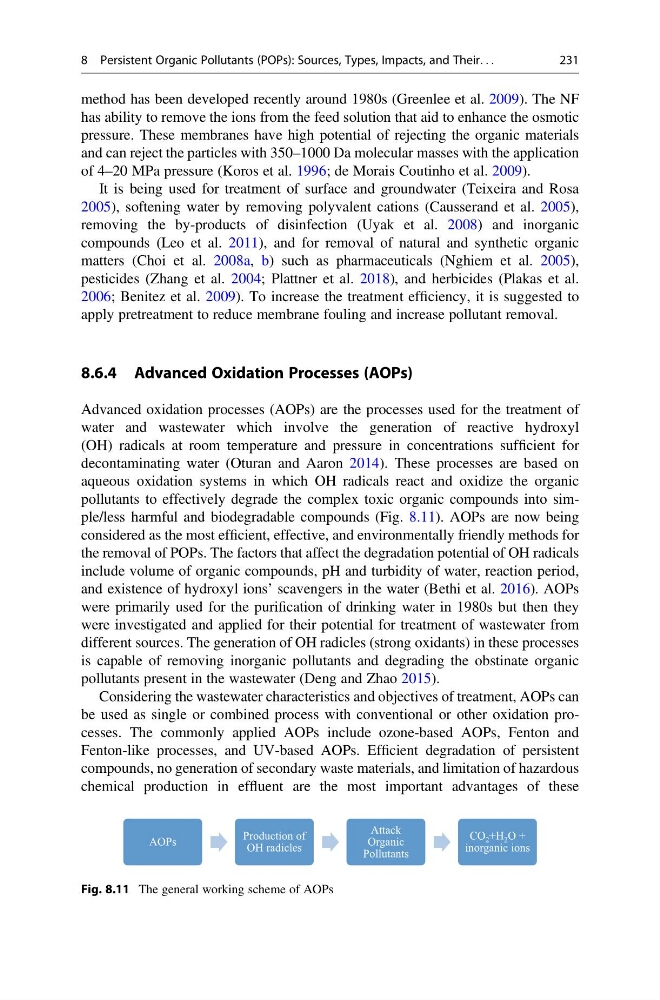
pollutants to effectively degrade the complex toxic organic compounds into simple/less harmful and biodegradable compounds (Fig. 8.11). AOPs are now being
considered as the most efficient, effective, and environmentally friendly methods for
the removal of POPs. The factors that affect the degradation potential of OH radicals
include volume of organic compounds, pH and turbidity of water, reaction period,
and existence of hydroxyl ions’ scavengers in the water (Bethi et al. 2016). AOPs
were primarily used for the purification of drinking water in 1980s but then they
were investigated and applied for their potential for treatment of wastewater from
different sources. The generation of OH radicles (strong oxidants) in these processes
is capable of removing inorganic pollutants and degrading the obstinate organic
pollutants present in the wastewater (Deng and Zhao 2015).
Considering the wastewater characteristics and objectives of treatment, AOPs can
be used as single or combined process with conventional or other oxidation processes. The commonly applied AOPs include ozone-based AOPs, Fenton and
Fenton-like processes, and UV-based AOPs. Efficient degradation of persistent
compounds, no generation of secondary waste materials, and limitation of hazardous
chemical production in effluent are the most important advantages of these
AOPs
Production of
OH radicles
Attack
Organic
Pollutants
CO 2 +H 2 O +
inorganic ions
Fig. 8.11 The general working scheme of AOPs
8 Persistent Organic Pollutants (POPs): Sources, Types, Impacts, and Their. . .
231
has ability to remove the ions from the feed solution that aid to enhance the osmotic
pressure. These membranes have high potential of rejecting the organic materials
and can reject the particles with 350–1000 Da molecular masses with the application
of 4–20 MPa pressure (Koros et al. 1996; de Morais Coutinho et al. 2009).
It is being used for treatment of surface and groundwater (Teixeira and Rosa
2005), softening water by removing polyvalent cations (Causserand et al. 2005),
removing the by-products of disinfection (Uyak et al. 2008) and inorganic
compounds (Leo et al. 2011), and for removal of natural and synthetic organic
matters (Choi et al. 2008a, b) such as pharmaceuticals (Nghiem et al. 2005),
pesticides (Zhang et al. 2004; Plattner et al. 2018), and herbicides (Plakas et al.
2006; Benitez et al. 2009). To increase the treatment efficiency, it is suggested to
apply pretreatment to reduce membrane fouling and increase pollutant removal.
8.6.4 Advanced Oxidation Processes (AOPs)
Advanced oxidation processes (AOPs) are the processes used for the treatment of
water and wastewater which involve the generation of reactive hydroxyl
(OH) radicals at room temperature and pressure in concentrations sufficient for
decontaminating water (Oturan and Aaron 2014). These processes are based on
aqueous oxidation systems in which OH radicals react and oxidize the organic
pollutants to effectively degrade the complex toxic organic compounds into simple/less harmful and biodegradable compounds (Fig. 8.11). AOPs are now being
considered as the most efficient, effective, and environmentally friendly methods for
the removal of POPs. The factors that affect the degradation potential of OH radicals
include volume of organic compounds, pH and turbidity of water, reaction period,
and existence of hydroxyl ions’ scavengers in the water (Bethi et al. 2016). AOPs
were primarily used for the purification of drinking water in 1980s but then they
were investigated and applied for their potential for treatment of wastewater from
different sources. The generation of OH radicles (strong oxidants) in these processes
is capable of removing inorganic pollutants and degrading the obstinate organic
pollutants present in the wastewater (Deng and Zhao 2015).
Considering the wastewater characteristics and objectives of treatment, AOPs can
be used as single or combined process with conventional or other oxidation processes. The commonly applied AOPs include ozone-based AOPs, Fenton and
Fenton-like processes, and UV-based AOPs. Efficient degradation of persistent
compounds, no generation of secondary waste materials, and limitation of hazardous
chemical production in effluent are the most important advantages of these
AOPs
Production of
OH radicles
Attack
Organic
Pollutants
CO 2 +H 2 O +
inorganic ions
Fig. 8.11 The general working scheme of AOPs
8 Persistent Organic Pollutants (POPs): Sources, Types, Impacts, and Their. . .
231