

of about 0.1–0.2 μm in size which are mainly microparticles or nanoparticles
(Werber et al. 2016). It is often regarded as the pretreatment process of nanofiltration
and reverse osmosis processes. Along with the application of pretreatment and
disinfection processes, this process can remove the organic contaminants and viruses
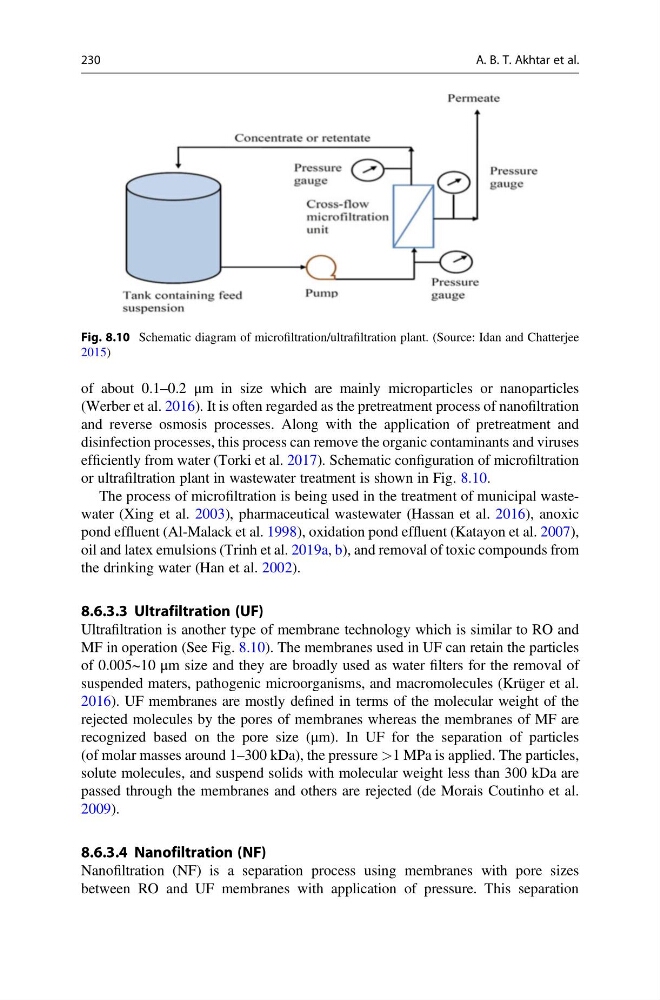
efficiently from water (Torki et al. 2017). Schematic configuration of microfiltration
or ultrafiltration plant in wastewater treatment is shown in Fig. 8.10.
The process of microfiltration is being used in the treatment of municipal wastewater (Xing et al. 2003), pharmaceutical wastewater (Hassan et al. 2016), anoxic
pond effluent (Al-Malack et al. 1998), oxidation pond effluent (Katayon et al. 2007),
oil and latex emulsions (Trinh et al. 2019a, b), and removal of toxic compounds from
the drinking water (Han et al. 2002).
8.6.3.3 Ultrafiltration (UF)
Ultrafiltration is another type of membrane technology which is similar to RO and
MF in operation (See Fig. 8.10). The membranes used in UF can retain the particles
of 0.005~10 μm size and they are broadly used as water filters for the removal of
suspended maters, pathogenic microorganisms, and macromolecules (Krüger et al.
2016). UF membranes are mostly defined in terms of the molecular weight of the
rejected molecules by the pores of membranes whereas the membranes of MF are
recognized based on the pore size (μm). In UF for the separation of particles
(of molar masses around 1–300 kDa), the pressure >1 MPa is applied. The particles,
solute molecules, and suspend solids with molecular weight less than 300 kDa are
passed through the membranes and others are rejected (de Morais Coutinho et al.
2009).
8.6.3.4 Nanofiltration (NF)
Nanofiltration (NF) is a separation process using membranes with pore sizes
between RO and UF membranes with application of pressure. This separation
Fig. 8.10 Schematic diagram of microfiltration/ultrafiltration plant. (Source: Idan and Chatterjee
2015)
230
A. B. T. Akhtar et al.
(Werber et al. 2016). It is often regarded as the pretreatment process of nanofiltration
and reverse osmosis processes. Along with the application of pretreatment and
disinfection processes, this process can remove the organic contaminants and viruses
efficiently from water (Torki et al. 2017). Schematic configuration of microfiltration
or ultrafiltration plant in wastewater treatment is shown in Fig. 8.10.
The process of microfiltration is being used in the treatment of municipal wastewater (Xing et al. 2003), pharmaceutical wastewater (Hassan et al. 2016), anoxic
pond effluent (Al-Malack et al. 1998), oxidation pond effluent (Katayon et al. 2007),
oil and latex emulsions (Trinh et al. 2019a, b), and removal of toxic compounds from
the drinking water (Han et al. 2002).
8.6.3.3 Ultrafiltration (UF)
Ultrafiltration is another type of membrane technology which is similar to RO and
MF in operation (See Fig. 8.10). The membranes used in UF can retain the particles
of 0.005~10 μm size and they are broadly used as water filters for the removal of
suspended maters, pathogenic microorganisms, and macromolecules (Krüger et al.
2016). UF membranes are mostly defined in terms of the molecular weight of the
rejected molecules by the pores of membranes whereas the membranes of MF are
recognized based on the pore size (μm). In UF for the separation of particles
(of molar masses around 1–300 kDa), the pressure >1 MPa is applied. The particles,
solute molecules, and suspend solids with molecular weight less than 300 kDa are
passed through the membranes and others are rejected (de Morais Coutinho et al.
2009).
8.6.3.4 Nanofiltration (NF)
Nanofiltration (NF) is a separation process using membranes with pore sizes
between RO and UF membranes with application of pressure. This separation
Fig. 8.10 Schematic diagram of microfiltration/ultrafiltration plant. (Source: Idan and Chatterjee
2015)
230
A. B. T. Akhtar et al.