

maintained and operated. However, membrane technology also has some limitations
such as membrane fouling, high operational and maintenance cost, expansive membrane materials, and their quick exhaustion (Gao 2016). The mechanisms of these
membrane processes are discussed here.
8.6.3.1 Reverse Osmosis
Reverse osmosis (RO) is one of the important and commonly used methods of
membrane technology. The first RO process was applied in 1960s for desalination of
water (Li et al. 2008). This is a pressure-driven method to remove smaller particles,
dissolved solids, and organic pollutants from water by using such selective
membranes that only allow molecules of water or solvents to pass and reject all
other particles such as larger molecules or ions. Such types of membranes are called
as semipermeable membranes (Warsinger et al. 2016).
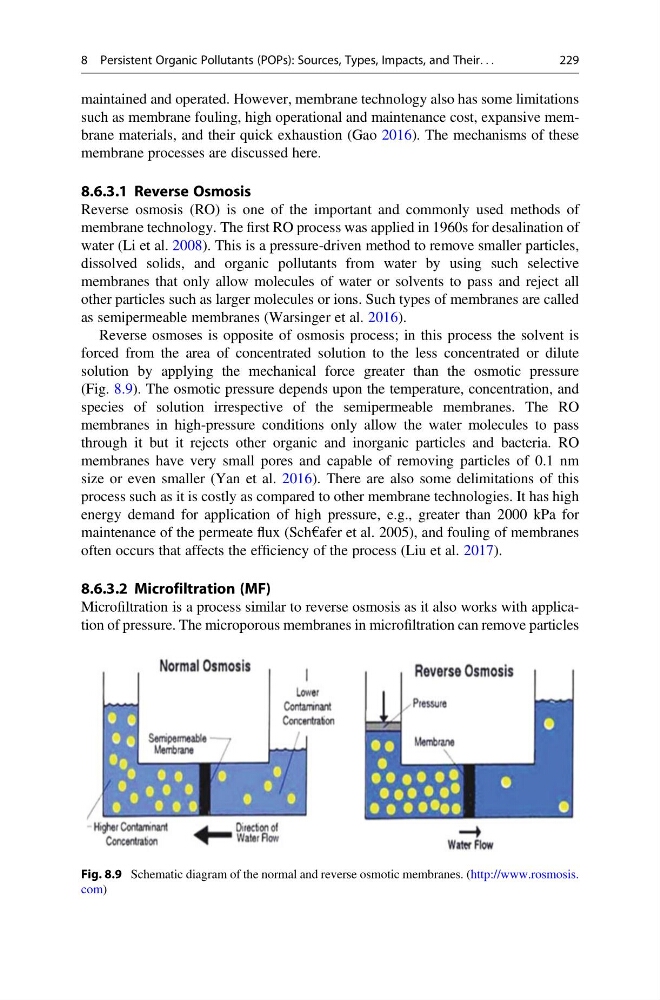
Reverse osmoses is opposite of osmosis process; in this process the solvent is
forced from the area of concentrated solution to the less concentrated or dilute
solution by applying the mechanical force greater than the osmotic pressure
(Fig. 8.9). The osmotic pressure depends upon the temperature, concentration, and
species of solution irrespective of the semipermeable membranes. The RO
membranes in high-pressure conditions only allow the water molecules to pass
through it but it rejects other organic and inorganic particles and bacteria. RO
membranes have very small pores and capable of removing particles of 0.1 nm
size or even smaller (Yan et al. 2016). There are also some delimitations of this
process such as it is costly as compared to other membrane technologies. It has high
energy demand for application of high pressure, e.g., greater than 2000 kPa for
maintenance of the permeate flux (Sch€afer et al. 2005), and fouling of membranes
often occurs that affects the efficiency of the process (Liu et al. 2017).
8.6.3.2 Microfiltration (MF)
Microfiltration is a process similar to reverse osmosis as it also works with application of pressure. The microporous membranes in microfiltration can remove particles
Fig. 8.9 Schematic diagram of the normal and reverse osmotic membranes. (http://www.rosmosis.
com)
8 Persistent Organic Pollutants (POPs): Sources, Types, Impacts, and Their. . .
229
such as membrane fouling, high operational and maintenance cost, expansive membrane materials, and their quick exhaustion (Gao 2016). The mechanisms of these
membrane processes are discussed here.
8.6.3.1 Reverse Osmosis
Reverse osmosis (RO) is one of the important and commonly used methods of
membrane technology. The first RO process was applied in 1960s for desalination of
water (Li et al. 2008). This is a pressure-driven method to remove smaller particles,
dissolved solids, and organic pollutants from water by using such selective
membranes that only allow molecules of water or solvents to pass and reject all
other particles such as larger molecules or ions. Such types of membranes are called
as semipermeable membranes (Warsinger et al. 2016).
Reverse osmoses is opposite of osmosis process; in this process the solvent is
forced from the area of concentrated solution to the less concentrated or dilute
solution by applying the mechanical force greater than the osmotic pressure
(Fig. 8.9). The osmotic pressure depends upon the temperature, concentration, and
species of solution irrespective of the semipermeable membranes. The RO
membranes in high-pressure conditions only allow the water molecules to pass
through it but it rejects other organic and inorganic particles and bacteria. RO
membranes have very small pores and capable of removing particles of 0.1 nm
size or even smaller (Yan et al. 2016). There are also some delimitations of this
process such as it is costly as compared to other membrane technologies. It has high
energy demand for application of high pressure, e.g., greater than 2000 kPa for
maintenance of the permeate flux (Sch€afer et al. 2005), and fouling of membranes
often occurs that affects the efficiency of the process (Liu et al. 2017).
8.6.3.2 Microfiltration (MF)
Microfiltration is a process similar to reverse osmosis as it also works with application of pressure. The microporous membranes in microfiltration can remove particles
Fig. 8.9 Schematic diagram of the normal and reverse osmotic membranes. (http://www.rosmosis.
com)
8 Persistent Organic Pollutants (POPs): Sources, Types, Impacts, and Their. . .
229