

pressure or concentration act as the driving forces in membranes for the transport of
materials (Mulder 1996). These processes are based on the physical separation and
efficiently work without addition of any chemicals in the injecting feeds or changing
the phases, hence known as the best alternatives of conventional methods such as
flocculation, coagulation precipitation, distillation, or biological treatment (Li et al.
2008). From some previous years membranes have considerably improved with
enhanced performance and they are rapidly growing worldwide.
There are basically four types of membrane processes used for separation of
liquid phases which include reverse osmosis (RO), ultrafiltration (UF), nanofiltration
(NF), and microfiltration (MF). These processes are based on the hydraulic pressure
application which act as driving forces for transportation of mass. The permeability
and retention of elements greatly depend upon the nature of membranes as the
separation of these components depends upon their interaction with membranes,
particle size, molar masses, and chemical affinity. Membrane technology can be
used for different types of wastewater and has high processing and separation
efficiency. There is no need of additives, thus limiting the generation of additional
waste products. The membrane devices occupy less surface area and can be easily
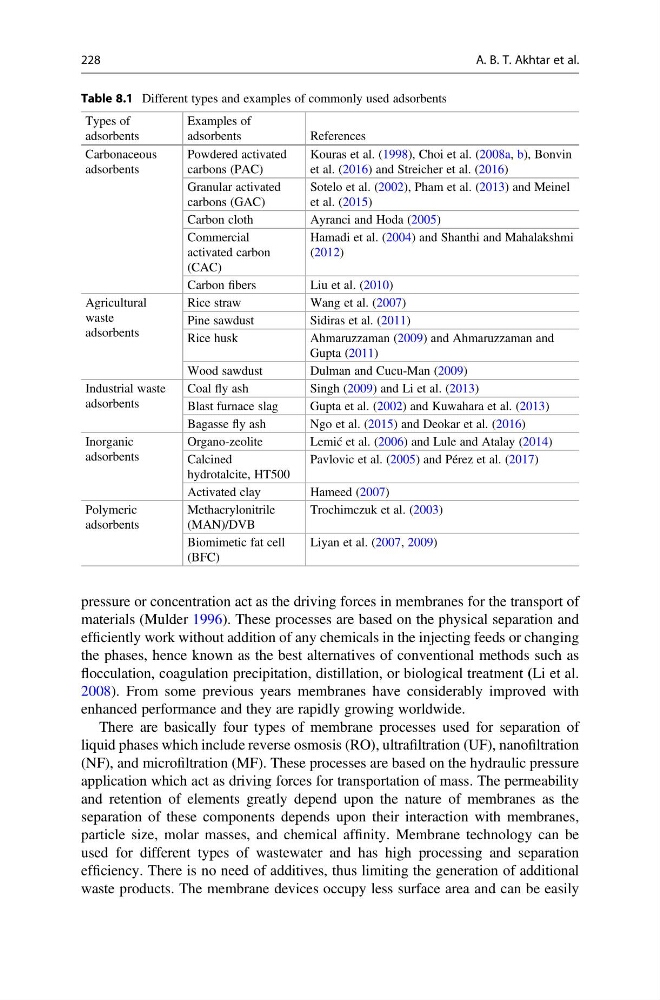
Table 8.1 Different types and examples of commonly used adsorbents
Types of
adsorbents
Examples of
adsorbents
References
Carbonaceous
adsorbents
Powdered activated
carbons (PAC)
Kouras et al. (1998), Choi et al. (2008a, b), Bonvin
et al. (2016) and Streicher et al. (2016)
Granular activated
carbons (GAC)
Sotelo et al. (2002), Pham et al. (2013) and Meinel
et al. (2015)
Carbon cloth
Ayranci and Hoda (2005)
Commercial
activated carbon
(CAC)
Hamadi et al. (2004) and Shanthi and Mahalakshmi
(2012)
Carbon fibers
Liu et al. (2010)
Agricultural
waste
adsorbents
Rice straw
Wang et al. (2007)
Pine sawdust
Sidiras et al. (2011)
Rice husk
Ahmaruzzaman (2009) and Ahmaruzzaman and
Gupta (2011)
Wood sawdust
Dulman and Cucu-Man (2009)
Industrial waste
adsorbents
Coal fly ash
Singh (2009) and Li et al. (2013)
Blast furnace slag
Gupta et al. (2002) and Kuwahara et al. (2013)
Bagasse fly ash
Ngo et al. (2015) and Deokar et al. (2016)
Inorganic
adsorbents
Organo-zeolite
Lemić et al. (2006) and Lule and Atalay (2014)
Calcined
hydrotalcite, HT500
Pavlovic et al. (2005) and Pérez et al. (2017)
Activated clay
Hameed (2007)
Polymeric
adsorbents
Methacrylonitrile
(MAN)/DVB
Trochimczuk et al. (2003)
Biomimetic fat cell
(BFC)
Liyan et al. (2007, 2009)
228
A. B. T. Akhtar et al.
materials (Mulder 1996). These processes are based on the physical separation and
efficiently work without addition of any chemicals in the injecting feeds or changing
the phases, hence known as the best alternatives of conventional methods such as
flocculation, coagulation precipitation, distillation, or biological treatment (Li et al.
2008). From some previous years membranes have considerably improved with
enhanced performance and they are rapidly growing worldwide.
There are basically four types of membrane processes used for separation of
liquid phases which include reverse osmosis (RO), ultrafiltration (UF), nanofiltration
(NF), and microfiltration (MF). These processes are based on the hydraulic pressure
application which act as driving forces for transportation of mass. The permeability
and retention of elements greatly depend upon the nature of membranes as the
separation of these components depends upon their interaction with membranes,
particle size, molar masses, and chemical affinity. Membrane technology can be
used for different types of wastewater and has high processing and separation
efficiency. There is no need of additives, thus limiting the generation of additional
waste products. The membrane devices occupy less surface area and can be easily
Table 8.1 Different types and examples of commonly used adsorbents
Types of
adsorbents
Examples of
adsorbents
References
Carbonaceous
adsorbents
Powdered activated
carbons (PAC)
Kouras et al. (1998), Choi et al. (2008a, b), Bonvin
et al. (2016) and Streicher et al. (2016)
Granular activated
carbons (GAC)
Sotelo et al. (2002), Pham et al. (2013) and Meinel
et al. (2015)
Carbon cloth
Ayranci and Hoda (2005)
Commercial
activated carbon
(CAC)
Hamadi et al. (2004) and Shanthi and Mahalakshmi
(2012)
Carbon fibers
Liu et al. (2010)
Agricultural
waste
adsorbents
Rice straw
Wang et al. (2007)
Pine sawdust
Sidiras et al. (2011)
Rice husk
Ahmaruzzaman (2009) and Ahmaruzzaman and
Gupta (2011)
Wood sawdust
Dulman and Cucu-Man (2009)
Industrial waste
adsorbents
Coal fly ash
Singh (2009) and Li et al. (2013)
Blast furnace slag
Gupta et al. (2002) and Kuwahara et al. (2013)
Bagasse fly ash
Ngo et al. (2015) and Deokar et al. (2016)
Inorganic
adsorbents
Organo-zeolite
Lemić et al. (2006) and Lule and Atalay (2014)
Calcined
hydrotalcite, HT500
Pavlovic et al. (2005) and Pérez et al. (2017)
Activated clay
Hameed (2007)
Polymeric
adsorbents
Methacrylonitrile
(MAN)/DVB
Trochimczuk et al. (2003)
Biomimetic fat cell
(BFC)
Liyan et al. (2007, 2009)
228
A. B. T. Akhtar et al.