

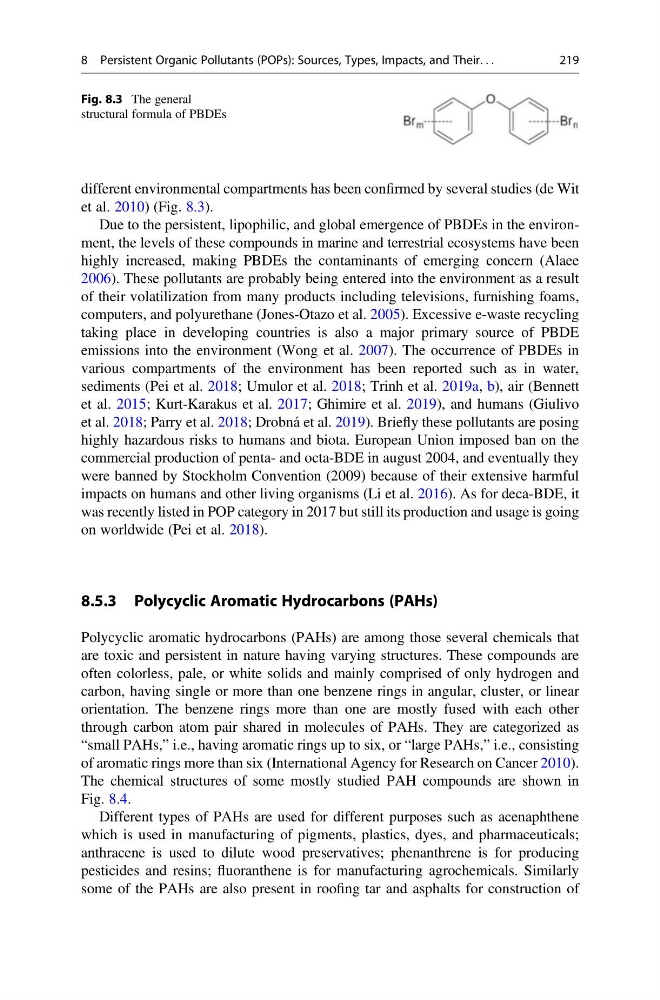
different environmental compartments has been confirmed by several studies (de Wit
et al. 2010) (Fig. 8.3).
Due to the persistent, lipophilic, and global emergence of PBDEs in the environment, the levels of these compounds in marine and terrestrial ecosystems have been
highly increased, making PBDEs the contaminants of emerging concern (Alaee
2006). These pollutants are probably being entered into the environment as a result
of their volatilization from many products including televisions, furnishing foams,
computers, and polyurethane (Jones-Otazo et al. 2005). Excessive e-waste recycling
taking place in developing countries is also a major primary source of PBDE
emissions into the environment (Wong et al. 2007). The occurrence of PBDEs in
various compartments of the environment has been reported such as in water,
sediments (Pei et al. 2018; Umulor et al. 2018; Trinh et al. 2019a, b), air (Bennett
et al. 2015; Kurt-Karakus et al. 2017; Ghimire et al. 2019), and humans (Giulivo
et al. 2018; Parry et al. 2018; Drobná et al. 2019). Briefly these pollutants are posing
highly hazardous risks to humans and biota. European Union imposed ban on the
commercial production of penta- and octa-BDE in august 2004, and eventually they
were banned by Stockholm Convention (2009) because of their extensive harmful
impacts on humans and other living organisms (Li et al. 2016). As for deca-BDE, it
was recently listed in POP category in 2017 but still its production and usage is going
on worldwide (Pei et al. 2018).
8.5.3 Polycyclic Aromatic Hydrocarbons (PAHs)
Polycyclic aromatic hydrocarbons (PAHs) are among those several chemicals that
are toxic and persistent in nature having varying structures. These compounds are
often colorless, pale, or white solids and mainly comprised of only hydrogen and
carbon, having single or more than one benzene rings in angular, cluster, or linear
orientation. The benzene rings more than one are mostly fused with each other
through carbon atom pair shared in molecules of PAHs. They are categorized as
“small PAHs,” i.e., having aromatic rings up to six, or “large PAHs,” i.e., consisting
of aromatic rings more than six (International Agency for Research on Cancer 2010).
The chemical structures of some mostly studied PAH compounds are shown in
Fig. 8.4.
Different types of PAHs are used for different purposes such as acenaphthene
which is used in manufacturing of pigments, plastics, dyes, and pharmaceuticals;
anthracene is used to dilute wood preservatives; phenanthrene is for producing
pesticides and resins; fluoranthene is for manufacturing agrochemicals. Similarly
some of the PAHs are also present in roofing tar and asphalts for construction of
Fig. 8.3 The general
structural formula of PBDEs
8 Persistent Organic Pollutants (POPs): Sources, Types, Impacts, and Their. . .
219
et al. 2010) (Fig. 8.3).
Due to the persistent, lipophilic, and global emergence of PBDEs in the environment, the levels of these compounds in marine and terrestrial ecosystems have been
highly increased, making PBDEs the contaminants of emerging concern (Alaee
2006). These pollutants are probably being entered into the environment as a result
of their volatilization from many products including televisions, furnishing foams,
computers, and polyurethane (Jones-Otazo et al. 2005). Excessive e-waste recycling
taking place in developing countries is also a major primary source of PBDE
emissions into the environment (Wong et al. 2007). The occurrence of PBDEs in
various compartments of the environment has been reported such as in water,
sediments (Pei et al. 2018; Umulor et al. 2018; Trinh et al. 2019a, b), air (Bennett
et al. 2015; Kurt-Karakus et al. 2017; Ghimire et al. 2019), and humans (Giulivo
et al. 2018; Parry et al. 2018; Drobná et al. 2019). Briefly these pollutants are posing
highly hazardous risks to humans and biota. European Union imposed ban on the
commercial production of penta- and octa-BDE in august 2004, and eventually they
were banned by Stockholm Convention (2009) because of their extensive harmful
impacts on humans and other living organisms (Li et al. 2016). As for deca-BDE, it
was recently listed in POP category in 2017 but still its production and usage is going
on worldwide (Pei et al. 2018).
8.5.3 Polycyclic Aromatic Hydrocarbons (PAHs)
Polycyclic aromatic hydrocarbons (PAHs) are among those several chemicals that
are toxic and persistent in nature having varying structures. These compounds are
often colorless, pale, or white solids and mainly comprised of only hydrogen and
carbon, having single or more than one benzene rings in angular, cluster, or linear
orientation. The benzene rings more than one are mostly fused with each other
through carbon atom pair shared in molecules of PAHs. They are categorized as
“small PAHs,” i.e., having aromatic rings up to six, or “large PAHs,” i.e., consisting
of aromatic rings more than six (International Agency for Research on Cancer 2010).
The chemical structures of some mostly studied PAH compounds are shown in
Fig. 8.4.
Different types of PAHs are used for different purposes such as acenaphthene
which is used in manufacturing of pigments, plastics, dyes, and pharmaceuticals;
anthracene is used to dilute wood preservatives; phenanthrene is for producing
pesticides and resins; fluoranthene is for manufacturing agrochemicals. Similarly
some of the PAHs are also present in roofing tar and asphalts for construction of
Fig. 8.3 The general
structural formula of PBDEs
8 Persistent Organic Pollutants (POPs): Sources, Types, Impacts, and Their. . .
219