

level of PCNs is comparatively lower than PCBs but toxicity level of PCNs is mostly
similar to many congeners of PCBs (Helm et al. 2002). In addition to their intentional commercial production, PCNs are also unintentionally released as by-products
from used electric equipment; as thermodynamic processes, e.g., in fly ash produced
from incineration; and as unintentional presence as contaminant in the industrial
chemical. PCNs are also found to be produced as a result of cooking process through
heating of oils such as olive and peanut oil (Dong et al. 2013). A number of
experimental studies have reported several toxic impacts of PCNs including carcinogenicity, hepatotoxicity, embryotoxicity, immunotoxicity, and mortality. Owing
to their dioxin-like toxicity, PCNs are recognized by the Stockholm Convention as
persistent organic pollutants, primarily to reduce their unintentional production and
eventually to eliminate completely (Fernandes et al. 2017).
8.5.2 Polybrominated Diphenyl Ethers (PBDEs)
Polybrominated diphenyl ethers (PBDEs) are members of organobromine
compounds, being produced to use as flame retardants in various products for
reduction of fire risks. They are manufactured as a result of bromination of polymers’
matrix generating the mixtures of isomers and homologues. Depending upon the
required bromination degree, three most important PBDE mixtures are produced and
sold in markets including penta-BDE, octa-BDE, and deca-BDE (Vonderheide et al.
2008). These mixtures are used for different purposes such as penta- and octa-BDE
which are used in electronic housing and plastics; however deca-BDE is majorly
used in textiles and polyurethane foams, PUFs (Lorber 2008). The ability of PBDEs
to retard formation of flammable gases is the main reason of their widespread use in
industrial products making them prevalent in the environment. Their existence in
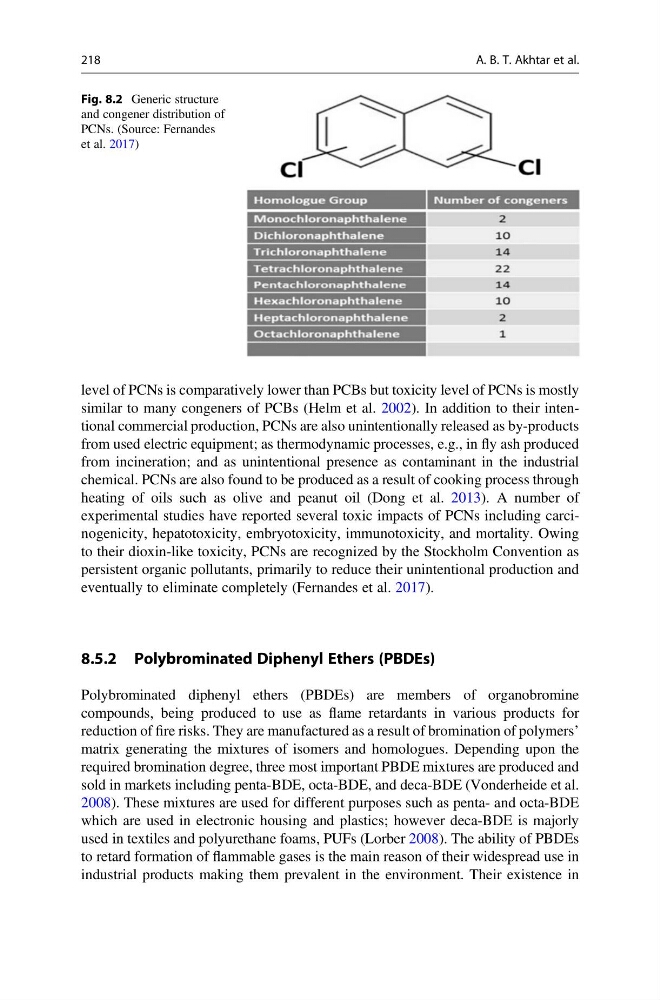
Fig. 8.2 Generic structure
and congener distribution of
PCNs. (Source: Fernandes
et al. 2017)
218
A. B. T. Akhtar et al.
similar to many congeners of PCBs (Helm et al. 2002). In addition to their intentional commercial production, PCNs are also unintentionally released as by-products
from used electric equipment; as thermodynamic processes, e.g., in fly ash produced
from incineration; and as unintentional presence as contaminant in the industrial
chemical. PCNs are also found to be produced as a result of cooking process through
heating of oils such as olive and peanut oil (Dong et al. 2013). A number of
experimental studies have reported several toxic impacts of PCNs including carcinogenicity, hepatotoxicity, embryotoxicity, immunotoxicity, and mortality. Owing
to their dioxin-like toxicity, PCNs are recognized by the Stockholm Convention as
persistent organic pollutants, primarily to reduce their unintentional production and
eventually to eliminate completely (Fernandes et al. 2017).
8.5.2 Polybrominated Diphenyl Ethers (PBDEs)
Polybrominated diphenyl ethers (PBDEs) are members of organobromine
compounds, being produced to use as flame retardants in various products for
reduction of fire risks. They are manufactured as a result of bromination of polymers’
matrix generating the mixtures of isomers and homologues. Depending upon the
required bromination degree, three most important PBDE mixtures are produced and
sold in markets including penta-BDE, octa-BDE, and deca-BDE (Vonderheide et al.
2008). These mixtures are used for different purposes such as penta- and octa-BDE
which are used in electronic housing and plastics; however deca-BDE is majorly
used in textiles and polyurethane foams, PUFs (Lorber 2008). The ability of PBDEs
to retard formation of flammable gases is the main reason of their widespread use in
industrial products making them prevalent in the environment. Their existence in
Fig. 8.2 Generic structure
and congener distribution of
PCNs. (Source: Fernandes
et al. 2017)
218
A. B. T. Akhtar et al.