

roads. Additionally, some products of PAHs are also used in liquid crystals and
electronics (Abdel-Shafy and Mansour 2016).
PAHs generally have high boiling and melting point, low solubility in water, and
low vapor pressure. The solubility of PAHs in water decreases with addition of each
benzene ring (Masih et al. 2010). However, these compounds due to their lipophilic
nature are highly soluble in organic solvents. Several functions are exhibited by
PAHs such as physiological actions, light sensitivity, heat, and corrosion resistance
(Akyüz and Çabuk 2010).
Some of the PAHs are produced in industries; however some of them are
produced as a result of biological processes or as by-products of incomplete burning,
either from natural sources (natural wildfires) or from anthropogenic sources of
combustion such as smoke of cigarettes and emissions from automobiles. Hence,
these persistent PAHs are reportedly found in soil, air, water, and lead to the
exposure to humans causing severe health problems (Fig. 8.5) and living organisms
(Baklanov et al. 2007).
8.5.4 Dechlorane Plus
Dechlorane plus (DP) is a member of polychlorinated compounds being used as
flame retardant. It was first manufactured as alternative of dechlorane also known as
mirex which was commercially used as flame retardant and pesticide but due to its
toxicity potential its production was banned in 1970s (Hoh et al. 2006). Commercially produced dechlorane plus contains two isomers, i.e., syn-DP and anti-DP
(Fig. 8.6), in 1:3 ratio approximately (Luo et al. 2013). DP is widely being used in
domestic and industrial products as an additive flame retardant. The main usage of
DP is in polymer materials with percentage composition of about 10% to 35% in
industrial polymer goods (Xian et al. 2011).
DP detection in multiple environmental matrices indicates its abundance in the
environment leading to its accumulation in humans. Long-range atmospheric
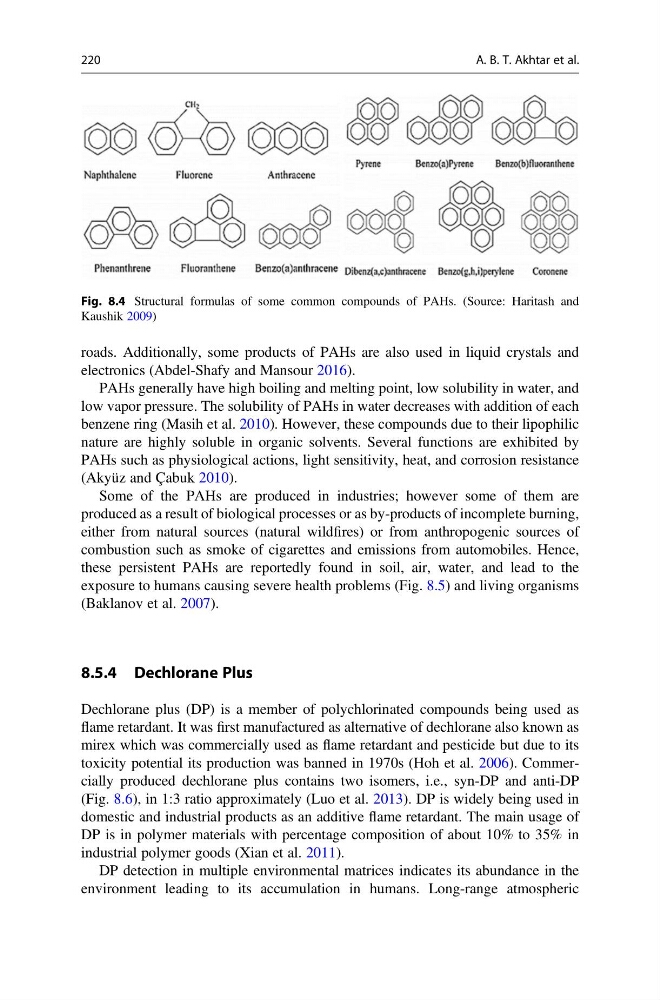
Fig. 8.4 Structural formulas of some common compounds of PAHs. (Source: Haritash and
Kaushik 2009)
220
A. B. T. Akhtar et al.
electronics (Abdel-Shafy and Mansour 2016).
PAHs generally have high boiling and melting point, low solubility in water, and
low vapor pressure. The solubility of PAHs in water decreases with addition of each
benzene ring (Masih et al. 2010). However, these compounds due to their lipophilic
nature are highly soluble in organic solvents. Several functions are exhibited by
PAHs such as physiological actions, light sensitivity, heat, and corrosion resistance
(Akyüz and Çabuk 2010).
Some of the PAHs are produced in industries; however some of them are
produced as a result of biological processes or as by-products of incomplete burning,
either from natural sources (natural wildfires) or from anthropogenic sources of
combustion such as smoke of cigarettes and emissions from automobiles. Hence,
these persistent PAHs are reportedly found in soil, air, water, and lead to the
exposure to humans causing severe health problems (Fig. 8.5) and living organisms
(Baklanov et al. 2007).
8.5.4 Dechlorane Plus
Dechlorane plus (DP) is a member of polychlorinated compounds being used as
flame retardant. It was first manufactured as alternative of dechlorane also known as
mirex which was commercially used as flame retardant and pesticide but due to its
toxicity potential its production was banned in 1970s (Hoh et al. 2006). Commercially produced dechlorane plus contains two isomers, i.e., syn-DP and anti-DP
(Fig. 8.6), in 1:3 ratio approximately (Luo et al. 2013). DP is widely being used in
domestic and industrial products as an additive flame retardant. The main usage of
DP is in polymer materials with percentage composition of about 10% to 35% in
industrial polymer goods (Xian et al. 2011).
DP detection in multiple environmental matrices indicates its abundance in the
environment leading to its accumulation in humans. Long-range atmospheric
Fig. 8.4 Structural formulas of some common compounds of PAHs. (Source: Haritash and
Kaushik 2009)
220
A. B. T. Akhtar et al.