

semipermeable membrane pass the solvent with a force, against pressure gradient
into the lower concentration solution. Hydraulic pressure is applied to the high
concentration side of column as is the reverse of natural osmosis. In this, using
mechanical pump pressure is applied on the solution to overcome inalienable
osmotic pressure. Using RO membrane process from industrial wastewater 98% F
is removed (Ndiaye et al. 2005). In RO system used polymeric membrane which
remove 95 to 98% fluoride from ground water of Moradgaon village chandrapur
district (Gedam et al. 2012).
Advantages
• RO membrane is a powerful technique for fluoride removal.
• Above 98% F can be removed through this process.
• RO membrane removes different types of ions at the same time.
• No hindrance by different ions.
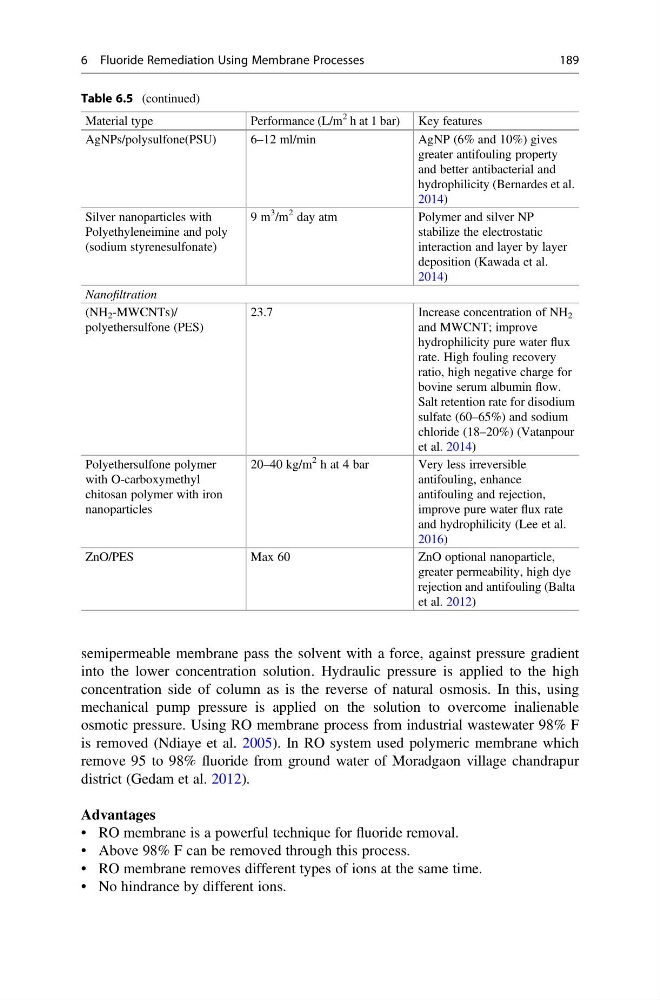
Table 6.5 (continued)
Material type
Performance (L/m
2 h at 1 bar) Key features
AgNPs/polysulfone(PSU)
6–12 ml/min
AgNP (6% and 10%) gives
greater antifouling property
and better antibacterial and
hydrophilicity (Bernardes et al.
2014)
Silver nanoparticles with
Polyethyleneimine and poly
(sodium styrenesulfonate)
9 m
3
/m
2 day atm
Polymer and silver NP
stabilize the electrostatic
interaction and layer by layer
deposition (Kawada et al.
2014)
Nanofiltration
(NH 2 -MWCNTs)/
polyethersulfone (PES)
23.7
Increase concentration of NH 2
and MWCNT; improve
hydrophilicity pure water flux
rate. High fouling recovery
ratio, high negative charge for
bovine serum albumin flow.
Salt retention rate for disodium
sulfate (60–65%) and sodium
chloride (18–20%) (Vatanpour
et al. 2014)
Polyethersulfone polymer
with O-carboxymethyl
chitosan polymer with iron
nanoparticles
20–40 kg/m
2 h at 4 bar
Very less irreversible
antifouling, enhance
antifouling and rejection,
improve pure water flux rate
and hydrophilicity (Lee et al.
2016)
ZnO/PES
Max 60
ZnO optional nanoparticle,
greater permeability, high dye
rejection and antifouling (Balta
et al. 2012)
6 Fluoride Remediation Using Membrane Processes
189
into the lower concentration solution. Hydraulic pressure is applied to the high
concentration side of column as is the reverse of natural osmosis. In this, using
mechanical pump pressure is applied on the solution to overcome inalienable
osmotic pressure. Using RO membrane process from industrial wastewater 98% F
is removed (Ndiaye et al. 2005). In RO system used polymeric membrane which
remove 95 to 98% fluoride from ground water of Moradgaon village chandrapur
district (Gedam et al. 2012).
Advantages
• RO membrane is a powerful technique for fluoride removal.
• Above 98% F can be removed through this process.
• RO membrane removes different types of ions at the same time.
• No hindrance by different ions.
Table 6.5 (continued)
Material type
Performance (L/m
2 h at 1 bar) Key features
AgNPs/polysulfone(PSU)
6–12 ml/min
AgNP (6% and 10%) gives
greater antifouling property
and better antibacterial and
hydrophilicity (Bernardes et al.
2014)
Silver nanoparticles with
Polyethyleneimine and poly
(sodium styrenesulfonate)
9 m
3
/m
2 day atm
Polymer and silver NP
stabilize the electrostatic
interaction and layer by layer
deposition (Kawada et al.
2014)
Nanofiltration
(NH 2 -MWCNTs)/
polyethersulfone (PES)
23.7
Increase concentration of NH 2
and MWCNT; improve
hydrophilicity pure water flux
rate. High fouling recovery
ratio, high negative charge for
bovine serum albumin flow.
Salt retention rate for disodium
sulfate (60–65%) and sodium
chloride (18–20%) (Vatanpour
et al. 2014)
Polyethersulfone polymer
with O-carboxymethyl
chitosan polymer with iron
nanoparticles
20–40 kg/m
2 h at 4 bar
Very less irreversible
antifouling, enhance
antifouling and rejection,
improve pure water flux rate
and hydrophilicity (Lee et al.
2016)
ZnO/PES
Max 60
ZnO optional nanoparticle,
greater permeability, high dye
rejection and antifouling (Balta
et al. 2012)
6 Fluoride Remediation Using Membrane Processes
189