

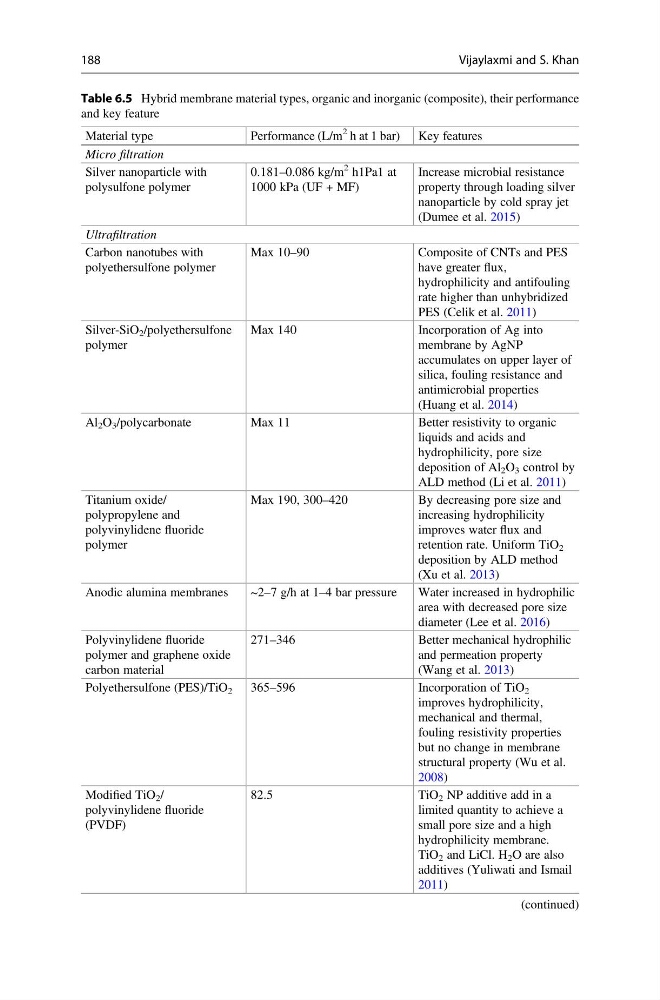
Table 6.5 Hybrid membrane material types, organic and inorganic (composite), their performance
and key feature
Material type
Performance (L/m
2 h at 1 bar) Key features
Micro filtration
Silver nanoparticle with
polysulfone polymer
0.181–0.086 kg/m
2 h1Pa1 at
1000 kPa (UF + MF)
Increase microbial resistance
property through loading silver
nanoparticle by cold spray jet
(Dumee et al. 2015)
Ultrafiltration
Carbon nanotubes with
polyethersulfone polymer
Max 10–90
Composite of CNTs and PES
have greater flux,
hydrophilicity and antifouling
rate higher than unhybridized
PES (Celik et al. 2011)
Silver-SiO 2 /polyethersulfone
polymer
Max 140
Incorporation of Ag into
membrane by AgNP
accumulates on upper layer of
silica, fouling resistance and
antimicrobial properties
(Huang et al. 2014)
Al 2 O 3 /polycarbonate
Max 11
Better resistivity to organic
liquids and acids and
hydrophilicity, pore size
deposition of Al 2 O 3 control by
ALD method (Li et al. 2011)
Titanium oxide/
polypropylene and
polyvinylidene fluoride
polymer
Max 190, 300–420
By decreasing pore size and
increasing hydrophilicity
improves water flux and
retention rate. Uniform TiO 2
deposition by ALD method
(Xu et al. 2013)
Anodic alumina membranes
~2–7 g/h at 1–4 bar pressure
Water increased in hydrophilic
area with decreased pore size
diameter (Lee et al. 2016)
Polyvinylidene fluoride
polymer and graphene oxide
carbon material
271–346
Better mechanical hydrophilic
and permeation property
(Wang et al. 2013)
Polyethersulfone (PES)/TiO 2 365–596
Incorporation of TiO 2
improves hydrophilicity,
mechanical and thermal,
fouling resistivity properties
but no change in membrane
structural property (Wu et al.
2008)
Modified TiO 2 /
polyvinylidene fluoride
(PVDF)
82.5
TiO 2 NP additive add in a
limited quantity to achieve a
small pore size and a high
hydrophilicity membrane.
TiO 2 and LiCl. H 2 O are also
additives (Yuliwati and Ismail
2011)
(continued)
188
Vijaylaxmi and S. Khan
and key feature
Material type
Performance (L/m
2 h at 1 bar) Key features
Micro filtration
Silver nanoparticle with
polysulfone polymer
0.181–0.086 kg/m
2 h1Pa1 at
1000 kPa (UF + MF)
Increase microbial resistance
property through loading silver
nanoparticle by cold spray jet
(Dumee et al. 2015)
Ultrafiltration
Carbon nanotubes with
polyethersulfone polymer
Max 10–90
Composite of CNTs and PES
have greater flux,
hydrophilicity and antifouling
rate higher than unhybridized
PES (Celik et al. 2011)
Silver-SiO 2 /polyethersulfone
polymer
Max 140
Incorporation of Ag into
membrane by AgNP
accumulates on upper layer of
silica, fouling resistance and
antimicrobial properties
(Huang et al. 2014)
Al 2 O 3 /polycarbonate
Max 11
Better resistivity to organic
liquids and acids and
hydrophilicity, pore size
deposition of Al 2 O 3 control by
ALD method (Li et al. 2011)
Titanium oxide/
polypropylene and
polyvinylidene fluoride
polymer
Max 190, 300–420
By decreasing pore size and
increasing hydrophilicity
improves water flux and
retention rate. Uniform TiO 2
deposition by ALD method
(Xu et al. 2013)
Anodic alumina membranes
~2–7 g/h at 1–4 bar pressure
Water increased in hydrophilic
area with decreased pore size
diameter (Lee et al. 2016)
Polyvinylidene fluoride
polymer and graphene oxide
carbon material
271–346
Better mechanical hydrophilic
and permeation property
(Wang et al. 2013)
Polyethersulfone (PES)/TiO 2 365–596
Incorporation of TiO 2
improves hydrophilicity,
mechanical and thermal,
fouling resistivity properties
but no change in membrane
structural property (Wu et al.
2008)
Modified TiO 2 /
polyvinylidene fluoride
(PVDF)
82.5
TiO 2 NP additive add in a
limited quantity to achieve a
small pore size and a high
hydrophilicity membrane.
TiO 2 and LiCl. H 2 O are also
additives (Yuliwati and Ismail
2011)
(continued)
188
Vijaylaxmi and S. Khan