

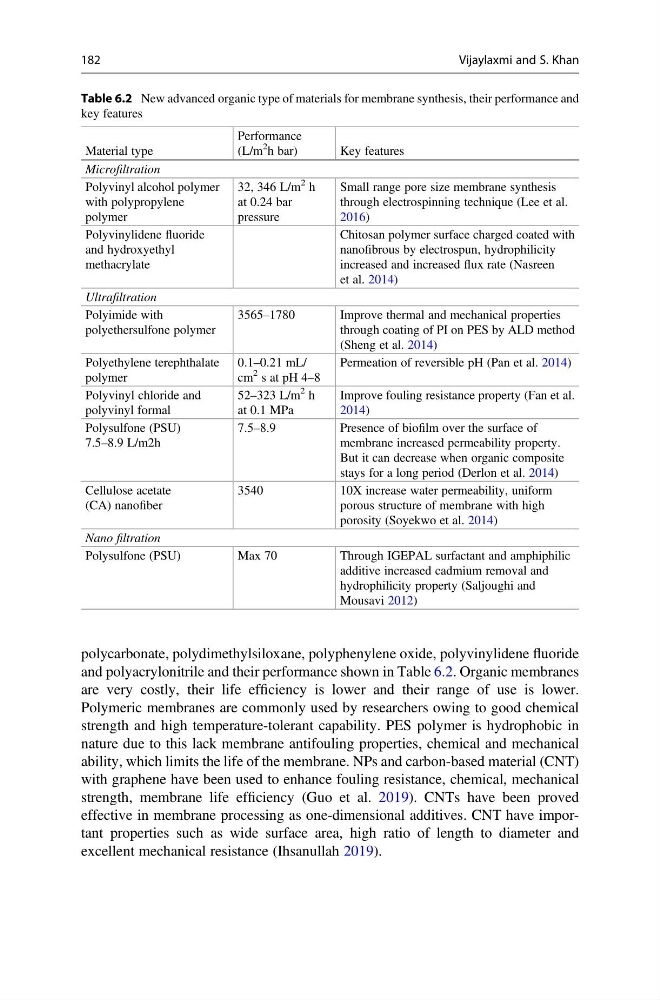
polycarbonate, polydimethylsiloxane, polyphenylene oxide, polyvinylidene fluoride
and polyacrylonitrile and their performance shown in Table 6.2. Organic membranes
are very costly, their life efficiency is lower and their range of use is lower.
Polymeric membranes are commonly used by researchers owing to good chemical
strength and high temperature-tolerant capability. PES polymer is hydrophobic in
nature due to this lack membrane antifouling properties, chemical and mechanical
ability, which limits the life of the membrane. NPs and carbon-based material (CNT)
with graphene have been used to enhance fouling resistance, chemical, mechanical
strength, membrane life efficiency (Guo et al. 2019). CNTs have been proved
effective in membrane processing as one-dimensional additives. CNT have important properties such as wide surface area, high ratio of length to diameter and
excellent mechanical resistance (Ihsanullah 2019).
Table 6.2 New advanced organic type of materials for membrane synthesis, their performance and
key features
Material type
Performance
(L/m
2
h bar)
Key features
Microfiltration
Polyvinyl alcohol polymer
with polypropylene
polymer
32, 346 L/m
2 h
at 0.24 bar
pressure
Small range pore size membrane synthesis
through electrospinning technique (Lee et al.
2016)
Polyvinylidene fluoride
and hydroxyethyl
methacrylate
Chitosan polymer surface charged coated with
nanofibrous by electrospun, hydrophilicity
increased and increased flux rate (Nasreen
et al. 2014)
Ultrafiltration
Polyimide with
polyethersulfone polymer
3565–1780
Improve thermal and mechanical properties
through coating of PI on PES by ALD method
(Sheng et al. 2014)
Polyethylene terephthalate
polymer
0.1–0.21 mL/
cm
2 s at pH 4–8
Permeation of reversible pH (Pan et al. 2014)
Polyvinyl chloride and
polyvinyl formal
52–323 L/m
2 h
at 0.1 MPa
Improve fouling resistance property (Fan et al.
2014)
Polysulfone (PSU)
7.5–8.9 L/m2h
7.5–8.9
Presence of biofilm over the surface of
membrane increased permeability property.
But it can decrease when organic composite
stays for a long period (Derlon et al. 2014)
Cellulose acetate
(CA) nanofiber
3540
10X increase water permeability, uniform
porous structure of membrane with high
porosity (Soyekwo et al. 2014)
Nano filtration
Polysulfone (PSU)
Max 70
Through IGEPAL surfactant and amphiphilic
additive increased cadmium removal and
hydrophilicity property (Saljoughi and
Mousavi 2012)
182
Vijaylaxmi and S. Khan
and polyacrylonitrile and their performance shown in Table 6.2. Organic membranes
are very costly, their life efficiency is lower and their range of use is lower.
Polymeric membranes are commonly used by researchers owing to good chemical
strength and high temperature-tolerant capability. PES polymer is hydrophobic in
nature due to this lack membrane antifouling properties, chemical and mechanical
ability, which limits the life of the membrane. NPs and carbon-based material (CNT)
with graphene have been used to enhance fouling resistance, chemical, mechanical
strength, membrane life efficiency (Guo et al. 2019). CNTs have been proved
effective in membrane processing as one-dimensional additives. CNT have important properties such as wide surface area, high ratio of length to diameter and
excellent mechanical resistance (Ihsanullah 2019).
Table 6.2 New advanced organic type of materials for membrane synthesis, their performance and
key features
Material type
Performance
(L/m
2
h bar)
Key features
Microfiltration
Polyvinyl alcohol polymer
with polypropylene
polymer
32, 346 L/m
2 h
at 0.24 bar
pressure
Small range pore size membrane synthesis
through electrospinning technique (Lee et al.
2016)
Polyvinylidene fluoride
and hydroxyethyl
methacrylate
Chitosan polymer surface charged coated with
nanofibrous by electrospun, hydrophilicity
increased and increased flux rate (Nasreen
et al. 2014)
Ultrafiltration
Polyimide with
polyethersulfone polymer
3565–1780
Improve thermal and mechanical properties
through coating of PI on PES by ALD method
(Sheng et al. 2014)
Polyethylene terephthalate
polymer
0.1–0.21 mL/
cm
2 s at pH 4–8
Permeation of reversible pH (Pan et al. 2014)
Polyvinyl chloride and
polyvinyl formal
52–323 L/m
2 h
at 0.1 MPa
Improve fouling resistance property (Fan et al.
2014)
Polysulfone (PSU)
7.5–8.9 L/m2h
7.5–8.9
Presence of biofilm over the surface of
membrane increased permeability property.
But it can decrease when organic composite
stays for a long period (Derlon et al. 2014)
Cellulose acetate
(CA) nanofiber
3540
10X increase water permeability, uniform
porous structure of membrane with high
porosity (Soyekwo et al. 2014)
Nano filtration
Polysulfone (PSU)
Max 70
Through IGEPAL surfactant and amphiphilic
additive increased cadmium removal and
hydrophilicity property (Saljoughi and
Mousavi 2012)
182
Vijaylaxmi and S. Khan