

pore diameter. Microporous membranes are identical to traditional filters, and the
size range varies only for pores. Microporous membrane pores are in size diameter
range 0.1–5μm (Thakur and voicu 2016). Microporous and non-porous dense film
cover by positively and negatively charged ion. The separation of the solute in this
membrane is driven by the ion concentration and the amount of the charge. There are
two types of anisotropic membranes, i.e. the phase separation membranes (LoebSourirajan membranes) and the self-assembled hybrid membranes, which are thin
films. Phase separation membranes are similar to isotropic microporous membrane
that have single chemical composition membranes, but different in porosity and pore
size across the membrane thickness. Structurally and chemically heterogeneous thin
film is a composite membrane. Thicker porous structure provides mechanical
strength to a thin surface of membrane. Traditionally membrane structure is made
up of different polymeric materials. But nowadays other different materials are used
in combination to enhance the efficiency of membrane. Several methods are available for membrane synthesis such as phase inversion, solution coating and plasma
polymerization, etc. Membrane thin surface layer determines the solute permeation
rate (Buonomenna 2016).
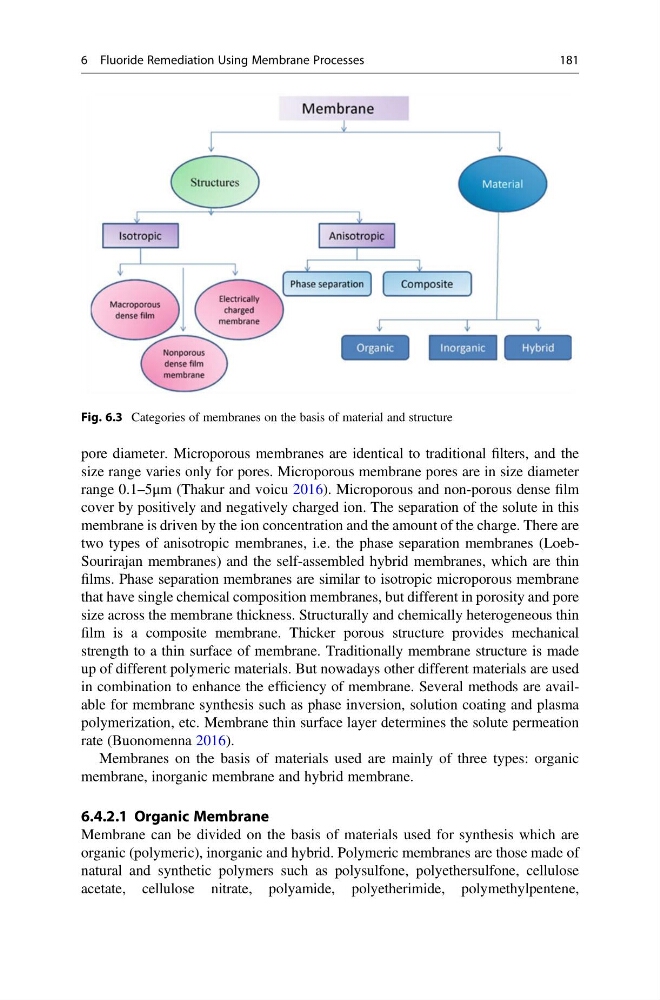
Membranes on the basis of materials used are mainly of three types: organic
membrane, inorganic membrane and hybrid membrane.
6.4.2.1 Organic Membrane
Membrane can be divided on the basis of materials used for synthesis which are
organic (polymeric), inorganic and hybrid. Polymeric membranes are those made of
natural and synthetic polymers such as polysulfone, polyethersulfone, cellulose
acetate, cellulose nitrate, polyamide, polyetherimide, polymethylpentene,
Fig. 6.3 Categories of membranes on the basis of material and structure
6 Fluoride Remediation Using Membrane Processes
181
size range varies only for pores. Microporous membrane pores are in size diameter
range 0.1–5μm (Thakur and voicu 2016). Microporous and non-porous dense film
cover by positively and negatively charged ion. The separation of the solute in this
membrane is driven by the ion concentration and the amount of the charge. There are
two types of anisotropic membranes, i.e. the phase separation membranes (LoebSourirajan membranes) and the self-assembled hybrid membranes, which are thin
films. Phase separation membranes are similar to isotropic microporous membrane
that have single chemical composition membranes, but different in porosity and pore
size across the membrane thickness. Structurally and chemically heterogeneous thin
film is a composite membrane. Thicker porous structure provides mechanical
strength to a thin surface of membrane. Traditionally membrane structure is made
up of different polymeric materials. But nowadays other different materials are used
in combination to enhance the efficiency of membrane. Several methods are available for membrane synthesis such as phase inversion, solution coating and plasma
polymerization, etc. Membrane thin surface layer determines the solute permeation
rate (Buonomenna 2016).
Membranes on the basis of materials used are mainly of three types: organic
membrane, inorganic membrane and hybrid membrane.
6.4.2.1 Organic Membrane
Membrane can be divided on the basis of materials used for synthesis which are
organic (polymeric), inorganic and hybrid. Polymeric membranes are those made of
natural and synthetic polymers such as polysulfone, polyethersulfone, cellulose
acetate, cellulose nitrate, polyamide, polyetherimide, polymethylpentene,
Fig. 6.3 Categories of membranes on the basis of material and structure
6 Fluoride Remediation Using Membrane Processes
181