

6.4.2 Membrane Process
In this method, particles are separated using exceptionally composed semipermeable
membrane based on molecular shape and size. In general, the semipermeable
membrane consists of inorganic, organic and hybrid (organic and inorganic) material. Main factors are very important in designing an efficient membrane choice of
material and physical and chemical properties of material. Membrane efficiency is
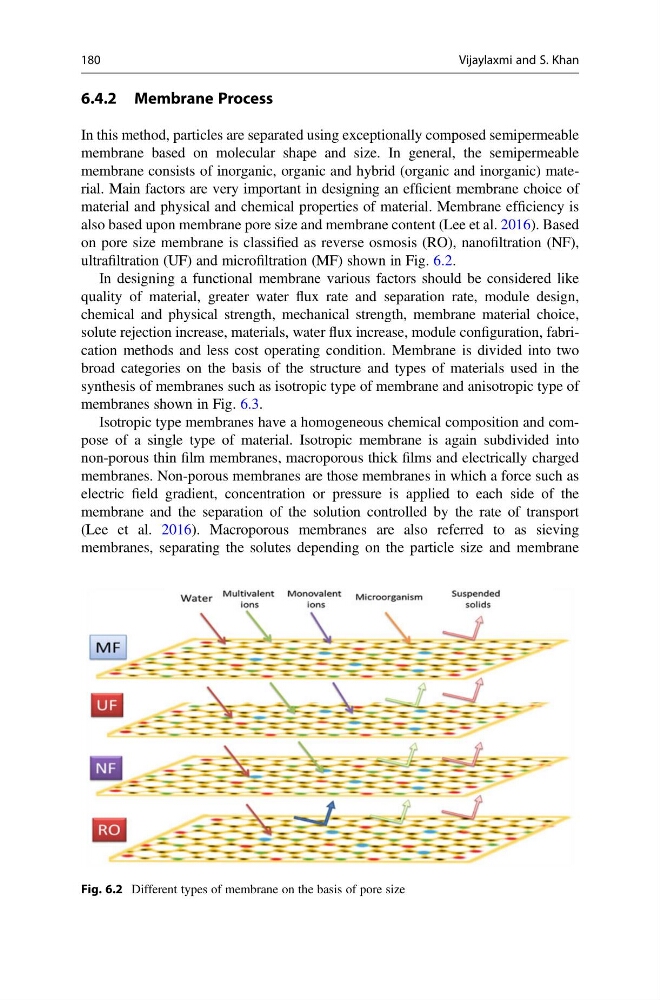
also based upon membrane pore size and membrane content (Lee et al. 2016). Based
on pore size membrane is classified as reverse osmosis (RO), nanofiltration (NF),
ultrafiltration (UF) and microfiltration (MF) shown in Fig. 6.2.
In designing a functional membrane various factors should be considered like
quality of material, greater water flux rate and separation rate, module design,
chemical and physical strength, mechanical strength, membrane material choice,
solute rejection increase, materials, water flux increase, module configuration, fabrication methods and less cost operating condition. Membrane is divided into two
broad categories on the basis of the structure and types of materials used in the
synthesis of membranes such as isotropic type of membrane and anisotropic type of
membranes shown in Fig. 6.3.
Isotropic type membranes have a homogeneous chemical composition and compose of a single type of material. Isotropic membrane is again subdivided into
non-porous thin film membranes, macroporous thick films and electrically charged
membranes. Non-porous membranes are those membranes in which a force such as
electric field gradient, concentration or pressure is applied to each side of the
membrane and the separation of the solution controlled by the rate of transport
(Lee et al. 2016). Macroporous membranes are also referred to as sieving
membranes, separating the solutes depending on the particle size and membrane
Fig. 6.2 Different types of membrane on the basis of pore size
180
Vijaylaxmi and S. Khan
In this method, particles are separated using exceptionally composed semipermeable
membrane based on molecular shape and size. In general, the semipermeable
membrane consists of inorganic, organic and hybrid (organic and inorganic) material. Main factors are very important in designing an efficient membrane choice of
material and physical and chemical properties of material. Membrane efficiency is
also based upon membrane pore size and membrane content (Lee et al. 2016). Based
on pore size membrane is classified as reverse osmosis (RO), nanofiltration (NF),
ultrafiltration (UF) and microfiltration (MF) shown in Fig. 6.2.
In designing a functional membrane various factors should be considered like
quality of material, greater water flux rate and separation rate, module design,
chemical and physical strength, mechanical strength, membrane material choice,
solute rejection increase, materials, water flux increase, module configuration, fabrication methods and less cost operating condition. Membrane is divided into two
broad categories on the basis of the structure and types of materials used in the
synthesis of membranes such as isotropic type of membrane and anisotropic type of
membranes shown in Fig. 6.3.
Isotropic type membranes have a homogeneous chemical composition and compose of a single type of material. Isotropic membrane is again subdivided into
non-porous thin film membranes, macroporous thick films and electrically charged
membranes. Non-porous membranes are those membranes in which a force such as
electric field gradient, concentration or pressure is applied to each side of the
membrane and the separation of the solution controlled by the rate of transport
(Lee et al. 2016). Macroporous membranes are also referred to as sieving
membranes, separating the solutes depending on the particle size and membrane
Fig. 6.2 Different types of membrane on the basis of pore size
180
Vijaylaxmi and S. Khan