

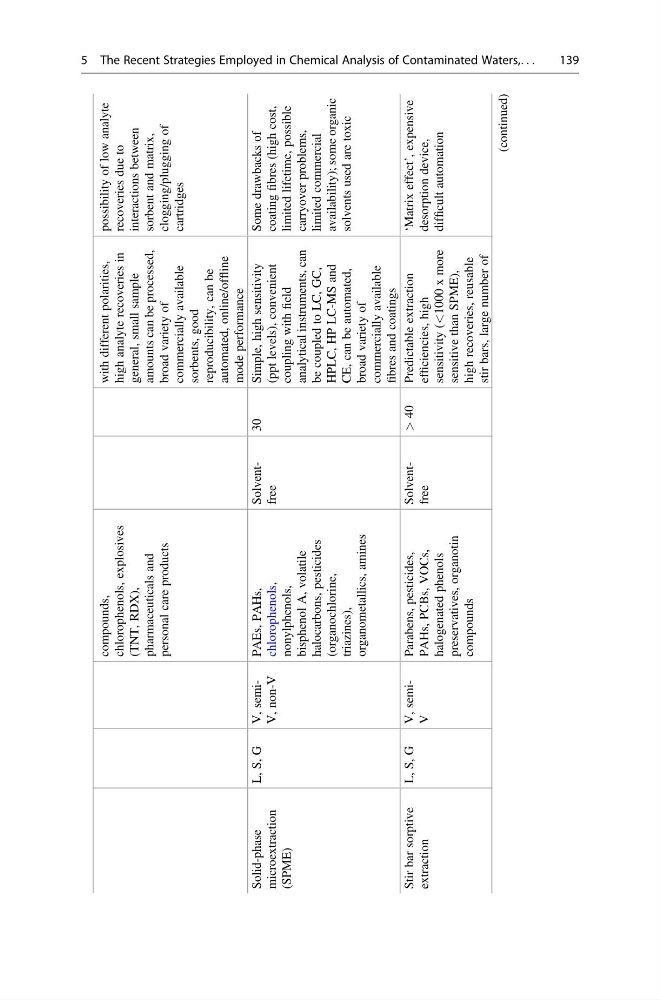
compounds,
chlorophenols, explosives
(TNT, RDX),
pharmaceuticals and
personal care products
with different polarities,
high analyte recoveries in
general, small sample
amounts can be processed,
broad variety of
commercially available
sorbents, good
reproducibility, can be
automated, online/offline
mode performance
possibility of low analyte
recoveries due to
interactions between
sorbent and matrix,
clogging/plugging of
cartridges
Solid-phase
microextraction
(SPME)
L, S, G
V, semiV, non-V
PAEs, PAHs,
chlorophenols,
nonylphenols,
bisphenol A, volatile
halocarbons, pesticides
(organochlorine,
triazines),
organometallics, amines
Solventfree
30
Simple, high sensitivity
(ppt levels), convenient
coupling with
field
analytical instruments, can
be coupled to LC, GC,
HPLC, HP LC-MS and
CE, can be automated,
broad variety of
commercially available
fibres and coatings
Some drawbacks of
coating
fibres (high cost,
limited lifetime, possible
carryover problems,
limited commercial
availability); some organic
solvents used are toxic
Stir bar sorptive
extraction
L, S, G
V, semiV
Parabens, pesticides,
PAHs, PCBs, VOCs,
halogenated phenols
preservatives, organotin
compounds
Solventfree
> 40
Predictable extraction
efficiencies, high
sensitivity (<1000 x more
sensitive than SPME),
high recoveries, reusable
stir bars, large number of
‘Matrix effect’, expensive
desorption device,
difficult automation
(continued)
5 The Recent Strategies Employed in Chemical Analysis of Contaminated Waters,. . .
139
chlorophenols, explosives
(TNT, RDX),
pharmaceuticals and
personal care products
with different polarities,
high analyte recoveries in
general, small sample
amounts can be processed,
broad variety of
commercially available
sorbents, good
reproducibility, can be
automated, online/offline
mode performance
possibility of low analyte
recoveries due to
interactions between
sorbent and matrix,
clogging/plugging of
cartridges
Solid-phase
microextraction
(SPME)
L, S, G
V, semiV, non-V
PAEs, PAHs,
chlorophenols,
nonylphenols,
bisphenol A, volatile
halocarbons, pesticides
(organochlorine,
triazines),
organometallics, amines
Solventfree
30
Simple, high sensitivity
(ppt levels), convenient
coupling with
field
analytical instruments, can
be coupled to LC, GC,
HPLC, HP LC-MS and
CE, can be automated,
broad variety of
commercially available
fibres and coatings
Some drawbacks of
coating
fibres (high cost,
limited lifetime, possible
carryover problems,
limited commercial
availability); some organic
solvents used are toxic
Stir bar sorptive
extraction
L, S, G
V, semiV
Parabens, pesticides,
PAHs, PCBs, VOCs,
halogenated phenols
preservatives, organotin
compounds
Solventfree
> 40
Predictable extraction
efficiencies, high
sensitivity (<1000 x more
sensitive than SPME),
high recoveries, reusable
stir bars, large number of
‘Matrix effect’, expensive
desorption device,
difficult automation
(continued)
5 The Recent Strategies Employed in Chemical Analysis of Contaminated Waters,. . .
139