

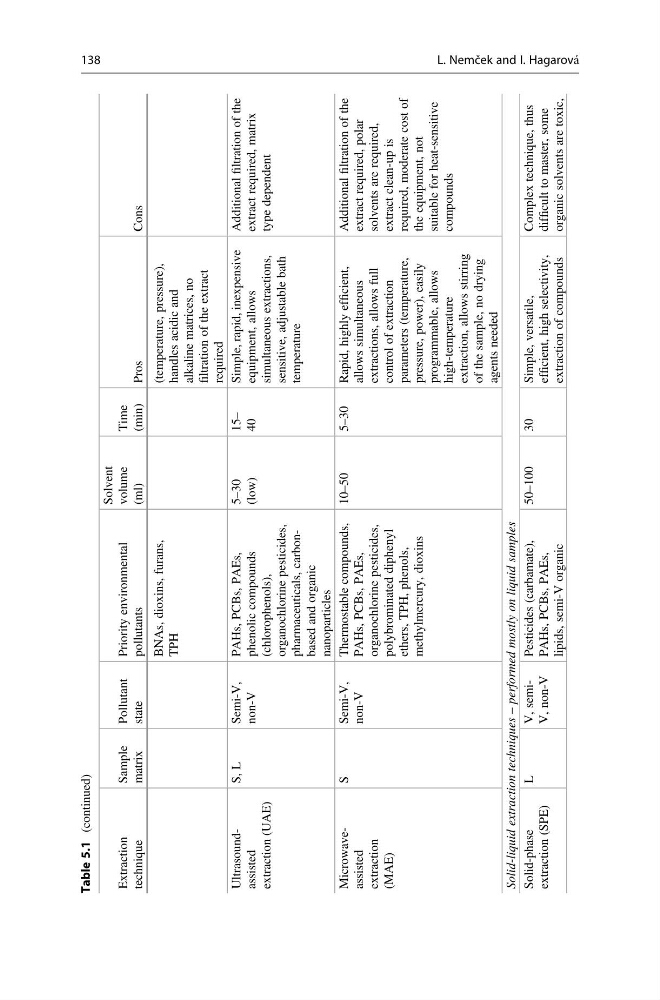
Table 5.1
(continued)
Extraction
technique
Sample
matrix
Pollutant
state
Priority environmental
pollutants
Solvent
volume
(ml)
Time
(min)
Pros
Cons
BNAs, dioxins, furans,
TPH
(temperature, pressure),
handles acidic and
alkaline matrices, no
filtration of the extract
required
Ultrasoundassisted
extraction (UAE)
S, L
Semi-V,
non-V
PAHs, PCBs, PAEs,
phenolic compounds
(chlorophenols),
organochlorine pesticides,
pharmaceuticals, carbonbased and organic
nanoparticles
5–30
(low)
15–
40
Simple, rapid, inexpensive
equipment, allows
simultaneous extractions,
sensitive, adjustable bath
temperature
Additional
filtration of the
extract required, matrix
type dependent
Microwaveassisted
extraction
(MAE)
S
Semi-V,
non-V
Thermostable compounds,
PAHs, PCBs, PAEs,
organochlorine pesticides,
polybrominated diphenyl
ethers, TPH, phenols,
methylmercury, dioxins
10–50
5–30
Rapid, highly efficient,
allows simultaneous
extractions, allows full
control of extraction
parameters (temperature,
pressure, power), easily
programmable, allows
high-temperature
extraction, allows stirring
of the sample, no drying
agents needed
Additional
filtration of the
extract required, polar
solvents are required,
extract clean-up is
required, moderate cost of
the equipment, not
suitable for heat-sensitive
compounds
Solid-liquid extraction techniques
– performed mostly on liquid samples
Solid-phase
extraction (SPE)
L
V, semiV, non-V
Pesticides (carbamate),
PAHs, PCBs, PAEs,
lipids, semi-V organic
50–100
30
Simple, versatile,
efficient, high selectivity,
extraction of compounds
Complex technique, thus
difficult to master, some
organic solvents are toxic,
138
L. Nemček and I. Hagarová
(continued)
Extraction
technique
Sample
matrix
Pollutant
state
Priority environmental
pollutants
Solvent
volume
(ml)
Time
(min)
Pros
Cons
BNAs, dioxins, furans,
TPH
(temperature, pressure),
handles acidic and
alkaline matrices, no
filtration of the extract
required
Ultrasoundassisted
extraction (UAE)
S, L
Semi-V,
non-V
PAHs, PCBs, PAEs,
phenolic compounds
(chlorophenols),
organochlorine pesticides,
pharmaceuticals, carbonbased and organic
nanoparticles
5–30
(low)
15–
40
Simple, rapid, inexpensive
equipment, allows
simultaneous extractions,
sensitive, adjustable bath
temperature
Additional
filtration of the
extract required, matrix
type dependent
Microwaveassisted
extraction
(MAE)
S
Semi-V,
non-V
Thermostable compounds,
PAHs, PCBs, PAEs,
organochlorine pesticides,
polybrominated diphenyl
ethers, TPH, phenols,
methylmercury, dioxins
10–50
5–30
Rapid, highly efficient,
allows simultaneous
extractions, allows full
control of extraction
parameters (temperature,
pressure, power), easily
programmable, allows
high-temperature
extraction, allows stirring
of the sample, no drying
agents needed
Additional
filtration of the
extract required, polar
solvents are required,
extract clean-up is
required, moderate cost of
the equipment, not
suitable for heat-sensitive
compounds
Solid-liquid extraction techniques
– performed mostly on liquid samples
Solid-phase
extraction (SPE)
L
V, semiV, non-V
Pesticides (carbamate),
PAHs, PCBs, PAEs,
lipids, semi-V organic
50–100
30
Simple, versatile,
efficient, high selectivity,
extraction of compounds
Complex technique, thus
difficult to master, some
organic solvents are toxic,
138
L. Nemček and I. Hagarová