

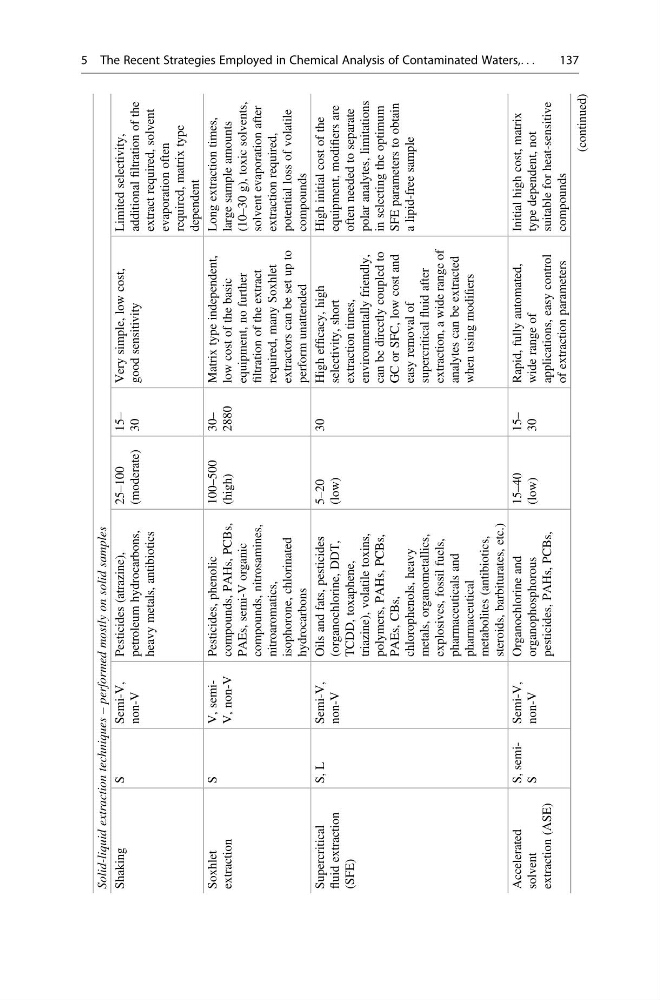
Solid-liquid extraction techniques
– performed mostly on solid samples
Shaking
S
Semi-V,
non-V
Pesticides (atrazine),
petroleum hydrocarbons,
heavy metals, antibiotics
25–100
(moderate)
15–
30
Very simple, low cost,
good sensitivity
Limited selectivity,
additional
filtration of the
extract required, solvent
evaporation often
required, matrix type
dependent
Soxhlet
extraction
S
V, semiV, non-V
Pesticides, phenolic
compounds, PAHs, PCBs,
PAEs, semi-V organic
compounds, nitrosamines,
nitroaromatics,
isophorone, chlorinated
hydrocarbons
100–500
(high)
30–
2880
Matrix type independent,
low cost of the basic
equipment, no further
filtration of the extract
required, many Soxhlet
extractors can be set up to
perform unattended
Long extraction times,
large sample amounts
(10–30 g), toxic solvents,
solvent evaporation after
extraction required,
potential loss of volatile
compounds
Supercritical
fluid extraction
(SFE)
S, L
Semi-V,
non-V
Oils and fats, pesticides
(organochlorine, DDT,
TCDD, toxaphene,
triazine), volatile toxins,
polymers, PAHs, PCBs,
PAEs, CBs,
chlorophenols, heavy
metals, organometallics,
explosives, fossil fuels,
pharmaceuticals and
pharmaceutical
metabolites (antibiotics,
steroids, barbiturates, etc.)
5–20
(low)
30
High efficacy, high
selectivity, short
extraction times,
environmentally friendly,
can be directly coupled to
GC or SFC, low cost and
easy removal of
supercritical
fluid after
extraction, a wide range of
analytes can be extracted
when using modifiers
High initial cost of the
equipment, modifiers are
often needed to separate
polar analytes, limitations
in selecting the optimum
SFE parameters to obtain
a lipid-free sample
Accelerated
solvent
extraction (ASE)
S, semiS
Semi-V,
non-V
Organochlorine and
organophosphorous
pesticides, PAHs, PCBs,
15–40
(low)
15–
30
Rapid, fully automated,
wide range of
applications, easy control
of extraction parameters
Initial high cost, matrix
type dependent, not
suitable for heat-sensitive
compounds
(continued)
5 The Recent Strategies Employed in Chemical Analysis of Contaminated Waters,. . .
137
– performed mostly on solid samples
Shaking
S
Semi-V,
non-V
Pesticides (atrazine),
petroleum hydrocarbons,
heavy metals, antibiotics
25–100
(moderate)
15–
30
Very simple, low cost,
good sensitivity
Limited selectivity,
additional
filtration of the
extract required, solvent
evaporation often
required, matrix type
dependent
Soxhlet
extraction
S
V, semiV, non-V
Pesticides, phenolic
compounds, PAHs, PCBs,
PAEs, semi-V organic
compounds, nitrosamines,
nitroaromatics,
isophorone, chlorinated
hydrocarbons
100–500
(high)
30–
2880
Matrix type independent,
low cost of the basic
equipment, no further
filtration of the extract
required, many Soxhlet
extractors can be set up to
perform unattended
Long extraction times,
large sample amounts
(10–30 g), toxic solvents,
solvent evaporation after
extraction required,
potential loss of volatile
compounds
Supercritical
fluid extraction
(SFE)
S, L
Semi-V,
non-V
Oils and fats, pesticides
(organochlorine, DDT,
TCDD, toxaphene,
triazine), volatile toxins,
polymers, PAHs, PCBs,
PAEs, CBs,
chlorophenols, heavy
metals, organometallics,
explosives, fossil fuels,
pharmaceuticals and
pharmaceutical
metabolites (antibiotics,
steroids, barbiturates, etc.)
5–20
(low)
30
High efficacy, high
selectivity, short
extraction times,
environmentally friendly,
can be directly coupled to
GC or SFC, low cost and
easy removal of
supercritical
fluid after
extraction, a wide range of
analytes can be extracted
when using modifiers
High initial cost of the
equipment, modifiers are
often needed to separate
polar analytes, limitations
in selecting the optimum
SFE parameters to obtain
a lipid-free sample
Accelerated
solvent
extraction (ASE)
S, semiS
Semi-V,
non-V
Organochlorine and
organophosphorous
pesticides, PAHs, PCBs,
15–40
(low)
15–
30
Rapid, fully automated,
wide range of
applications, easy control
of extraction parameters
Initial high cost, matrix
type dependent, not
suitable for heat-sensitive
compounds
(continued)
5 The Recent Strategies Employed in Chemical Analysis of Contaminated Waters,. . .
137