

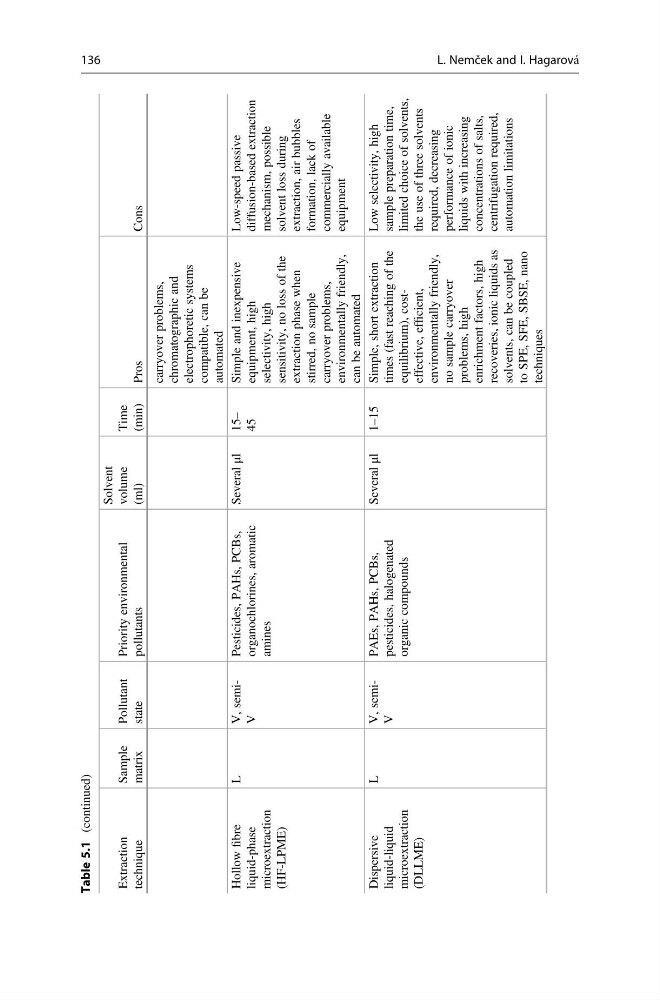
Table 5.1
(continued)
Extraction
technique
Sample
matrix
Pollutant
state
Priority environmental
pollutants
Solvent
volume
(ml)
Time
(min)
Pros
Cons
carryover problems,
chromatographic and
electrophoretic systems
compatible, can be
automated
Hollow
fibre
liquid-phase
microextraction
(HF-LPME)
L
V, semiV
Pesticides, PAHs, PCBs,
organochlorines, aromatic
amines
Several
μl
15–
45
Simple and inexpensive
equipment, high
selectivity, high
sensitivity, no loss of the
extraction phase when
stirred, no sample
carryover problems,
environmentally friendly,
can be automated
Low-speed passive
diffusion-based extraction
mechanism, possible
solvent loss during
extraction, air bubbles
formation, lack of
commercially available
equipment
Dispersive
liquid-liquid
microextraction
(DLLME)
L
V, semiV
PAEs, PAHs, PCBs,
pesticides, halogenated
organic compounds
Several
μl
1–15
Simple, short extraction
times (fast reaching of the
equilibrium), costeffective, efficient,
environmentally friendly,
no sample carryover
problems, high
enrichment factors, high
recoveries, ionic liquids as
solvents, can be coupled
to SPE, SFE, SBSE, nano
techniques
Low selectivity, high
sample preparation time,
limited choice of solvents,
the use of three solvents
required, decreasing
performance of ionic
liquids with increasing
concentrations of salts,
centrifugation required,
automation limitations
136
L. Nemček and I. Hagarová
(continued)
Extraction
technique
Sample
matrix
Pollutant
state
Priority environmental
pollutants
Solvent
volume
(ml)
Time
(min)
Pros
Cons
carryover problems,
chromatographic and
electrophoretic systems
compatible, can be
automated
Hollow
fibre
liquid-phase
microextraction
(HF-LPME)
L
V, semiV
Pesticides, PAHs, PCBs,
organochlorines, aromatic
amines
Several
μl
15–
45
Simple and inexpensive
equipment, high
selectivity, high
sensitivity, no loss of the
extraction phase when
stirred, no sample
carryover problems,
environmentally friendly,
can be automated
Low-speed passive
diffusion-based extraction
mechanism, possible
solvent loss during
extraction, air bubbles
formation, lack of
commercially available
equipment
Dispersive
liquid-liquid
microextraction
(DLLME)
L
V, semiV
PAEs, PAHs, PCBs,
pesticides, halogenated
organic compounds
Several
μl
1–15
Simple, short extraction
times (fast reaching of the
equilibrium), costeffective, efficient,
environmentally friendly,
no sample carryover
problems, high
enrichment factors, high
recoveries, ionic liquids as
solvents, can be coupled
to SPE, SFE, SBSE, nano
techniques
Low selectivity, high
sample preparation time,
limited choice of solvents,
the use of three solvents
required, decreasing
performance of ionic
liquids with increasing
concentrations of salts,
centrifugation required,
automation limitations
136
L. Nemček and I. Hagarová