

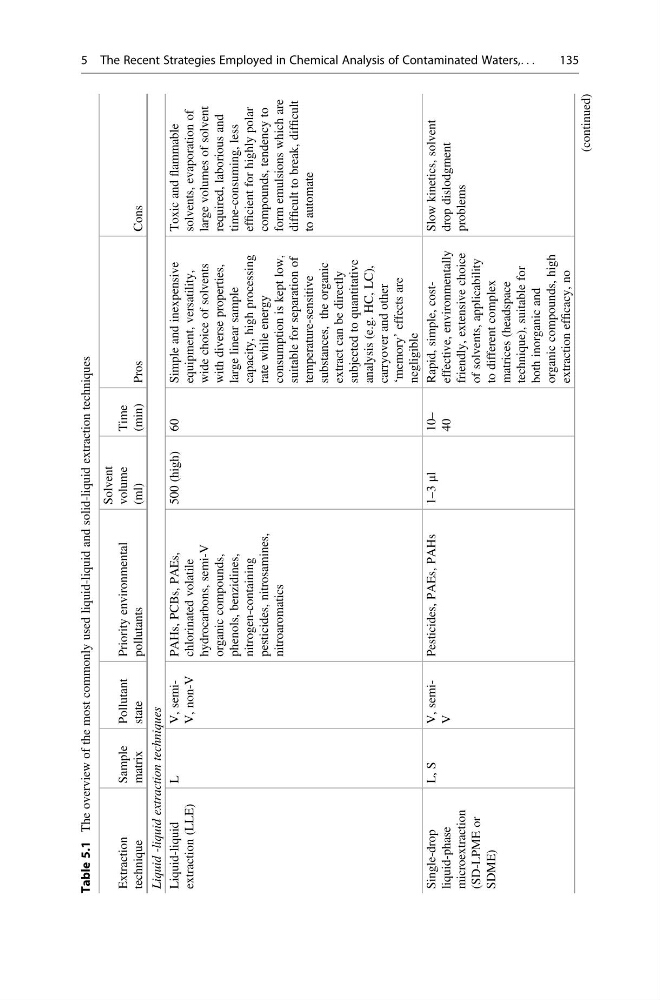
Table 5.1
The overview of the most commonly used liquid-liquid and solid-liquid extraction techniques
Extraction
technique
Sample
matrix
Pollutant
state
Priority environmental
pollutants
Solvent
volume
(ml)
Time
(min)
Pros
Cons
Liquid -liquid extraction techniques
Liquid-liquid
extraction (LLE)
L
V, semiV, non-V
PAHs, PCBs, PAEs,
chlorinated volatile
hydrocarbons, semi-V
organic compounds,
phenols, benzidines,
nitrogen-containing
pesticides, nitrosamines,
nitroaromatics
500 (high)
60
Simple and inexpensive
equipment, versatility,
wide choice of solvents
with diverse properties,
large linear sample
capacity, high processing
rate while energy
consumption is kept low,
suitable for separation of
temperature-sensitive
substances, the organic
extract can be directly
subjected to quantitative
analysis (e.g. HC, LC),
carryover and other
‘memory’ effects are
negligible
Toxic and
flammable
solvents, evaporation of
large volumes of solvent
required, laborious and
time-consuming, less
efficient for highly polar
compounds, tendency to
form emulsions which are
difficult to break, difficult
to automate
Single-drop
liquid-phase
microextraction
(SD-LPME or
SDME)
L, S
V, semiV
Pesticides, PAEs, PAHs
1–3
μl
1 0
–
40
Rapid, simple, costeffective, environmentally
friendly, extensive choice
of solvents, applicability
to different complex
matrices (headspace
technique), suitable for
both inorganic and
organic compounds, high
extraction efficacy, no
Slow kinetics, solvent
drop dislodgment
problems
(continued)
5 The Recent Strategies Employed in Chemical Analysis of Contaminated Waters,. . .
135
The overview of the most commonly used liquid-liquid and solid-liquid extraction techniques
Extraction
technique
Sample
matrix
Pollutant
state
Priority environmental
pollutants
Solvent
volume
(ml)
Time
(min)
Pros
Cons
Liquid -liquid extraction techniques
Liquid-liquid
extraction (LLE)
L
V, semiV, non-V
PAHs, PCBs, PAEs,
chlorinated volatile
hydrocarbons, semi-V
organic compounds,
phenols, benzidines,
nitrogen-containing
pesticides, nitrosamines,
nitroaromatics
500 (high)
60
Simple and inexpensive
equipment, versatility,
wide choice of solvents
with diverse properties,
large linear sample
capacity, high processing
rate while energy
consumption is kept low,
suitable for separation of
temperature-sensitive
substances, the organic
extract can be directly
subjected to quantitative
analysis (e.g. HC, LC),
carryover and other
‘memory’ effects are
negligible
Toxic and
flammable
solvents, evaporation of
large volumes of solvent
required, laborious and
time-consuming, less
efficient for highly polar
compounds, tendency to
form emulsions which are
difficult to break, difficult
to automate
Single-drop
liquid-phase
microextraction
(SD-LPME or
SDME)
L, S
V, semiV
Pesticides, PAEs, PAHs
1–3
μl
1 0
–
40
Rapid, simple, costeffective, environmentally
friendly, extensive choice
of solvents, applicability
to different complex
matrices (headspace
technique), suitable for
both inorganic and
organic compounds, high
extraction efficacy, no
Slow kinetics, solvent
drop dislodgment
problems
(continued)
5 The Recent Strategies Employed in Chemical Analysis of Contaminated Waters,. . .
135