

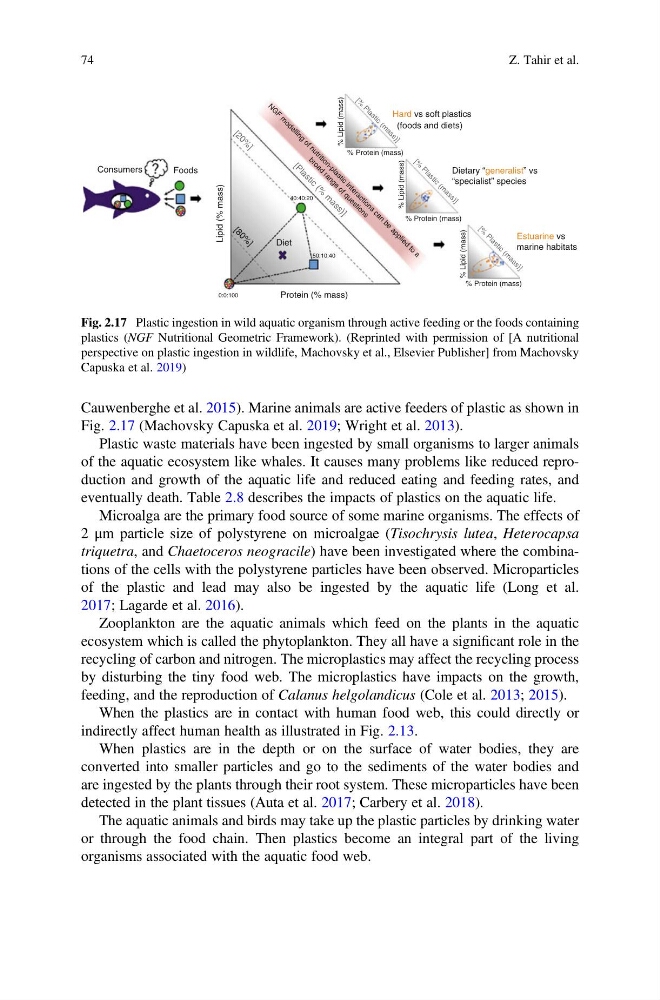
Cauwenberghe et al. 2015). Marine animals are active feeders of plastic as shown in
Fig. 2.17 (Machovsky Capuska et al. 2019; Wright et al. 2013).
Plastic waste materials have been ingested by small organisms to larger animals
of the aquatic ecosystem like whales. It causes many problems like reduced reproduction and growth of the aquatic life and reduced eating and feeding rates, and
eventually death. Table 2.8 describes the impacts of plastics on the aquatic life.
Microalga are the primary food source of some marine organisms. The effects of
2 μm particle size of polystyrene on microalgae (Tisochrysis lutea, Heterocapsa
triquetra, and Chaetoceros neogracile) have been investigated where the combinations of the cells with the polystyrene particles have been observed. Microparticles
of the plastic and lead may also be ingested by the aquatic life (Long et al.
2017; Lagarde et al. 2016).
Zooplankton are the aquatic animals which feed on the plants in the aquatic
ecosystem which is called the phytoplankton. They all have a significant role in the
recycling of carbon and nitrogen. The microplastics may affect the recycling process
by disturbing the tiny food web. The microplastics have impacts on the growth,
feeding, and the reproduction of Calanus helgolandicus (Cole et al. 2013; 2015).
When the plastics are in contact with human food web, this could directly or
indirectly affect human health as illustrated in Fig. 2.13.
When plastics are in the depth or on the surface of water bodies, they are
converted into smaller particles and go to the sediments of the water bodies and
are ingested by the plants through their root system. These microparticles have been
detected in the plant tissues (Auta et al. 2017; Carbery et al. 2018).
The aquatic animals and birds may take up the plastic particles by drinking water
or through the food chain. Then plastics become an integral part of the living
organisms associated with the aquatic food web.
Consumers
Foods
Lipid (% mass)
% Lipid (mass)
% Lipid (mass)
% Lipid (mass)
Protein (% mass)
% Protein (mass)
% Protein (mass)
% Protein (mass)
0:0:100
Diet
50:10:40
40:40:20
(foods and diets)
Dietary “generalist” vs
“specialist” species
Estuarine vs
marine habitats
N
G
F
m
o d e ll in
g
o f n u tr it io
n - p la
s ti c
in
te
r a c ti o n s
c a n
b e
a p p li e d
to
a
b r o a d
r a n g e
o f q u e s ti o n s
[% P la
s ti c
( m
a s s ) ]
[% P la
s ti c
( m
a s s ) ]
[% P la
s ti c
( m
a s s ) ]
[ P la
s t ic
( %
m
a s s ) ]
[ 2 0 %
]
[ 8
0
%
]
Hard vs soft plastics
Fig. 2.17 Plastic ingestion in wild aquatic organism through active feeding or the foods containing
plastics (NGF Nutritional Geometric Framework). (Reprinted with permission of [A nutritional
perspective on plastic ingestion in wildlife, Machovsky et al., Elsevier Publisher] from Machovsky
Capuska et al. 2019)
74
Z. Tahir et al.
Fig. 2.17 (Machovsky Capuska et al. 2019; Wright et al. 2013).
Plastic waste materials have been ingested by small organisms to larger animals
of the aquatic ecosystem like whales. It causes many problems like reduced reproduction and growth of the aquatic life and reduced eating and feeding rates, and
eventually death. Table 2.8 describes the impacts of plastics on the aquatic life.
Microalga are the primary food source of some marine organisms. The effects of
2 μm particle size of polystyrene on microalgae (Tisochrysis lutea, Heterocapsa
triquetra, and Chaetoceros neogracile) have been investigated where the combinations of the cells with the polystyrene particles have been observed. Microparticles
of the plastic and lead may also be ingested by the aquatic life (Long et al.
2017; Lagarde et al. 2016).
Zooplankton are the aquatic animals which feed on the plants in the aquatic
ecosystem which is called the phytoplankton. They all have a significant role in the
recycling of carbon and nitrogen. The microplastics may affect the recycling process
by disturbing the tiny food web. The microplastics have impacts on the growth,
feeding, and the reproduction of Calanus helgolandicus (Cole et al. 2013; 2015).
When the plastics are in contact with human food web, this could directly or
indirectly affect human health as illustrated in Fig. 2.13.
When plastics are in the depth or on the surface of water bodies, they are
converted into smaller particles and go to the sediments of the water bodies and
are ingested by the plants through their root system. These microparticles have been
detected in the plant tissues (Auta et al. 2017; Carbery et al. 2018).
The aquatic animals and birds may take up the plastic particles by drinking water
or through the food chain. Then plastics become an integral part of the living
organisms associated with the aquatic food web.
Consumers
Foods
Lipid (% mass)
% Lipid (mass)
% Lipid (mass)
% Lipid (mass)
Protein (% mass)
% Protein (mass)
% Protein (mass)
% Protein (mass)
0:0:100
Diet
50:10:40
40:40:20
(foods and diets)
Dietary “generalist” vs
“specialist” species
Estuarine vs
marine habitats
N
G
F
m
o d e ll in
g
o f n u tr it io
n - p la
s ti c
in
te
r a c ti o n s
c a n
b e
a p p li e d
to
a
b r o a d
r a n g e
o f q u e s ti o n s
[% P la
s ti c
( m
a s s ) ]
[% P la
s ti c
( m
a s s ) ]
[% P la
s ti c
( m
a s s ) ]
[ P la
s t ic
( %
m
a s s ) ]
[ 2 0 %
]
[ 8
0
%
]
Hard vs soft plastics
Fig. 2.17 Plastic ingestion in wild aquatic organism through active feeding or the foods containing
plastics (NGF Nutritional Geometric Framework). (Reprinted with permission of [A nutritional
perspective on plastic ingestion in wildlife, Machovsky et al., Elsevier Publisher] from Machovsky
Capuska et al. 2019)
74
Z. Tahir et al.