

identified by Fourier transform infrared spectroscopy technique with high accuracy.
For the identification of small size particles, Fourier transform infrared spectroscopy/
microscopy technique is used. But this technique cannot analyze particle less than
20 μm (Löder and Gerdts 2015).
Mass spectroscopy when combined with the pyrolysis-gas chromatography is
used to get the chemical arrangement of the microplastics by investigating their
thermally-degraded products (Fries et al. 2013). This can be used to determine the
type of polymer, by correlating their combustion product with a reference (Fries
et al. 2013). Additives can be examined concurrently using a pyrolysis-gas chromatography/mass spectrometry runs, if the thermal desorption occurs before the last
step of the pyrolysis. This is suitable for the lower-sized microparticles. The analysis
of one particle per run can be done by this technique but not for the bulky particles
(Löder and Gerdts 2015). Different techniques can be used to quantify the marine
water plastic contaminants (Fig. 2.12) (Kroon et al. 2018), which include the
microscopic photography, Fourier transform infrared spectroscopy, stereomicroscopic visual sorting, and attenuated total reflectance.
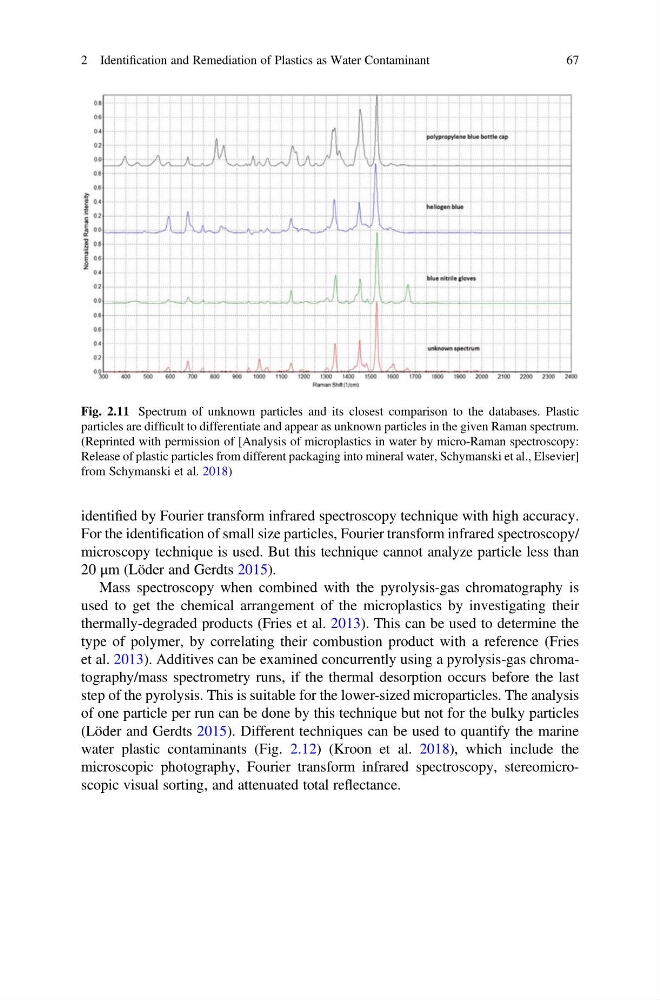
Fig. 2.11 Spectrum of unknown particles and its closest comparison to the databases. Plastic
particles are difficult to differentiate and appear as unknown particles in the given Raman spectrum.
(Reprinted with permission of [Analysis of microplastics in water by micro-Raman spectroscopy:
Release of plastic particles from different packaging into mineral water, Schymanski et al., Elsevier]
from Schymanski et al. 2018)
2 Identification and Remediation of Plastics as Water Contaminant
67
For the identification of small size particles, Fourier transform infrared spectroscopy/
microscopy technique is used. But this technique cannot analyze particle less than
20 μm (Löder and Gerdts 2015).
Mass spectroscopy when combined with the pyrolysis-gas chromatography is
used to get the chemical arrangement of the microplastics by investigating their
thermally-degraded products (Fries et al. 2013). This can be used to determine the
type of polymer, by correlating their combustion product with a reference (Fries
et al. 2013). Additives can be examined concurrently using a pyrolysis-gas chromatography/mass spectrometry runs, if the thermal desorption occurs before the last
step of the pyrolysis. This is suitable for the lower-sized microparticles. The analysis
of one particle per run can be done by this technique but not for the bulky particles
(Löder and Gerdts 2015). Different techniques can be used to quantify the marine
water plastic contaminants (Fig. 2.12) (Kroon et al. 2018), which include the
microscopic photography, Fourier transform infrared spectroscopy, stereomicroscopic visual sorting, and attenuated total reflectance.
Fig. 2.11 Spectrum of unknown particles and its closest comparison to the databases. Plastic
particles are difficult to differentiate and appear as unknown particles in the given Raman spectrum.
(Reprinted with permission of [Analysis of microplastics in water by micro-Raman spectroscopy:
Release of plastic particles from different packaging into mineral water, Schymanski et al., Elsevier]
from Schymanski et al. 2018)
2 Identification and Remediation of Plastics as Water Contaminant
67