

Overall, biological methods are comparatively green and sustainable. A major
issue associated with the biological method is robustness. Innovative approaches are
required to ensure the reproducibility of results. Moreover, there is still room to
explore the synergistic effect of microorganisms not only within the domain but in
combination with physical and chemical methods.
17.5 Conclusions and Prospects
The natural and synthetic dyes which make our life colorful also cause much
pollution of water bodies. Effluents from the dye industry contain very harmful
chemicals. The organic dyes should be discharged up to only certain strict limits in
final effluents discharged untreated in natural water resources. Removal of dye from
textile effluents is an environmental issue that can be solved by use of adequate
mechano-physical-chemical and biological treatment of textile effluents. A thorough
survey of all the useful data is available for the study and is discussed with the
overall impact on the treatment of wastewater. Conclusively, among the different
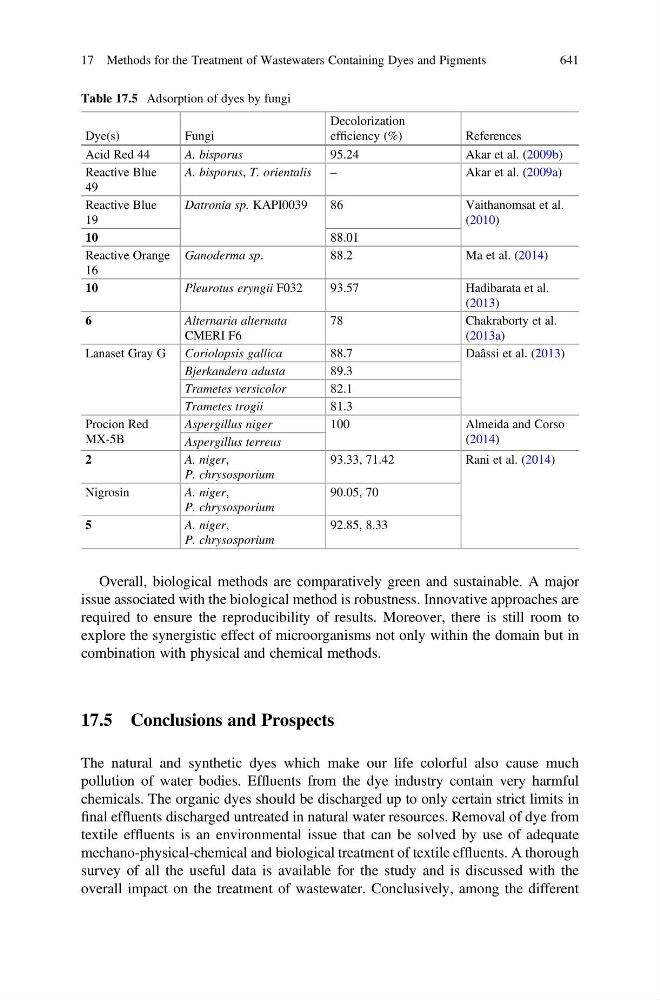
Table 17.5 Adsorption of dyes by fungi
Dye(s)
Fungi
Decolorization
efficiency (%)
References
Acid Red 44
A. bisporus
95.24
Akar et al. (2009b)
Reactive Blue
49
A. bisporus, T. orientalis –
Akar et al. (2009a)
Reactive Blue
19
Datronia sp. KAPI0039
86
Vaithanomsat et al.
(2010)
10
88.01
Reactive Orange
16
Ganoderma sp.
88.2
Ma et al. (2014)
10
Pleurotus eryngii F032
93.57
Hadibarata et al.
(2013)
6
Alternaria alternata
CMERI F6
78
Chakraborty et al.
(2013a)
Lanaset Gray G Coriolopsis gallica
88.7
Daâssi et al. (2013)
Bjerkandera adusta
89.3
Trametes versicolor
82.1
Trametes trogii
81.3
Procion Red
MX-5B
Aspergillus niger
100
Almeida and Corso
(2014)
Aspergillus terreus
2
A. niger,
P. chrysosporium
93.33, 71.42
Rani et al. (2014)
Nigrosin
A. niger,
P. chrysosporium
90.05, 70
5
A. niger,
P. chrysosporium
92.85, 8.33
17 Methods for the Treatment of Wastewaters Containing Dyes and Pigments
641
issue associated with the biological method is robustness. Innovative approaches are
required to ensure the reproducibility of results. Moreover, there is still room to
explore the synergistic effect of microorganisms not only within the domain but in
combination with physical and chemical methods.
17.5 Conclusions and Prospects
The natural and synthetic dyes which make our life colorful also cause much
pollution of water bodies. Effluents from the dye industry contain very harmful
chemicals. The organic dyes should be discharged up to only certain strict limits in
final effluents discharged untreated in natural water resources. Removal of dye from
textile effluents is an environmental issue that can be solved by use of adequate
mechano-physical-chemical and biological treatment of textile effluents. A thorough
survey of all the useful data is available for the study and is discussed with the
overall impact on the treatment of wastewater. Conclusively, among the different
Table 17.5 Adsorption of dyes by fungi
Dye(s)
Fungi
Decolorization
efficiency (%)
References
Acid Red 44
A. bisporus
95.24
Akar et al. (2009b)
Reactive Blue
49
A. bisporus, T. orientalis –
Akar et al. (2009a)
Reactive Blue
19
Datronia sp. KAPI0039
86
Vaithanomsat et al.
(2010)
10
88.01
Reactive Orange
16
Ganoderma sp.
88.2
Ma et al. (2014)
10
Pleurotus eryngii F032
93.57
Hadibarata et al.
(2013)
6
Alternaria alternata
CMERI F6
78
Chakraborty et al.
(2013a)
Lanaset Gray G Coriolopsis gallica
88.7
Daâssi et al. (2013)
Bjerkandera adusta
89.3
Trametes versicolor
82.1
Trametes trogii
81.3
Procion Red
MX-5B
Aspergillus niger
100
Almeida and Corso
(2014)
Aspergillus terreus
2
A. niger,
P. chrysosporium
93.33, 71.42
Rani et al. (2014)
Nigrosin
A. niger,
P. chrysosporium
90.05, 70
5
A. niger,
P. chrysosporium
92.85, 8.33
17 Methods for the Treatment of Wastewaters Containing Dyes and Pigments
641