

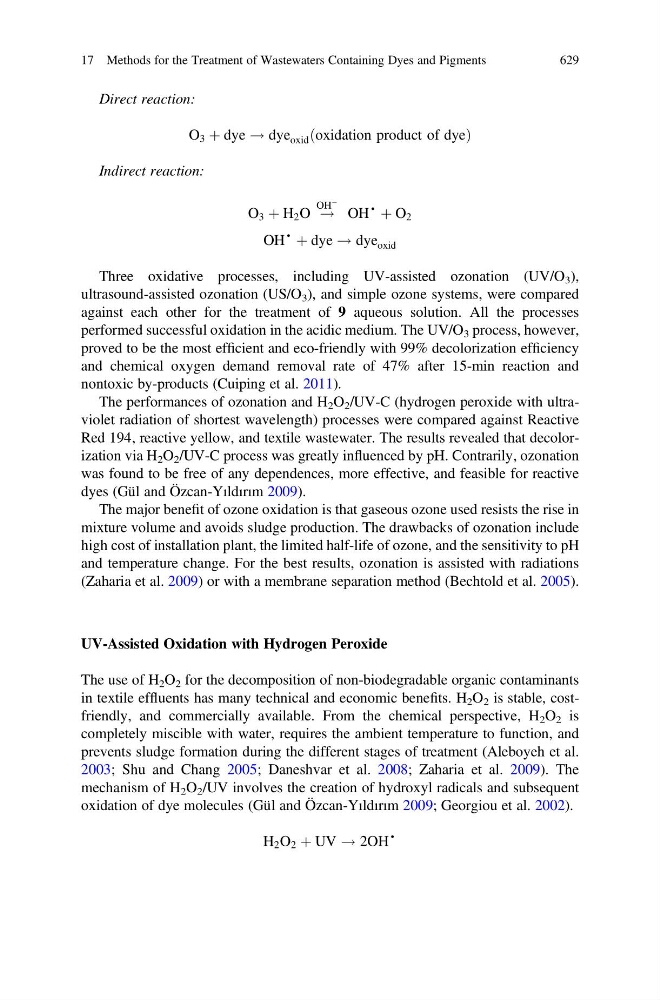
Direct reaction:
O 3 þ dye ! dye oxid oxidation product of dye
ð
Þ
Indirect reaction:
O 3 þ H 2 O !
OH
À
OH
•
þ O 2
OH
•
þ dye ! dye oxid
Three oxidative processes, including UV-assisted ozonation (UV/O 3 ),
ultrasound-assisted ozonation (US/O 3 ), and simple ozone systems, were compared
against each other for the treatment of 9 aqueous solution. All the processes
performed successful oxidation in the acidic medium. The UV/O 3 process, however,
proved to be the most efficient and eco-friendly with 99% decolorization efficiency
and chemical oxygen demand removal rate of 47% after 15-min reaction and
nontoxic by-products (Cuiping et al. 2011).
The performances of ozonation and H 2 O 2 /UV-C (hydrogen peroxide with ultraviolet radiation of shortest wavelength) processes were compared against Reactive
Red 194, reactive yellow, and textile wastewater. The results revealed that decolorization via H 2 O 2 /UV-C process was greatly influenced by pH. Contrarily, ozonation
was found to be free of any dependences, more effective, and feasible for reactive
dyes (Gül and Özcan-Yıldırım 2009).
The major benefit of ozone oxidation is that gaseous ozone used resists the rise in
mixture volume and avoids sludge production. The drawbacks of ozonation include
high cost of installation plant, the limited half-life of ozone, and the sensitivity to pH
and temperature change. For the best results, ozonation is assisted with radiations
(Zaharia et al. 2009) or with a membrane separation method (Bechtold et al. 2005).
UV-Assisted Oxidation with Hydrogen Peroxide
The use of H 2 O 2 for the decomposition of non-biodegradable organic contaminants
in textile effluents has many technical and economic benefits. H 2 O 2 is stable, costfriendly, and commercially available. From the chemical perspective, H 2 O 2 is
completely miscible with water, requires the ambient temperature to function, and
prevents sludge formation during the different stages of treatment (Aleboyeh et al.
2003; Shu and Chang 2005; Daneshvar et al. 2008; Zaharia et al. 2009). The
mechanism of H 2 O 2 /UV involves the creation of hydroxyl radicals and subsequent
oxidation of dye molecules (Gül and Özcan-Yıldırım 2009; Georgiou et al. 2002).
H 2 O 2 þ UV ! 2OH
•
17 Methods for the Treatment of Wastewaters Containing Dyes and Pigments
629
O 3 þ dye ! dye oxid oxidation product of dye
ð
Þ
Indirect reaction:
O 3 þ H 2 O !
OH
À
OH
•
þ O 2
OH
•
þ dye ! dye oxid
Three oxidative processes, including UV-assisted ozonation (UV/O 3 ),
ultrasound-assisted ozonation (US/O 3 ), and simple ozone systems, were compared
against each other for the treatment of 9 aqueous solution. All the processes
performed successful oxidation in the acidic medium. The UV/O 3 process, however,
proved to be the most efficient and eco-friendly with 99% decolorization efficiency
and chemical oxygen demand removal rate of 47% after 15-min reaction and
nontoxic by-products (Cuiping et al. 2011).
The performances of ozonation and H 2 O 2 /UV-C (hydrogen peroxide with ultraviolet radiation of shortest wavelength) processes were compared against Reactive
Red 194, reactive yellow, and textile wastewater. The results revealed that decolorization via H 2 O 2 /UV-C process was greatly influenced by pH. Contrarily, ozonation
was found to be free of any dependences, more effective, and feasible for reactive
dyes (Gül and Özcan-Yıldırım 2009).
The major benefit of ozone oxidation is that gaseous ozone used resists the rise in
mixture volume and avoids sludge production. The drawbacks of ozonation include
high cost of installation plant, the limited half-life of ozone, and the sensitivity to pH
and temperature change. For the best results, ozonation is assisted with radiations
(Zaharia et al. 2009) or with a membrane separation method (Bechtold et al. 2005).
UV-Assisted Oxidation with Hydrogen Peroxide
The use of H 2 O 2 for the decomposition of non-biodegradable organic contaminants
in textile effluents has many technical and economic benefits. H 2 O 2 is stable, costfriendly, and commercially available. From the chemical perspective, H 2 O 2 is
completely miscible with water, requires the ambient temperature to function, and
prevents sludge formation during the different stages of treatment (Aleboyeh et al.
2003; Shu and Chang 2005; Daneshvar et al. 2008; Zaharia et al. 2009). The
mechanism of H 2 O 2 /UV involves the creation of hydroxyl radicals and subsequent
oxidation of dye molecules (Gül and Özcan-Yıldırım 2009; Georgiou et al. 2002).
H 2 O 2 þ UV ! 2OH
•
17 Methods for the Treatment of Wastewaters Containing Dyes and Pigments
629