

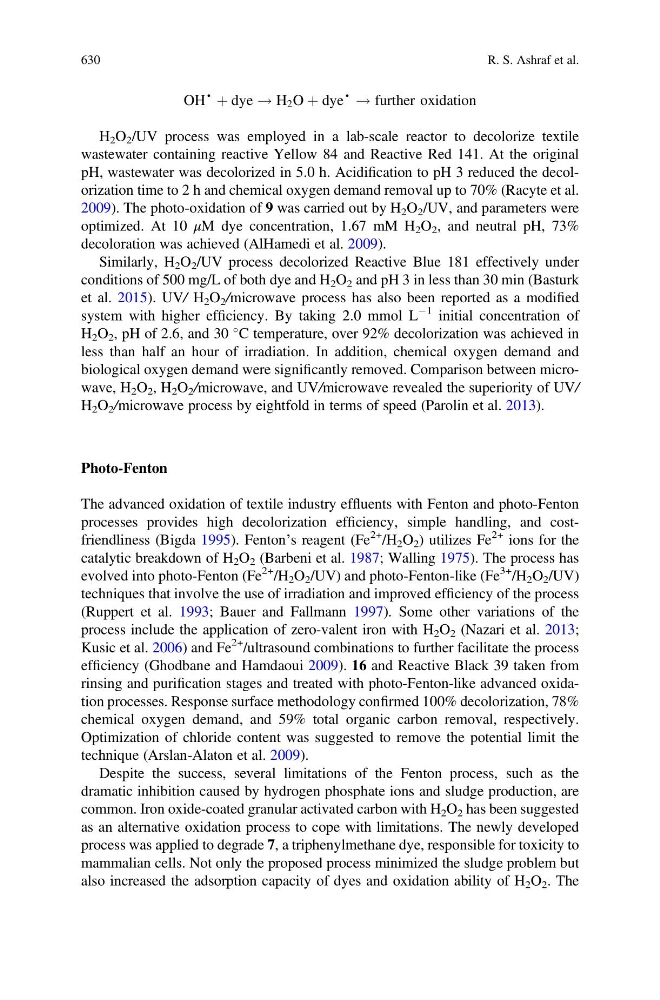
OH
•
þ dye ! H 2 O þ dye
•
! further oxidation
H 2 O 2 /UV process was employed in a lab-scale reactor to decolorize textile
wastewater containing reactive Yellow 84 and Reactive Red 141. At the original
pH, wastewater was decolorized in 5.0 h. Acidification to pH 3 reduced the decolorization time to 2 h and chemical oxygen demand removal up to 70% (Racyte et al.
2009). The photo-oxidation of 9 was carried out by H 2 O 2 /UV, and parameters were
optimized. At 10 μM dye concentration, 1.67 mM H 2 O 2 , and neutral pH, 73%
decoloration was achieved (AlHamedi et al. 2009).
Similarly, H 2 O 2 /UV process decolorized Reactive Blue 181 effectively under
conditions of 500 mg/L of both dye and H 2 O 2 and pH 3 in less than 30 min (Basturk
et al. 2015). UV/ H 2 O 2 /microwave process has also been reported as a modified
system with higher efficiency. By taking 2.0 mmol L
À1 initial concentration of
H 2 O 2 , pH of 2.6, and 30
C temperature, over 92% decolorization was achieved in
less than half an hour of irradiation. In addition, chemical oxygen demand and
biological oxygen demand were significantly removed. Comparison between microwave, H 2 O 2 , H 2 O 2 /microwave, and UV/microwave revealed the superiority of UV/
H 2 O 2 /microwave process by eightfold in terms of speed (Parolin et al. 2013).
Photo-Fenton
The advanced oxidation of textile industry effluents with Fenton and photo-Fenton
processes provides high decolorization efficiency, simple handling, and costfriendliness (Bigda 1995). Fenton’s reagent (Fe
2+ /H 2 O 2 ) utilizes Fe
2+ ions for the
catalytic breakdown of H 2 O 2 (Barbeni et al. 1987; Walling 1975). The process has
evolved into photo-Fenton (Fe
2+ /H 2 O 2 /UV) and photo-Fenton-like (Fe
3+ /H 2 O 2 /UV)
techniques that involve the use of irradiation and improved efficiency of the process
(Ruppert et al. 1993; Bauer and Fallmann 1997). Some other variations of the
process include the application of zero-valent iron with H 2 O 2 (Nazari et al. 2013;
Kusic et al. 2006) and Fe
2+ /ultrasound combinations to further facilitate the process
efficiency (Ghodbane and Hamdaoui 2009). 16 and Reactive Black 39 taken from
rinsing and purification stages and treated with photo-Fenton-like advanced oxidation processes. Response surface methodology confirmed 100% decolorization, 78%
chemical oxygen demand, and 59% total organic carbon removal, respectively.
Optimization of chloride content was suggested to remove the potential limit the
technique (Arslan-Alaton et al. 2009).
Despite the success, several limitations of the Fenton process, such as the
dramatic inhibition caused by hydrogen phosphate ions and sludge production, are
common. Iron oxide-coated granular activated carbon with H 2 O 2 has been suggested
as an alternative oxidation process to cope with limitations. The newly developed
process was applied to degrade 7, a triphenylmethane dye, responsible for toxicity to
mammalian cells. Not only the proposed process minimized the sludge problem but
also increased the adsorption capacity of dyes and oxidation ability of H 2 O 2 . The
630
R. S. Ashraf et al.
•
þ dye ! H 2 O þ dye
•
! further oxidation
H 2 O 2 /UV process was employed in a lab-scale reactor to decolorize textile
wastewater containing reactive Yellow 84 and Reactive Red 141. At the original
pH, wastewater was decolorized in 5.0 h. Acidification to pH 3 reduced the decolorization time to 2 h and chemical oxygen demand removal up to 70% (Racyte et al.
2009). The photo-oxidation of 9 was carried out by H 2 O 2 /UV, and parameters were
optimized. At 10 μM dye concentration, 1.67 mM H 2 O 2 , and neutral pH, 73%
decoloration was achieved (AlHamedi et al. 2009).
Similarly, H 2 O 2 /UV process decolorized Reactive Blue 181 effectively under
conditions of 500 mg/L of both dye and H 2 O 2 and pH 3 in less than 30 min (Basturk
et al. 2015). UV/ H 2 O 2 /microwave process has also been reported as a modified
system with higher efficiency. By taking 2.0 mmol L
À1 initial concentration of
H 2 O 2 , pH of 2.6, and 30
C temperature, over 92% decolorization was achieved in
less than half an hour of irradiation. In addition, chemical oxygen demand and
biological oxygen demand were significantly removed. Comparison between microwave, H 2 O 2 , H 2 O 2 /microwave, and UV/microwave revealed the superiority of UV/
H 2 O 2 /microwave process by eightfold in terms of speed (Parolin et al. 2013).
Photo-Fenton
The advanced oxidation of textile industry effluents with Fenton and photo-Fenton
processes provides high decolorization efficiency, simple handling, and costfriendliness (Bigda 1995). Fenton’s reagent (Fe
2+ /H 2 O 2 ) utilizes Fe
2+ ions for the
catalytic breakdown of H 2 O 2 (Barbeni et al. 1987; Walling 1975). The process has
evolved into photo-Fenton (Fe
2+ /H 2 O 2 /UV) and photo-Fenton-like (Fe
3+ /H 2 O 2 /UV)
techniques that involve the use of irradiation and improved efficiency of the process
(Ruppert et al. 1993; Bauer and Fallmann 1997). Some other variations of the
process include the application of zero-valent iron with H 2 O 2 (Nazari et al. 2013;
Kusic et al. 2006) and Fe
2+ /ultrasound combinations to further facilitate the process
efficiency (Ghodbane and Hamdaoui 2009). 16 and Reactive Black 39 taken from
rinsing and purification stages and treated with photo-Fenton-like advanced oxidation processes. Response surface methodology confirmed 100% decolorization, 78%
chemical oxygen demand, and 59% total organic carbon removal, respectively.
Optimization of chloride content was suggested to remove the potential limit the
technique (Arslan-Alaton et al. 2009).
Despite the success, several limitations of the Fenton process, such as the
dramatic inhibition caused by hydrogen phosphate ions and sludge production, are
common. Iron oxide-coated granular activated carbon with H 2 O 2 has been suggested
as an alternative oxidation process to cope with limitations. The newly developed
process was applied to degrade 7, a triphenylmethane dye, responsible for toxicity to
mammalian cells. Not only the proposed process minimized the sludge problem but
also increased the adsorption capacity of dyes and oxidation ability of H 2 O 2 . The
630
R. S. Ashraf et al.