

XAD-1180 were used. Adsorption data followed Langmuir adsorption isotherm
model with q max values of 560.7, 270.9, and 35.7 mg g
À1 for Lewatit MonoPlus
SP-112, Dowex Optipore SD-2 and Amberlite XAD-1180, respectively. Kinetically,
the system followed pseudo-second-order, and 100% performance was reported with
four cycles of sorption-desorption (Wawrzkiewicz 2013).
17.3 Chemical Methods
Chemical methods for dye decolorization and degradation from wastewater mainly
include advanced oxidation processes and photocatalytic and electrochemical treatments. All methods mentioned above involve the use of chemicals and chemical
reactions between reagents and dye molecules, which often results in hazardous
by-products. Nevertheless, many novel approaches have been designed to unlock the
potential and safety of chemical methods. Below is the detail of all the major dye
removal chemical methods.
17.3.1 Advanced Oxidation Processes
Because of the simple handling, oxidation is the most commonly used chemical
decolorization process. Constant developments and improved understanding of the
oxidation mechanism enabled the evolution of advanced oxidation processes. The
advanced oxidation processes are suitable for the removal of chemically stable and
non-biodegradable wastewater constituents. Advanced oxidation processes transform the pollutants by mineralization into carbon dioxide, water, and salts (Poyatos
et al. 2010).
Advanced oxidation processes involve the production of hydroxyl (
•
OH) radicals
destroying pollutants until mineralization. All types of advanced oxidation processes, including photochemical degradation (O 3 /UV, UV/H 2 O 2 ), photocatalysis
(UV/TiO 2 ), and chemical oxidation methods (O 3 , O 3 /H 2 O 2 , H 2 O 2 /Fe
2+ ), share the
same mechanism (Rosenfeldt et al. 2007; Skoumal et al. 2006; Ollis 1993).
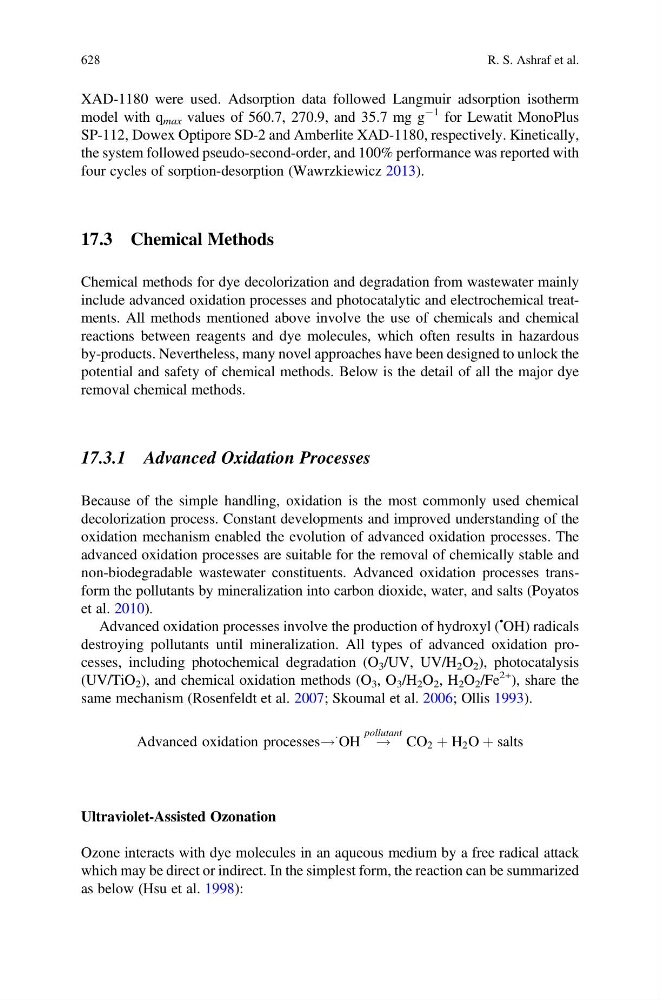
Advanced oxidation processes!
Á OH !
pollutant CO 2 þ H 2 O þ salts
Ultraviolet-Assisted Ozonation
Ozone interacts with dye molecules in an aqueous medium by a free radical attack
which may be direct or indirect. In the simplest form, the reaction can be summarized
as below (Hsu et al. 1998):
628
R. S. Ashraf et al.
model with q max values of 560.7, 270.9, and 35.7 mg g
À1 for Lewatit MonoPlus
SP-112, Dowex Optipore SD-2 and Amberlite XAD-1180, respectively. Kinetically,
the system followed pseudo-second-order, and 100% performance was reported with
four cycles of sorption-desorption (Wawrzkiewicz 2013).
17.3 Chemical Methods
Chemical methods for dye decolorization and degradation from wastewater mainly
include advanced oxidation processes and photocatalytic and electrochemical treatments. All methods mentioned above involve the use of chemicals and chemical
reactions between reagents and dye molecules, which often results in hazardous
by-products. Nevertheless, many novel approaches have been designed to unlock the
potential and safety of chemical methods. Below is the detail of all the major dye
removal chemical methods.
17.3.1 Advanced Oxidation Processes
Because of the simple handling, oxidation is the most commonly used chemical
decolorization process. Constant developments and improved understanding of the
oxidation mechanism enabled the evolution of advanced oxidation processes. The
advanced oxidation processes are suitable for the removal of chemically stable and
non-biodegradable wastewater constituents. Advanced oxidation processes transform the pollutants by mineralization into carbon dioxide, water, and salts (Poyatos
et al. 2010).
Advanced oxidation processes involve the production of hydroxyl (
•
OH) radicals
destroying pollutants until mineralization. All types of advanced oxidation processes, including photochemical degradation (O 3 /UV, UV/H 2 O 2 ), photocatalysis
(UV/TiO 2 ), and chemical oxidation methods (O 3 , O 3 /H 2 O 2 , H 2 O 2 /Fe
2+ ), share the
same mechanism (Rosenfeldt et al. 2007; Skoumal et al. 2006; Ollis 1993).
Advanced oxidation processes!
Á OH !
pollutant CO 2 þ H 2 O þ salts
Ultraviolet-Assisted Ozonation
Ozone interacts with dye molecules in an aqueous medium by a free radical attack
which may be direct or indirect. In the simplest form, the reaction can be summarized
as below (Hsu et al. 1998):
628
R. S. Ashraf et al.