

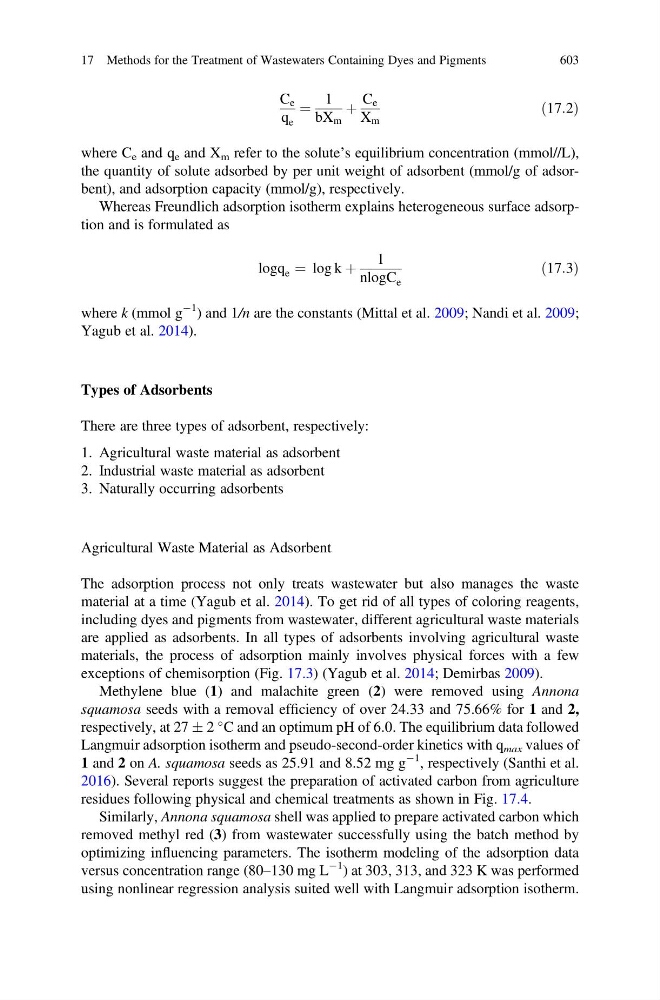
C e
q e
¼
1
bX m
þ
C e
X m
ð17:2Þ
where C e and q e and X m refer to the solute’s equilibrium concentration (mmol//L),
the quantity of solute adsorbed by per unit weight of adsorbent (mmol/g of adsorbent), and adsorption capacity (mmol/g), respectively.
Whereas Freundlich adsorption isotherm explains heterogeneous surface adsorption and is formulated as
logq e ¼ log k þ
1
nlogC e
ð17:3Þ
where k (mmol g
À1 ) and 1/n are the constants (Mittal et al. 2009; Nandi et al. 2009;
Yagub et al. 2014).
Types of Adsorbents
There are three types of adsorbent, respectively:
1. Agricultural waste material as adsorbent
2. Industrial waste material as adsorbent
3. Naturally occurring adsorbents
Agricultural Waste Material as Adsorbent
The adsorption process not only treats wastewater but also manages the waste
material at a time (Yagub et al. 2014). To get rid of all types of coloring reagents,
including dyes and pigments from wastewater, different agricultural waste materials
are applied as adsorbents. In all types of adsorbents involving agricultural waste
materials, the process of adsorption mainly involves physical forces with a few
exceptions of chemisorption (Fig. 17.3) (Yagub et al. 2014; Demirbas 2009).
Methylene blue (1) and malachite green (2) were removed using Annona
squamosa seeds with a removal efficiency of over 24.33 and 75.66% for 1 and 2,
respectively, at 27 Æ 2
C and an optimum pH of 6.0. The equilibrium data followed
Langmuir adsorption isotherm and pseudo-second-order kinetics with q max values of
1 and 2 on A. squamosa seeds as 25.91 and 8.52 mg g
À1 , respectively (Santhi et al.
2016). Several reports suggest the preparation of activated carbon from agriculture
residues following physical and chemical treatments as shown in Fig. 17.4.
Similarly, Annona squamosa shell was applied to prepare activated carbon which
removed methyl red (3) from wastewater successfully using the batch method by
optimizing influencing parameters. The isotherm modeling of the adsorption data
versus concentration range (80–130 mg L
À1 ) at 303, 313, and 323 K was performed
using nonlinear regression analysis suited well with Langmuir adsorption isotherm.
17 Methods for the Treatment of Wastewaters Containing Dyes and Pigments
603
q e
¼
1
bX m
þ
C e
X m
ð17:2Þ
where C e and q e and X m refer to the solute’s equilibrium concentration (mmol//L),
the quantity of solute adsorbed by per unit weight of adsorbent (mmol/g of adsorbent), and adsorption capacity (mmol/g), respectively.
Whereas Freundlich adsorption isotherm explains heterogeneous surface adsorption and is formulated as
logq e ¼ log k þ
1
nlogC e
ð17:3Þ
where k (mmol g
À1 ) and 1/n are the constants (Mittal et al. 2009; Nandi et al. 2009;
Yagub et al. 2014).
Types of Adsorbents
There are three types of adsorbent, respectively:
1. Agricultural waste material as adsorbent
2. Industrial waste material as adsorbent
3. Naturally occurring adsorbents
Agricultural Waste Material as Adsorbent
The adsorption process not only treats wastewater but also manages the waste
material at a time (Yagub et al. 2014). To get rid of all types of coloring reagents,
including dyes and pigments from wastewater, different agricultural waste materials
are applied as adsorbents. In all types of adsorbents involving agricultural waste
materials, the process of adsorption mainly involves physical forces with a few
exceptions of chemisorption (Fig. 17.3) (Yagub et al. 2014; Demirbas 2009).
Methylene blue (1) and malachite green (2) were removed using Annona
squamosa seeds with a removal efficiency of over 24.33 and 75.66% for 1 and 2,
respectively, at 27 Æ 2
C and an optimum pH of 6.0. The equilibrium data followed
Langmuir adsorption isotherm and pseudo-second-order kinetics with q max values of
1 and 2 on A. squamosa seeds as 25.91 and 8.52 mg g
À1 , respectively (Santhi et al.
2016). Several reports suggest the preparation of activated carbon from agriculture
residues following physical and chemical treatments as shown in Fig. 17.4.
Similarly, Annona squamosa shell was applied to prepare activated carbon which
removed methyl red (3) from wastewater successfully using the batch method by
optimizing influencing parameters. The isotherm modeling of the adsorption data
versus concentration range (80–130 mg L
À1 ) at 303, 313, and 323 K was performed
using nonlinear regression analysis suited well with Langmuir adsorption isotherm.
17 Methods for the Treatment of Wastewaters Containing Dyes and Pigments
603