

Kinetic modeling confirmed pseudo-first-order and pseudo-second-order rate
expressions suggesting activated carbon made from Annona squamosa shell a strong
adsorbent for decolorization of other industrial effluents as well (Khan and Khan
2018). Likewise, adsorbent prepared from Annona squamosa shell adsorbed Orange
II (19) from aqueous solution using a batch process at optimum contact time and
pH. Results from all evaluated concentrations from 5 to 40 mg L
À1 followed the
pseudo-second-order kinetics. Both Langmuir and Freundlich adsorption isotherms
confirmed utilization of Annona squamosa seeds as an economic adsorbent for dye
remediation from effluents (Sonawane and Shrivastava 2011).
Another adsorbent, chemically modified barley straw obtained by treating barley
straw with NaOH and a cationic surfactant hexadecyl pyridinium chloride
monohydrate, removed anionic dyes such as Acid Blue 40 (15) and Reactive Blue
4 (20) with q max determined from the Langmuir adsorption isotherm at 250
C of
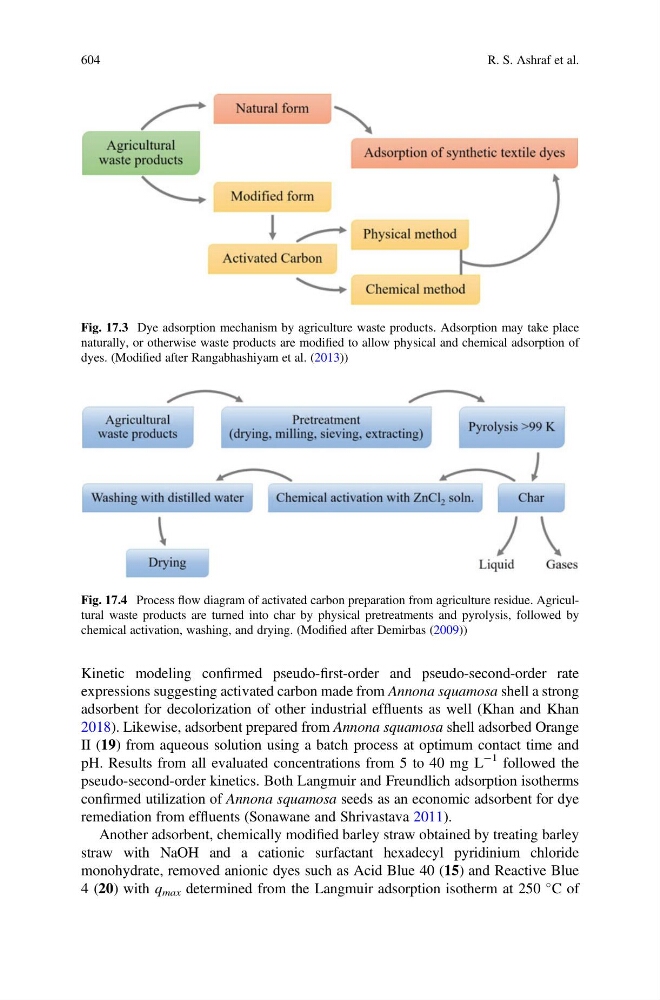
Fig. 17.3 Dye adsorption mechanism by agriculture waste products. Adsorption may take place
naturally, or otherwise waste products are modified to allow physical and chemical adsorption of
dyes. (Modified after Rangabhashiyam et al. (2013))
Fig. 17.4 Process flow diagram of activated carbon preparation from agriculture residue. Agricultural waste products are turned into char by physical pretreatments and pyrolysis, followed by
chemical activation, washing, and drying. (Modified after Demirbas (2009))
604
R. S. Ashraf et al.
expressions suggesting activated carbon made from Annona squamosa shell a strong
adsorbent for decolorization of other industrial effluents as well (Khan and Khan
2018). Likewise, adsorbent prepared from Annona squamosa shell adsorbed Orange
II (19) from aqueous solution using a batch process at optimum contact time and
pH. Results from all evaluated concentrations from 5 to 40 mg L
À1 followed the
pseudo-second-order kinetics. Both Langmuir and Freundlich adsorption isotherms
confirmed utilization of Annona squamosa seeds as an economic adsorbent for dye
remediation from effluents (Sonawane and Shrivastava 2011).
Another adsorbent, chemically modified barley straw obtained by treating barley
straw with NaOH and a cationic surfactant hexadecyl pyridinium chloride
monohydrate, removed anionic dyes such as Acid Blue 40 (15) and Reactive Blue
4 (20) with q max determined from the Langmuir adsorption isotherm at 250
C of
Fig. 17.3 Dye adsorption mechanism by agriculture waste products. Adsorption may take place
naturally, or otherwise waste products are modified to allow physical and chemical adsorption of
dyes. (Modified after Rangabhashiyam et al. (2013))
Fig. 17.4 Process flow diagram of activated carbon preparation from agriculture residue. Agricultural waste products are turned into char by physical pretreatments and pyrolysis, followed by
chemical activation, washing, and drying. (Modified after Demirbas (2009))
604
R. S. Ashraf et al.