

benefits, i.e., waste treatment and waste management, thus, killing two birds with
one stone (Rafatullah et al. 2010; Salleh et al. 2011).
Besides adsorption, the ion-exchange method is also reported in different studies
but carries a significant drawback of limited efficiency in the removal of dyes from
textile effluents. Moreover, recent studies have also used different anion-exchange
resins (Greluk and Hubicki 2011), ion-exchange membrane adsorbers (Labanda
et al. 2009), and organic hybrid anion-exchange resins (Chiu et al. 2009). Membrane
processes such as nanofiltration possess a major drawback of shorter life span with
periodic replacement and less favorability for scalable usage against dyes and
pigments (Ejder-Korucu et al. 2015).
17.2.1 Adsorption
The adsorption being a surface phenomenon is the accumulation of material at the
interface of liquid-solid or gas-solid phases, thus providing adsorbate (accumulated
at the interface) and adsorbent (solid surface carrying adsorption). Chemical sorption
is based on strong chemical interaction between adsorbate and the adsorbent surface,
and physical sorption results from weak van der Waals interaction between adsorbent and adsorbate (Yagub et al. 2014). With time, equilibrium is established
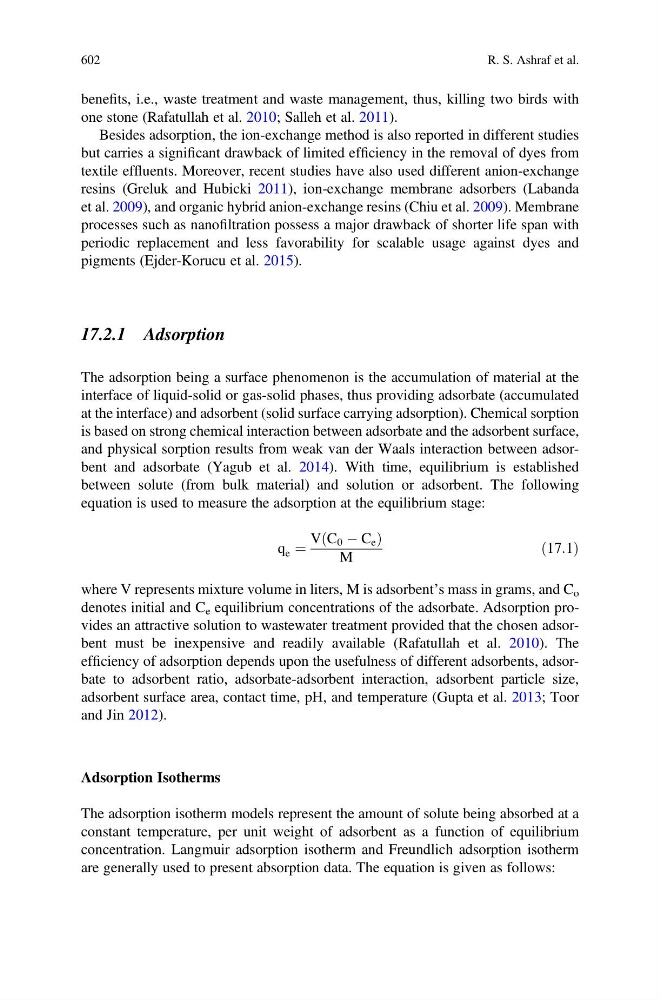
between solute (from bulk material) and solution or adsorbent. The following
equation is used to measure the adsorption at the equilibrium stage:
q e ¼
V C 0 À C e
ð
Þ
M
ð17:1Þ
where V represents mixture volume in liters, M is adsorbent’s mass in grams, and C o
denotes initial and C e equilibrium concentrations of the adsorbate. Adsorption provides an attractive solution to wastewater treatment provided that the chosen adsorbent must be inexpensive and readily available (Rafatullah et al. 2010). The
efficiency of adsorption depends upon the usefulness of different adsorbents, adsorbate to adsorbent ratio, adsorbate-adsorbent interaction, adsorbent particle size,
adsorbent surface area, contact time, pH, and temperature (Gupta et al. 2013; Toor
and Jin 2012).
Adsorption Isotherms
The adsorption isotherm models represent the amount of solute being absorbed at a
constant temperature, per unit weight of adsorbent as a function of equilibrium
concentration. Langmuir adsorption isotherm and Freundlich adsorption isotherm
are generally used to present absorption data. The equation is given as follows:
602
R. S. Ashraf et al.
one stone (Rafatullah et al. 2010; Salleh et al. 2011).
Besides adsorption, the ion-exchange method is also reported in different studies
but carries a significant drawback of limited efficiency in the removal of dyes from
textile effluents. Moreover, recent studies have also used different anion-exchange
resins (Greluk and Hubicki 2011), ion-exchange membrane adsorbers (Labanda
et al. 2009), and organic hybrid anion-exchange resins (Chiu et al. 2009). Membrane
processes such as nanofiltration possess a major drawback of shorter life span with
periodic replacement and less favorability for scalable usage against dyes and
pigments (Ejder-Korucu et al. 2015).
17.2.1 Adsorption
The adsorption being a surface phenomenon is the accumulation of material at the
interface of liquid-solid or gas-solid phases, thus providing adsorbate (accumulated
at the interface) and adsorbent (solid surface carrying adsorption). Chemical sorption
is based on strong chemical interaction between adsorbate and the adsorbent surface,
and physical sorption results from weak van der Waals interaction between adsorbent and adsorbate (Yagub et al. 2014). With time, equilibrium is established
between solute (from bulk material) and solution or adsorbent. The following
equation is used to measure the adsorption at the equilibrium stage:
q e ¼
V C 0 À C e
ð
Þ
M
ð17:1Þ
where V represents mixture volume in liters, M is adsorbent’s mass in grams, and C o
denotes initial and C e equilibrium concentrations of the adsorbate. Adsorption provides an attractive solution to wastewater treatment provided that the chosen adsorbent must be inexpensive and readily available (Rafatullah et al. 2010). The
efficiency of adsorption depends upon the usefulness of different adsorbents, adsorbate to adsorbent ratio, adsorbate-adsorbent interaction, adsorbent particle size,
adsorbent surface area, contact time, pH, and temperature (Gupta et al. 2013; Toor
and Jin 2012).
Adsorption Isotherms
The adsorption isotherm models represent the amount of solute being absorbed at a
constant temperature, per unit weight of adsorbent as a function of equilibrium
concentration. Langmuir adsorption isotherm and Freundlich adsorption isotherm
are generally used to present absorption data. The equation is given as follows:
602
R. S. Ashraf et al.