

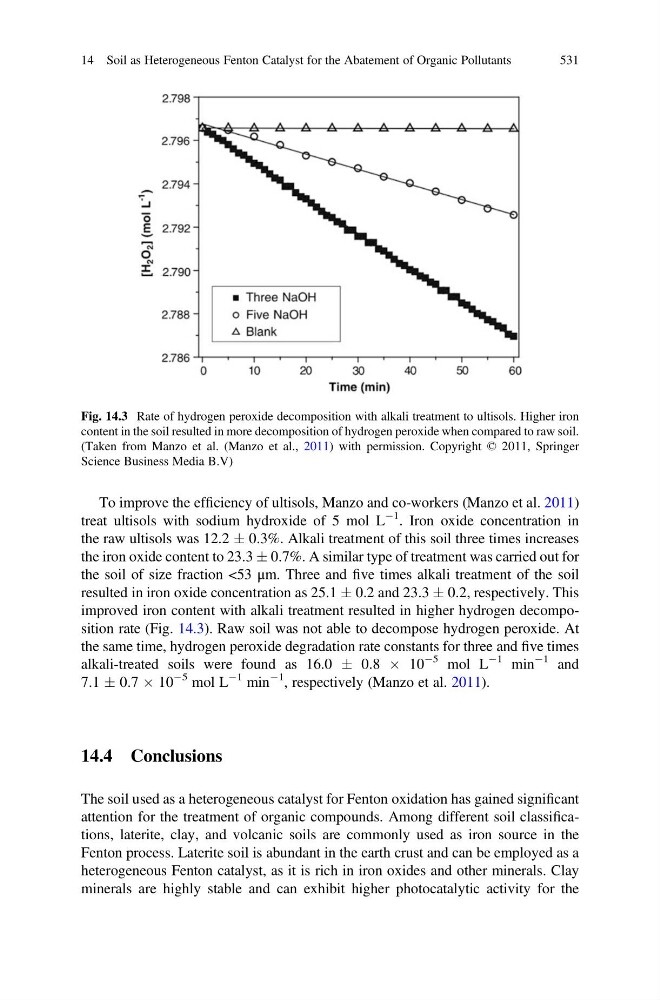
To improve the efficiency of ultisols, Manzo and co-workers (Manzo et al. 2011)
treat ultisols with sodium hydroxide of 5 mol L
À1 . Iron oxide concentration in
the raw ultisols was 12.2 Æ 0.3%. Alkali treatment of this soil three times increases
the iron oxide content to 23.3 Æ 0.7%. A similar type of treatment was carried out for
the soil of size fraction <53 μm. Three and five times alkali treatment of the soil
resulted in iron oxide concentration as 25.1 Æ 0.2 and 23.3 Æ 0.2, respectively. This
improved iron content with alkali treatment resulted in higher hydrogen decomposition rate (Fig. 14.3). Raw soil was not able to decompose hydrogen peroxide. At
the same time, hydrogen peroxide degradation rate constants for three and five times
alkali-treated soils were found as 16.0 Æ 0.8 Â 10
À5 mol L
À1 min
À1 and
7.1 Æ 0.7 Â 10
À5 mol L
À1 min
À1 , respectively (Manzo et al. 2011).
14.4 Conclusions
The soil used as a heterogeneous catalyst for Fenton oxidation has gained significant
attention for the treatment of organic compounds. Among different soil classifications, laterite, clay, and volcanic soils are commonly used as iron source in the
Fenton process. Laterite soil is abundant in the earth crust and can be employed as a
heterogeneous Fenton catalyst, as it is rich in iron oxides and other minerals. Clay
minerals are highly stable and can exhibit higher photocatalytic activity for the
Fig. 14.3 Rate of hydrogen peroxide decomposition with alkali treatment to ultisols. Higher iron
content in the soil resulted in more decomposition of hydrogen peroxide when compared to raw soil.
(Taken from Manzo et al. (Manzo et al., 2011) with permission. Copyright © 2011, Springer
Science Business Media B.V)
14 Soil as Heterogeneous Fenton Catalyst for the Abatement of Organic Pollutants
531
treat ultisols with sodium hydroxide of 5 mol L
À1 . Iron oxide concentration in
the raw ultisols was 12.2 Æ 0.3%. Alkali treatment of this soil three times increases
the iron oxide content to 23.3 Æ 0.7%. A similar type of treatment was carried out for
the soil of size fraction <53 μm. Three and five times alkali treatment of the soil
resulted in iron oxide concentration as 25.1 Æ 0.2 and 23.3 Æ 0.2, respectively. This
improved iron content with alkali treatment resulted in higher hydrogen decomposition rate (Fig. 14.3). Raw soil was not able to decompose hydrogen peroxide. At
the same time, hydrogen peroxide degradation rate constants for three and five times
alkali-treated soils were found as 16.0 Æ 0.8 Â 10
À5 mol L
À1 min
À1 and
7.1 Æ 0.7 Â 10
À5 mol L
À1 min
À1 , respectively (Manzo et al. 2011).
14.4 Conclusions
The soil used as a heterogeneous catalyst for Fenton oxidation has gained significant
attention for the treatment of organic compounds. Among different soil classifications, laterite, clay, and volcanic soils are commonly used as iron source in the
Fenton process. Laterite soil is abundant in the earth crust and can be employed as a
heterogeneous Fenton catalyst, as it is rich in iron oxides and other minerals. Clay
minerals are highly stable and can exhibit higher photocatalytic activity for the
Fig. 14.3 Rate of hydrogen peroxide decomposition with alkali treatment to ultisols. Higher iron
content in the soil resulted in more decomposition of hydrogen peroxide when compared to raw soil.
(Taken from Manzo et al. (Manzo et al., 2011) with permission. Copyright © 2011, Springer
Science Business Media B.V)
14 Soil as Heterogeneous Fenton Catalyst for the Abatement of Organic Pollutants
531