

heterogeneous Fenton catalyst. For example, magnetite is found effective for the
degradation of dye (Nidheesh et al. 2014), p-nitrophenol (Sun and Lemley 2011),
phenol (Chun et al. 2012), bisphenol A (Cleveland et al. 2014), carbamazepine (Sun
et al. 2013), and ibuprofen (Sun et al. 2013). Volcanic ultisols are found as effective
heterogeneous Fenton catalysts (Aravena et al. 2010). The authors (Aravena et al.
2010) collected soil samples from Collipulli and Metrenco located in southern Chile
and checked the hydrogen peroxide degradation rate. The soils are rich in iron oxides
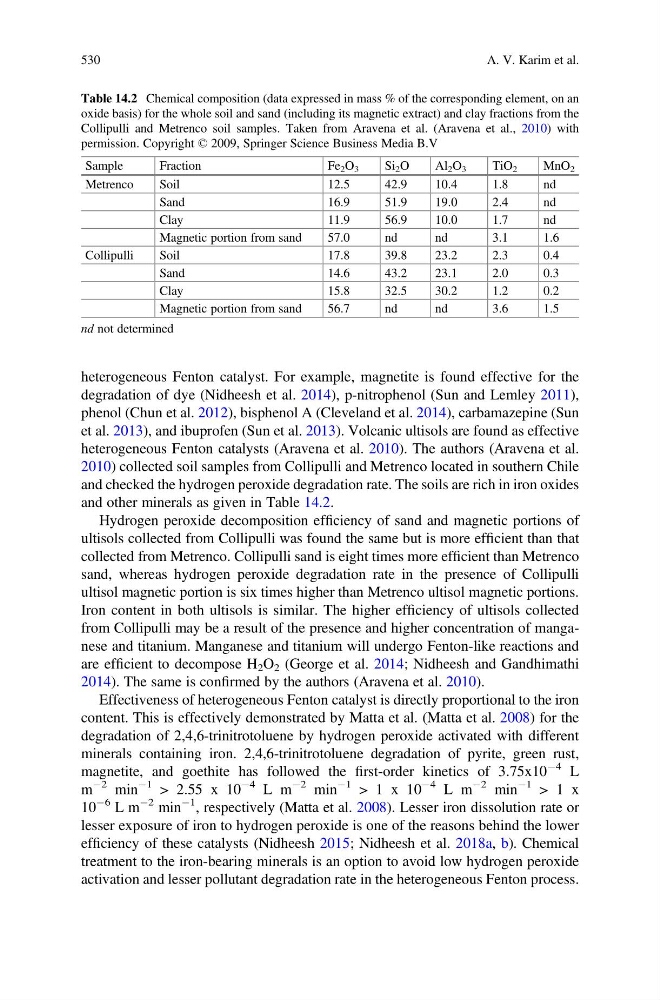
and other minerals as given in Table 14.2.
Hydrogen peroxide decomposition efficiency of sand and magnetic portions of
ultisols collected from Collipulli was found the same but is more efficient than that
collected from Metrenco. Collipulli sand is eight times more efficient than Metrenco
sand, whereas hydrogen peroxide degradation rate in the presence of Collipulli
ultisol magnetic portion is six times higher than Metrenco ultisol magnetic portions.
Iron content in both ultisols is similar. The higher efficiency of ultisols collected
from Collipulli may be a result of the presence and higher concentration of manganese and titanium. Manganese and titanium will undergo Fenton-like reactions and
are efficient to decompose H 2 O 2 (George et al. 2014; Nidheesh and Gandhimathi
2014). The same is confirmed by the authors (Aravena et al. 2010).
Effectiveness of heterogeneous Fenton catalyst is directly proportional to the iron
content. This is effectively demonstrated by Matta et al. (Matta et al. 2008) for the
degradation of 2,4,6-trinitrotoluene by hydrogen peroxide activated with different
minerals containing iron. 2,4,6-trinitrotoluene degradation of pyrite, green rust,
magnetite, and goethite has followed the first-order kinetics of 3.75x10
À4 L
m
À2 min
À1 > 2.55 x 10
À4 L m
À2 min
À1 > 1 x 10
À4 L m
À2 min
À1 > 1 x
10
À6 L m
À2 min
À1 , respectively (Matta et al. 2008). Lesser iron dissolution rate or
lesser exposure of iron to hydrogen peroxide is one of the reasons behind the lower
efficiency of these catalysts (Nidheesh 2015; Nidheesh et al. 2018a, b). Chemical
treatment to the iron-bearing minerals is an option to avoid low hydrogen peroxide
activation and lesser pollutant degradation rate in the heterogeneous Fenton process.
Table 14.2 Chemical composition (data expressed in mass % of the corresponding element, on an
oxide basis) for the whole soil and sand (including its magnetic extract) and clay fractions from the
Collipulli and Metrenco soil samples. Taken from Aravena et al. (Aravena et al., 2010) with
permission. Copyright © 2009, Springer Science Business Media B.V
Sample
Fraction
Fe 2 O 3
Si 2 O
Al 2 O 3
TiO 2
MnO 2
Metrenco
Soil
12.5
42.9
10.4
1.8
nd
Sand
16.9
51.9
19.0
2.4
nd
Clay
11.9
56.9
10.0
1.7
nd
Magnetic portion from sand
57.0
nd
nd
3.1
1.6
Collipulli
Soil
17.8
39.8
23.2
2.3
0.4
Sand
14.6
43.2
23.1
2.0
0.3
Clay
15.8
32.5
30.2
1.2
0.2
Magnetic portion from sand
56.7
nd
nd
3.6
1.5
nd not determined
530
A. V. Karim et al.
degradation of dye (Nidheesh et al. 2014), p-nitrophenol (Sun and Lemley 2011),
phenol (Chun et al. 2012), bisphenol A (Cleveland et al. 2014), carbamazepine (Sun
et al. 2013), and ibuprofen (Sun et al. 2013). Volcanic ultisols are found as effective
heterogeneous Fenton catalysts (Aravena et al. 2010). The authors (Aravena et al.
2010) collected soil samples from Collipulli and Metrenco located in southern Chile
and checked the hydrogen peroxide degradation rate. The soils are rich in iron oxides
and other minerals as given in Table 14.2.
Hydrogen peroxide decomposition efficiency of sand and magnetic portions of
ultisols collected from Collipulli was found the same but is more efficient than that
collected from Metrenco. Collipulli sand is eight times more efficient than Metrenco
sand, whereas hydrogen peroxide degradation rate in the presence of Collipulli
ultisol magnetic portion is six times higher than Metrenco ultisol magnetic portions.
Iron content in both ultisols is similar. The higher efficiency of ultisols collected
from Collipulli may be a result of the presence and higher concentration of manganese and titanium. Manganese and titanium will undergo Fenton-like reactions and
are efficient to decompose H 2 O 2 (George et al. 2014; Nidheesh and Gandhimathi
2014). The same is confirmed by the authors (Aravena et al. 2010).
Effectiveness of heterogeneous Fenton catalyst is directly proportional to the iron
content. This is effectively demonstrated by Matta et al. (Matta et al. 2008) for the
degradation of 2,4,6-trinitrotoluene by hydrogen peroxide activated with different
minerals containing iron. 2,4,6-trinitrotoluene degradation of pyrite, green rust,
magnetite, and goethite has followed the first-order kinetics of 3.75x10
À4 L
m
À2 min
À1 > 2.55 x 10
À4 L m
À2 min
À1 > 1 x 10
À4 L m
À2 min
À1 > 1 x
10
À6 L m
À2 min
À1 , respectively (Matta et al. 2008). Lesser iron dissolution rate or
lesser exposure of iron to hydrogen peroxide is one of the reasons behind the lower
efficiency of these catalysts (Nidheesh 2015; Nidheesh et al. 2018a, b). Chemical
treatment to the iron-bearing minerals is an option to avoid low hydrogen peroxide
activation and lesser pollutant degradation rate in the heterogeneous Fenton process.
Table 14.2 Chemical composition (data expressed in mass % of the corresponding element, on an
oxide basis) for the whole soil and sand (including its magnetic extract) and clay fractions from the
Collipulli and Metrenco soil samples. Taken from Aravena et al. (Aravena et al., 2010) with
permission. Copyright © 2009, Springer Science Business Media B.V
Sample
Fraction
Fe 2 O 3
Si 2 O
Al 2 O 3
TiO 2
MnO 2
Metrenco
Soil
12.5
42.9
10.4
1.8
nd
Sand
16.9
51.9
19.0
2.4
nd
Clay
11.9
56.9
10.0
1.7
nd
Magnetic portion from sand
57.0
nd
nd
3.1
1.6
Collipulli
Soil
17.8
39.8
23.2
2.3
0.4
Sand
14.6
43.2
23.1
2.0
0.3
Clay
15.8
32.5
30.2
1.2
0.2
Magnetic portion from sand
56.7
nd
nd
3.6
1.5
nd not determined
530
A. V. Karim et al.